Energy
Artificial intelligence has become one of the most electricity-intensive industries in the modern economy. AI systems now consume over 10% of electricity in some advanced economies, driven by massive data centers, high-performance GPUs, and round-the-clock computational workloads that require both power and cooling infrastructure. This surge in demand is forcing utilities, governments, and technology companies to rethink how they plan and build energy systems for the next decade.
The energy demands of AI are reshaping investment priorities across the power sector. Hyperscalers are signing contracts for nuclear capacity, building renewable energy projects, and competing internationally for reliable electricity supplies. Your understanding of this shift matters whether you work in energy, technology, policy, or finance.
AI's role in the energy transition presents a complex picture. While AI infrastructure consumes substantial electricity, the same technology offers tools for grid management, renewable integration, and efficiency improvements. This dynamic creates both challenges and opportunities as countries balance AI development with climate goals and grid reliability.
Key Takeaways
- AI systems consume massive amounts of electricity through data centers and specialized computing hardware that run continuously
- Technology companies are investing in nuclear power, renewable energy, and grid infrastructure to support AI growth
- Governments face trade-offs between supporting AI development and managing electricity demand and environmental impact
Significance of Electricity Consumption
AI infrastructure represents a fundamental shift in how you should think about industrial electricity demand. Data centers now consume around 415 terawatt hours globally, accounting for approximately 1.5% of total global electricity consumption.
This figure is projected to more than double by 2030. You're looking at nearly 945 TWh annually, representing just under 3% of worldwide electricity use.
Key Growth Drivers:
- GPU-powered accelerated servers growing at 30% annually
- Cooling infrastructure scaling with higher power densities
- Hyperscale data center expansion by major tech companies
The consumption patterns matter because they're growing four times faster than electricity demand from all other sectors combined. AI-driven data center growth creates direct pressure on regional grids and wholesale power markets.
Your grid planning horizons need to account for a sector where facilities become operational in two to three years. Energy infrastructure typically requires longer lead times. This mismatch creates investment risk and potential supply constraints.
Accelerated servers account for nearly half of projected increases in data center electricity consumption through 2030. Conventional servers contribute only 20%, with cooling and infrastructure making up the remainder.
The significance extends beyond raw numbers. You're witnessing a load profile that operates continuously at high capacity factors, requiring baseload generation or firm renewable power backed by storage. This demand characteristic influences procurement strategies for nuclear energy development and renewable power contracts across multiple decades.
Electricity Requirements of Artificial Intelligence
AI systems demand substantial electrical power to operate. Data centers running artificial intelligence applications require far more energy than traditional computing facilities. When you use ChatGPT or similar large language models, the infrastructure supporting these tools consumes massive amounts of electricity.
Global AI data center power requirements could reach 68 gigawatts by 2027, nearly doubling total global data center capacity from 2022 levels. The scale becomes more apparent when you consider that data centers consumed 4.4% of U.S. electricity in 2023, a figure that could triple by 2028.
Key Power Drivers:
- GPUs: Graphics processing units that train AI models consume significantly more power than standard CPUs
- Cooling systems: Heat generated by dense computing requires extensive cooling infrastructure
- Data transmission: Moving information between servers and users adds to the electrical load
Connection requests for hyperscale facilities of 300-1000MW are stretching local grid capacity. These requests arrive with lead times of only 1-3 years, creating challenges for utilities trying to expand generation capacity.
Your grid faces mounting stress as AI deployment accelerates. Projections indicate 75-100 GW of new electricity generating capacity will be needed to supply as much as 1,000 terawatt-hours annually by the early 2030s. This demand requires substantial investment in both power generation and transmission infrastructure to support artificial intelligence growth.
Data Centers and Their Increasing Power Needs
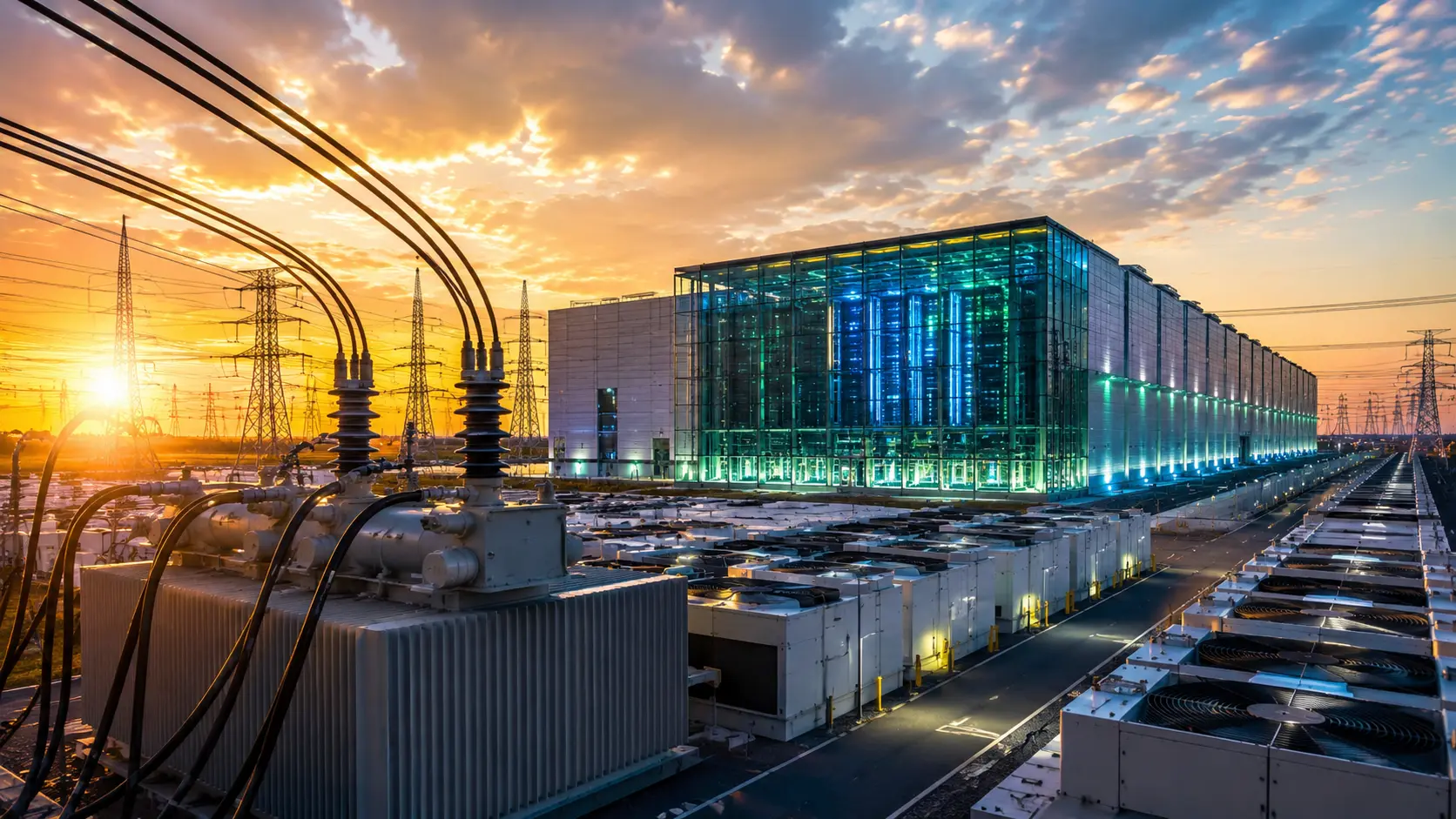
AI data centers now require as much electricity as small cities, creating unprecedented demands on power grids across the country. You're seeing hyperscale facilities request connections between 300 and 1000 megawatts with lead times of just one to three years.
The rapid growth in data center power consumption stems primarily from GPU-intensive AI workloads. These processors generate significant heat and require substantial cooling systems, which further increases total electricity usage.
Key Power Demand Factors:
- GPU computational requirements for AI training and inference
- Cooling infrastructure to maintain optimal operating temperatures
- Continuous 24/7 operations with minimal downtime
- Rapid deployment timelines that stress grid capacity
Your local grid may already be feeling the strain. Some regions report no spare supply capacity for new data centers, prompting developers to build their own power plants. Hyperscaler companies are now exploring nuclear energy and renewable power sources to meet their growing needs.
The shift toward AI applications is creating a watershed moment for electricity infrastructure. Connection requests are stretching local grid capacity to deliver power at the required pace. Several states are weighing legislation that would require data centers to report their electricity usage and draw power from renewable sources.
Energy Demands of GPUs
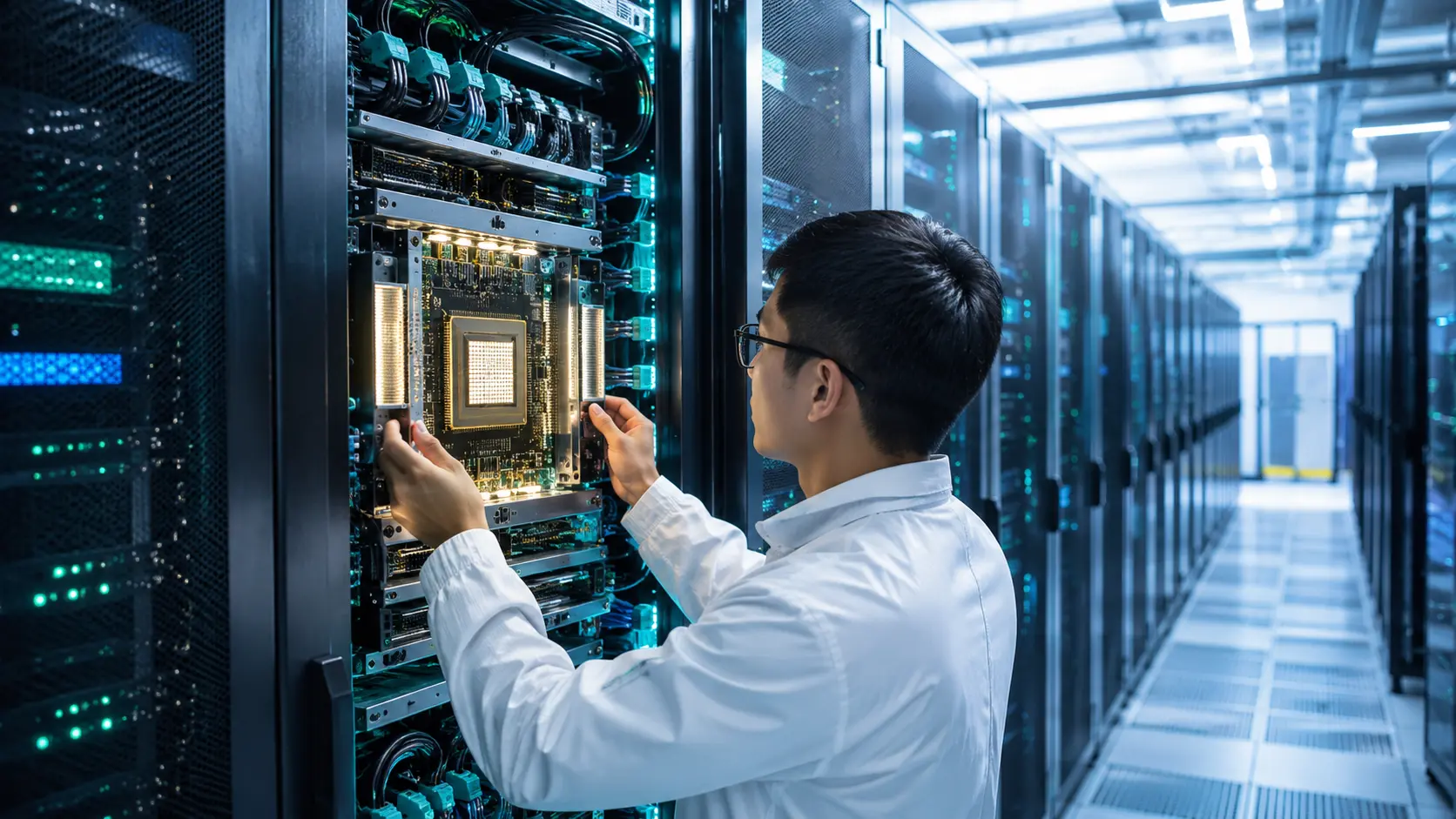
Graphics processing units have become the primary hardware driving AI workloads in data centers. A single modern AI GPU consumes up to 3.7 MWh of power per year, which equals the annual electricity use of about three average American homes.
When you deploy thousands of these processors in a single facility, the power requirements multiply quickly. The GPUs sold in just one year consume more electricity than 1.3 million households use annually.
Key Energy Considerations:
- Training vs. Inference: Training large AI models requires massive bursts of power, but inference operations happen continuously every time someone uses AI
- Power Density: Modern accelerated servers pack more computing power into smaller spaces, increasing electricity demands per rack
- Cooling Requirements: High-performance GPUs generate substantial heat that requires additional energy for cooling systems
Your data center's total energy footprint extends beyond the processors themselves. The biggest energy demands come from GPUs, accelerators, servers, networking, storage, and cooling systems.
Accelerated servers are projected to grow electricity consumption by 30% annually, far outpacing conventional server growth at 9% per year. This rapid expansion means accelerated servers will account for nearly half of all new data center electricity consumption through 2030.
The infrastructure supporting these GPUs requires careful planning. You need reliable power supplies, robust cooling systems, and grid connections capable of handling sustained high loads.
Integration of AI With Power Grids
You're witnessing a fundamental shift in how power grids operate as artificial intelligence becomes essential infrastructure. The technology now helps optimize grid operations by analyzing massive data streams from your local distribution networks, renewable sources, and demand patterns in real time.
Your grid operators face mounting pressure from AI data centers that consume exponentially more electricity than traditional facilities. These hyperscale operations require constant power for GPU clusters and cooling systems that can draw 50 to 100 megawatts per campus.
Key AI Applications in Grid Management:
- Real-time monitoring and fault detection across transmission networks
- Predictive maintenance scheduling to prevent equipment failures
- Load forecasting to balance supply and demand
- Renewable energy output optimization based on weather data
- Energy storage dispatch timing for peak demand periods
AI algorithms analyze weather forecasts to predict when your solar and wind installations will generate power. This capability lets grid operators schedule backup generation and coordinate energy storage systems more effectively.
You'll see renewable integration challenges intensify as intermittent sources scale up alongside AI power demands. The grid must handle both the variability of wind and solar generation while meeting the baseline requirements of data centers that cannot tolerate outages.
Your utilities are deploying AI-accelerated power grid models to plan capacity expansions and transmission upgrades. These tools process scenarios faster than traditional methods, helping you identify bottlenecks before they create reliability issues.
Hyperscalers and the International Energy Competition
The race for AI dominance has transformed into a battle for energy resources. Major hyperscalers are now competing globally to secure electricity supplies that can power their expanding data center operations.
Global electricity generation for data centers is projected to surge from 460 TWh in 2024 to over 1,000 TWh by 2030. This unprecedented demand is reshaping energy markets worldwide.
Regional Power Dynamics:
- United States: Natural gas supplies over 40% of data center electricity, with renewables at 24%
- China: Coal dominates at 70%, though renewables are gaining ground rapidly
- Europe: Nuclear and renewables together will reach 85% by 2030
You're witnessing hyperscalers move beyond traditional tech company boundaries. AI compute providers are exploring co-location with energy sources and investing directly in power generation. Technology companies have already committed to financing more than 20 GW of small modular reactors.
The International Energy Agency reports that renewables will meet nearly half of additional data center demand through 2030. However, natural gas and coal together account for over 40% of new supply in the near term.
This creates a complex competitive landscape. Your grid connection times, local fuel mix, and regulatory environment determine where you can build capacity. Countries with abundant renewable resources or advanced nuclear programs gain strategic advantages in attracting AI infrastructure investment.
The competition extends beyond just securing megawatts. Energy markets are racing to develop specialized software and grid management solutions for AI loads.
Nuclear Power in AI Operations
Your AI infrastructure is driving an unprecedented shift toward nuclear energy as a primary power source. Microsoft and NVIDIA are collaborating to streamline nuclear plant permitting and operations specifically to meet data center electricity demands.
The numbers tell a clear story. Your GPU clusters require constant, high-density power that renewables alone cannot reliably provide. Nuclear offers baseload capacity without carbon emissions, making it the logical choice for hyperscalers building out AI infrastructure.
Key advantages you gain from nuclear-powered AI operations:
- Consistent uptime for training runs that can't tolerate grid interruptions
- Carbon-free power that meets your sustainability commitments
- High power density suitable for concentrated data center loads
- Predictable costs over multi-decade operational periods
Aalo Atomics reduced their permitting timeline by 92% using AI-powered documentation tools, saving an estimated $80 million annually. This acceleration matters because your data center projects can't wait years for power infrastructure.
Your cooling systems also benefit from nuclear proximity. Many advanced reactor designs generate process heat that you can integrate into thermal management systems, improving overall energy efficiency.
Both Amazon and Microsoft are turning to nuclear power to secure reliable electricity for their expanding AI operations. This trend signals a fundamental restructuring of how you should plan long-term data center power procurement strategies.
Role of Renewable Energy in AI Infrastructure
Your AI data centers consume massive amounts of electricity. A single large facility can use as much power as a small city, with GPUs running continuously to train models and process requests.
This creates a major challenge for clean energy transition efforts. Your infrastructure demands compete with broader decarbonization goals, forcing tough decisions about power allocation.
Key Energy Demands in AI Facilities:
- GPU clusters requiring 24/7 uptime
- Cooling systems accounting for 30-40% of total consumption
- Network equipment supporting data transfer at scale
Renewable energy plays a critical role in meeting these needs without overwhelming the grid. Solar and wind installations can enhance efficiency when paired with your operations, though timing challenges persist.
Your hyperscaler companies are investing billions in renewable power purchase agreements. These contracts secure dedicated clean energy capacity, helping you meet sustainability commitments while managing costs.
The problem is timing. AI infrastructure scales in months, but renewable energy projects take three to five years to complete. This mismatch creates grid stress as your facilities come online before new clean power sources.
You're also exploring nuclear options for baseload power. Small modular reactors offer reliable electricity without intermittency issues that affect solar and wind. This diversified approach helps ensure your operations maintain uptime while reducing carbon emissions.
The industrial implications are significant. Your energy choices influence utility planning, transmission upgrades, and renewable energy systems development for decades ahead.
Natural Gas and Backup Systems
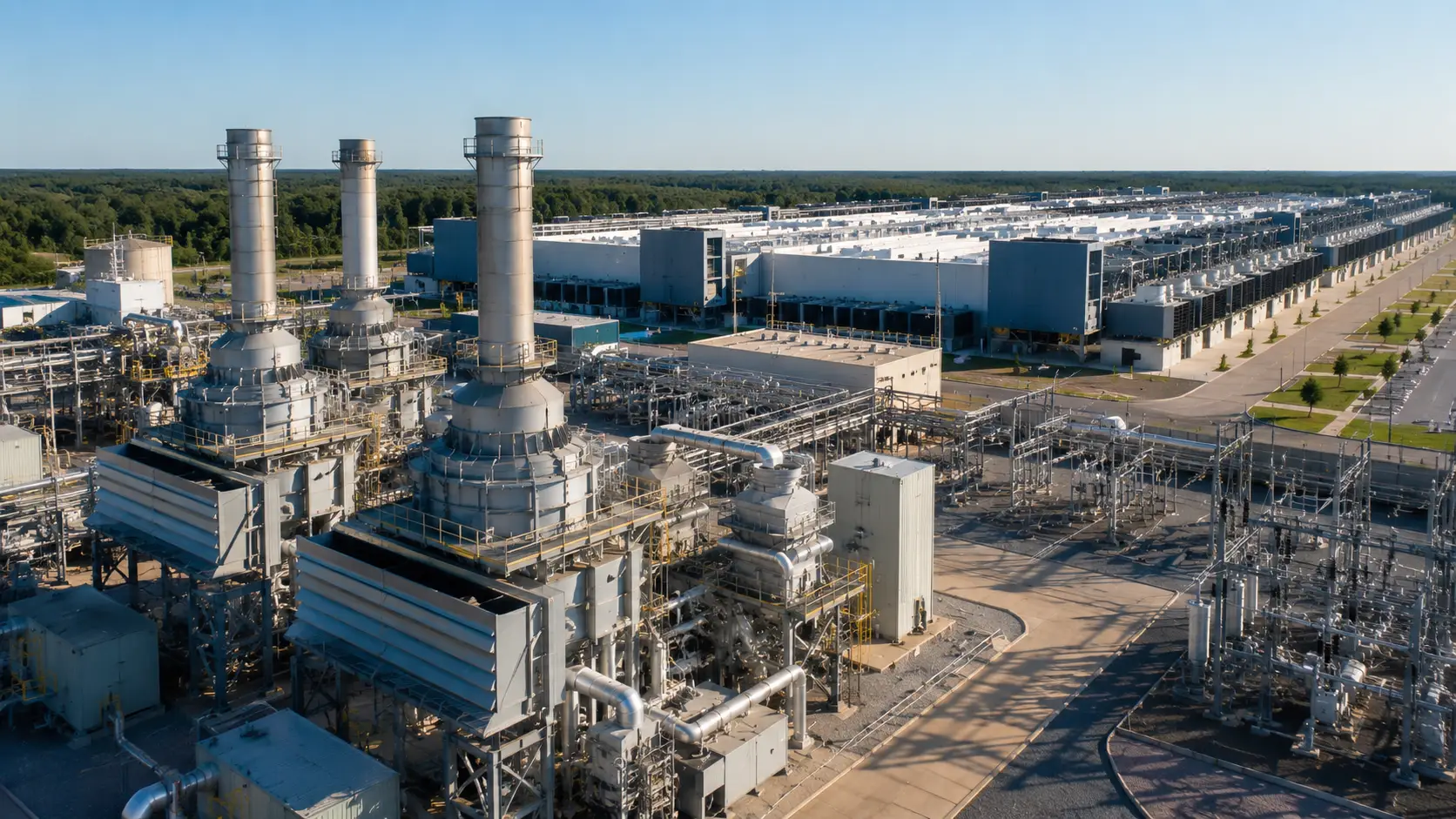
Data centers are pairing batteries with natural gas generators to maintain continuous power for AI operations. This combination addresses the challenge of meeting instant power demands that your GPU clusters create during model training and inference.
The battery-plus-gas approach has grown rapidly. Bloomberg NEF tracked 4.9 gigawatts of energy storage paired with on-site fossil fuel generation at data centers, representing 32% of announced global on-site battery capacity.
Key advantages of gas-battery systems:
- Batteries discharge power instantly during demand spikes
- Gas turbines provide baseline power but ramp up slowly
- Combined systems deliver 99.999% reliability for operations
- Batteries protect turbines from frequent ramping cycles
Your data center faces average wait times of four years to connect to the grid. Natural gas with battery backup offers faster deployment than waiting for utility connections.
Major facilities already use this configuration. The xAI Colossus supercomputer in Memphis deploys Tesla Megapacks alongside gas turbines in a 1.2 gigawatt off-grid plant. In West Texas, the GW Ranch data center pairs 1.8 gigawatts of battery storage with 7.65 gigawatts of gas generation.
Energy storage is projected to support 9.8 gigawatt-hours of gas generation at data centers through 2030. While this setup increases carbon emissions, it enables immediate expansion of your AI infrastructure without waiting for grid upgrades or renewable energy buildout.
Thermal Management and Cooling Technologies
Your data center's power density has increased dramatically with AI workloads. Modern GPU clusters generate heat loads that traditional air cooling cannot handle efficiently.
Liquid cooling systems are becoming essential infrastructure for AI operations. Direct-to-chip liquid cooling architectures deliver superior heat transfer compared to air-based systems. This allows you to pack more computing power into smaller spaces while maintaining operational stability.
You have several cooling approaches to consider:
- Direct liquid cooling - coolant flows directly to hot components
- Immersion cooling - servers submerge in dielectric fluid
- Hybrid systems - combining air and liquid methods
AI-driven thermal optimization analyzes real-time sensor data to adjust cooling dynamically. These systems detect equipment degradation early, reducing downtime and operational costs. Your facility can optimize energy use by matching cooling output to actual thermal loads rather than running at constant capacity.
The financial implications are significant. Industry analysts view advanced thermal management as a defining infrastructure challenge of the AI era. Rising GPU power densities require facility redesigns across power distribution and cooling systems.
Your cooling infrastructure directly impacts your power consumption and total cost of ownership. Efficient thermal management solutions reduce energy waste while enabling higher-density computing deployments that maximize your infrastructure investment.
Water Consumption and Environmental Impact
AI data centers require massive amounts of water for cooling systems that keep GPUs and servers from overheating. A single AI query consumes around 10 milliliters of freshwater, which adds up quickly when you consider billions of daily interactions.
The scale becomes clearer when you examine projections. US AI servers' water footprint is expected to increase dramatically between 2024 and 2030, with indirect water use from electricity generation accounting for 71% of total consumption. Direct cooling operations make up the remaining 29%.
Water Usage Breakdown:
- Direct cooling - Evaporation from cooling towers and liquid cooling systems
- Indirect consumption - Water used in electricity generation at power plants
- Regional variation - Southern states like Florida show higher water usage than northern states like Washington
Your facility's location matters significantly. Installing AI infrastructure in water-stressed regions can disrupt local water supplies for millions of residents. Centralized AI server deployment threatens regional water balance, particularly in areas already facing scarcity.
The environmental impact extends beyond water. Greenhouse gas emissions from AI operations primarily stem from electricity consumption, with data centers now accounting for 0.6% of global carbon emissions. This figure threatens to double by 2026 as AI adoption accelerates.
You can reduce these impacts through improved water usage effectiveness (WUE). Best-practice scenarios suggest over 85% WUE reduction potential through technology upgrades and operational optimization.
Infrastructure Challenges and Grid Limitations
The power grid faces serious strain as AI data centers expand rapidly across the country. Data centers consumed around 415 TWh of electricity in 2024, representing about 1.5% of global demand. This figure is projected to more than double by 2030.
You'll find that AI computing racks demand 30 to 100+ kilowatts per rack, compared to traditional server racks that use only 7-10 kilowatts. A single ChatGPT query consumes about 2.9 watt-hours, nearly ten times the 0.3 watt-hours of a regular Google search. Training GPT-4 required an estimated 50 gigawatt-hours of electricity, equivalent to nearly 0.1% of New York City's annual use.
Key Infrastructure Barriers:
- Aging transmission systems unable to handle concentrated loads
- Long interconnection queues delaying new data center projects by years
- Limited transformer capacity in regions with high AI development
- Geographic concentration creating bottlenecks in specific states
Your grid connections face additional complexity because AI workloads create fast, large power fluctuations. GPU clusters can produce power swings of hundreds of megawatts within seconds, challenging system operators who must maintain balance.
Power density presents another obstacle for your infrastructure planning. Modern hyperscale facilities exceed 100 megawatts, with some new campuses planned at the gigawatt level. These massive installations require direct connections to high-voltage transmission lines rather than standard distribution networks.
Geographic clustering intensifies local grid stress, as fifteen states accounted for 80% of total data center demand in 2023. Virginia, Texas, and California lead this concentration, forcing regional grid operators to manage unprecedented demand growth.
Regional Variations in Energy Demand
Your data center's energy requirements will vary dramatically depending on where you build. Different regions face distinct challenges in powering AI infrastructure.
North America leads in hyperscale facility requests, with connection demands for AI data centers reaching 300-1000MW per facility. These requests arrive with 1-3 year lead times, stretching local grids beyond their delivery capacity.
Europe confronts unique constraints around renewable integration and grid modernization. Your GPU clusters in European facilities must navigate stricter carbon regulations and higher electricity costs. The region's commitment to decarbonization means you'll likely pay premium prices for clean power.
Asia-Pacific shows the most variation internally. Research indicates that AI development impacts energy consumption differently across Chinese regions, with the Yangtze River Economic Belt proving more sensitive to AI-driven demand increases.
Your cooling systems will consume different proportions of total energy depending on climate. Facilities in warmer regions require more sophisticated cooling infrastructure, directly impacting your operational costs.
Key Regional Factors:
- Climate conditions affecting cooling demands
- Grid reliability and transmission capacity
- Renewable energy availability and pricing
- Regulatory frameworks around emissions
- Nuclear capacity for baseload power
Global greenhouse gas emissions increase under AI expansion scenarios due to heightened energy demand from IT infrastructure. Your location choice determines whether you'll access low-carbon power sources or rely on fossil fuel generation during peak demand periods.
National Strategies for AI Sovereignty
Governments worldwide now recognize that AI infrastructure has become a lever of national power. Control over compute resources, data centers, and energy systems determines your country's ability to develop and deploy advanced AI models independently.
You'll find that sovereignty in this context extends beyond traditional borders. It encompasses the capacity to generate your own intelligence without relying on foreign cloud platforms or chip supplies. Countries that lack domestic compute infrastructure must depend on other nations for critical AI capabilities.
The Department of Energy has developed an AI strategy that addresses these challenges through national laboratory research and development. This approach focuses on trustworthy AI deployment for energy and national security missions.
Key components of national AI sovereignty include:
- Domestic chip manufacturing for GPUs and specialized AI accelerators
- Energy independence to power large-scale data centers
- Sovereign cloud platforms that keep data within national borders
- Strategic grid capacity to handle concentrated power loads from hyperscalers
Your country's position in the global AI race depends heavily on electricity availability. Data centers running advanced models require unprecedented power density, with single facilities consuming as much energy as small cities. Nations pursuing sovereign AI ecosystems must coordinate across government agencies, technology providers, and energy utilities.
Some nations prioritize sovereignty in defense and healthcare sectors while collaborating internationally in less sensitive areas. This hybrid approach balances strategic autonomy with practical resource constraints.
Economic Impacts of Electricity Use
Your electricity costs will rise as AI data centers compete for power capacity. The AI-driven expansion requires 75-100 GW of new generating capacity by the early 2030s, creating upward pressure on electricity prices in regions with concentrated data center growth.
Your business may face higher energy bills even if you don't use AI services. A typical AI data center consumes as much electricity as 100,000 households, and hyperscalers are securing long-term power purchase agreements that tighten available grid capacity.
Key Economic Effects:
- Industrial electricity rates increase in data center-heavy regions
- Utilities invest billions in generation and transmission infrastructure
- Your local grid faces stress during peak demand periods
- Natural gas and nuclear power projects accelerate to meet baseload requirements
Your energy costs depend partly on where hyperscalers build their facilities. GPU clusters require massive cooling systems that run continuously, driving 24/7 electricity demand. This baseload consumption differs from typical commercial usage patterns and could represent 7.5% of national electricity demand.
Your utility may pass infrastructure upgrade costs to ratepayers. Grid operators must balance AI growth with residential and commercial needs. The capital required for new generation, transmission lines, and substation capacity flows through to your electricity rates over time.
Nuclear and renewable power investments offer your region potential economic benefits through construction jobs and tax revenue, though these projects require years to complete.
Pathways to Greater Energy Efficiency
AI's energy consumption challenge has multiple solutions emerging across the technology stack. Software and hardware advances have dropped energy use per AI task by at least an order of magnitude annually in recent years. Simple text queries now consume less electricity than running your television for the same duration.
Data center operators are focusing on several key efficiency areas:
- Chip optimization: New GPU architectures deliver more computational power per watt
- Cooling innovations: Advanced liquid cooling systems replace traditional air-based methods
- Load management: Battery storage systems smooth power demands and reduce waste
- Grid integration: Smart systems optimize when and how data centers draw electricity
Recent breakthroughs could slash AI energy use by up to 100 times while improving accuracy. These gains come from better algorithms and more efficient processing methods.
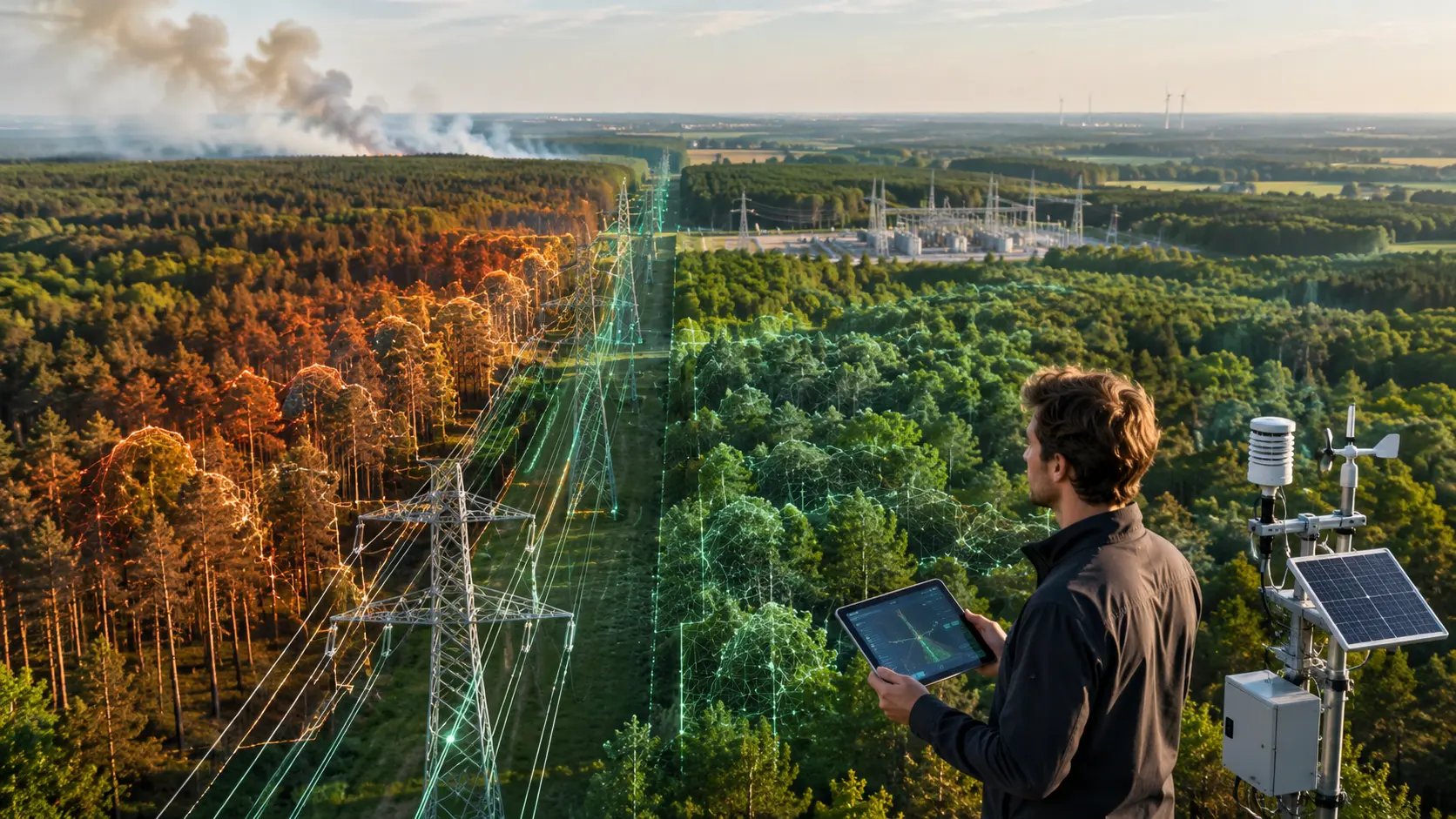
Your electricity grid benefits when AI technologies monitor transformers and equipment to reduce unexpected failures. Digital grid-enhancing technologies help optimize existing capacity without costly expansions.
Hyperscalers are investing heavily in renewable power purchase agreements. By 2030, you'll see around 20-25 GW of battery storage installed in data centers globally. This storage helps balance variable renewable energy with AI's demanding power requirements.
Industrial applications show promise too. AI-enabled optimization of production processes could reduce energy costs by 3-10 percentage points in energy-intensive industries. Well-documented use cases could save over 13 exajoules of energy by 2035 if adoption barriers are overcome.
Outlook for AI-Driven Energy Infrastructure
The AI-driven data center building boom is reshaping electricity demand patterns across major markets. You're witnessing hyperscalers invest billions in power infrastructure to support GPU clusters that require unprecedented energy density.
Data centers now compete directly with industrial users for grid capacity. Cooling systems alone can account for 40% of a facility's total power draw. This creates immediate pressure on regional grids that weren't designed for such concentrated loads.
Energy markets are racing to solve the AI power bottleneck through multiple pathways. Nuclear energy is gaining renewed attention as a baseload solution for 24/7 AI operations. You'll see major tech companies signing long-term power purchase agreements for both renewable and nuclear capacity.
Key infrastructure trends you should monitor:
- Direct connections between data centers and power generation assets
- Investment in small modular nuclear reactors
- Expansion of grid-scale battery storage
- Development of off-grid solutions for remote facilities
The IMF projects manageable but varying increases in energy prices depending on policy frameworks and infrastructure constraints through 2030. Your planning should account for regional differences in grid readiness and regulatory approaches.
AI's rapid growth is creating new opportunities for investors in power supply and infrastructure. The convergence of technology, energy, and financial sectors represents a fundamental shift in how electricity infrastructure gets financed and deployed.
Conclusion
The relationship between AI and energy represents one of the most significant infrastructure challenges you'll face in the coming decade. Global data centers consumed 415 TWh of electricity in 2024 and projections indicate this will more than double by 2030.
Your understanding of this challenge must extend beyond simple consumption metrics. The AI energy impact now drives fundamental decisions in grid planning, power procurement, and regional economic development. Hyperscalers are increasingly investing in dedicated power infrastructure to support GPU-intensive workloads.
Key considerations for your planning:
- Data center cooling systems account for substantial operational costs
- Grid stability requires careful coordination with utility providers
- Nuclear and renewable power sources increasingly compete for AI data center contracts
- Geographic location decisions now prioritize electricity availability over traditional factors
You should recognize that AI's role in the energy transition cuts both ways. While AI infrastructure demands significant electricity, these same technologies enable grid optimization, predictive maintenance, and renewable energy integration.
The industrial implications extend beyond technology companies. Your energy procurement strategies, infrastructure investments, and operational planning must account for AI-driven electricity demand. This isn't speculation about future trends—major providers are already deploying gigawatt-scale computing facilities.
Your response to these dynamics will determine competitive positioning in an increasingly AI-dependent economy.
Frequently Asked Questions
AI systems now consume significant electricity through data center operations, with projections showing AI could account for 9% of U.S. power demand by 2030. Organizations face growing pressure to measure carbon footprints, adopt efficiency techniques, and secure reliable energy sources as AI data centers strain utility infrastructure.
What are the main drivers of energy consumption in modern AI models and systems?
Your AI workloads consume electricity primarily through GPU clusters that train and run large models. High-speed chip technologies enable hundreds of GPUs to communicate across multiple servers, creating massive data processing clusters that drive up power requirements.
Training large language models requires enormous computational power to process datasets simultaneously. Once trained, inference operations continue drawing electricity as your models respond to user queries around the clock.
Cooling systems represent another major energy draw in your facilities. Data centers must maintain optimal temperatures for GPU performance, which adds substantial overhead to your total power consumption.
How can organizations measure and report the electricity and carbon footprint of AI workloads?
You can track power consumption at the hardware level by monitoring GPU energy draw during training and inference cycles. Most cloud providers now offer tools that measure kilowatt-hours consumed per workload or per model run.
Your carbon footprint calculation requires multiplying electricity consumption by the emissions intensity of your grid. If you operate in regions with coal-heavy grids, your carbon impact per megawatt-hour will be significantly higher than facilities powered by renewables.
You should report both direct energy consumption and scope 2 emissions from purchased electricity. Some organizations now publish energy efficiency metrics like computations per kilowatt-hour to demonstrate improvement over time.
Which techniques most effectively reduce the energy cost of training and running AI models?
Model optimization through pruning and quantization lets you remove unnecessary parameters and reduce precision without sacrificing accuracy. These techniques can cut your inference energy costs by 50% or more while maintaining acceptable performance.
You can adopt more efficient training approaches like transfer learning and few-shot learning. These methods require less computational power than training models from scratch on massive datasets.
Hardware selection matters significantly for your energy efficiency. Newer GPU architectures deliver better performance per watt, and you should evaluate specialized AI chips designed for lower power consumption.
Batch processing and load balancing help you maximize utilization of existing resources. Running inference requests in optimized batches reduces idle time and spreads fixed cooling costs across more useful work.
What do current studies indicate about AI energy consumption trends over the next few years?
The International Energy Agency projects electricity demand from AI will grow substantially through 2030 based on new global modeling and extensive industry consultation. Your sector faces accelerating power requirements as model sizes and deployment scale both increase.
AI data centers consumed more than 4% of U.S. electricity in 2023 and are projected to reach 9% by 2030. This growth drives utility companies to invest $1.4 trillion in infrastructure upgrades to meet surging demand from hyperscalers.
Your industry shows awareness of these constraints through investment in alternative energy sources. Meta has committed to purchasing 150 megawatts of geothermal power starting in 2027, while other major operators secure nuclear and renewable capacity.
Where can consumers buy the Ai Energy drink through reputable retailers or official channels?
Ai Energy drink is not related to artificial intelligence infrastructure or data center operations. This beverage product operates in a completely different market segment from the AI technology sector discussed in energy consumption analyses.
You should verify any energy drink purchases through established retail channels and check product authenticity. No connection exists between AI computational systems and branded energy beverages sharing similar names.
How much caffeine is in the Ai Energy drink, and how does it compare with similar beverages?
This question addresses a consumer beverage product unrelated to artificial intelligence energy consumption. The caffeine content of energy drinks falls outside the scope of AI infrastructure and electricity demand analysis.
Your focus on AI energy topics should center on data center power requirements, GPU efficiency, and grid capacity rather than caffeinated beverages. These represent entirely separate industries with no operational overlap.

Just in

Can your personal AI read your work email on Android? Google draws the line

AMD to Buy World Labs for $8.2 Billion in All-Stock Deal

Dutch security agencies warn: AI is accelerating cyberattacks — act now

Peter Thiel: AI could be bigger than the internet; Europe is 'extremely far' behind

Fifteen Dutch female MPs unite against AI-generated nude deepfakes

ChatGPT can now talk to your apps by voice: here’s what changes for you
Latest comments
Loading