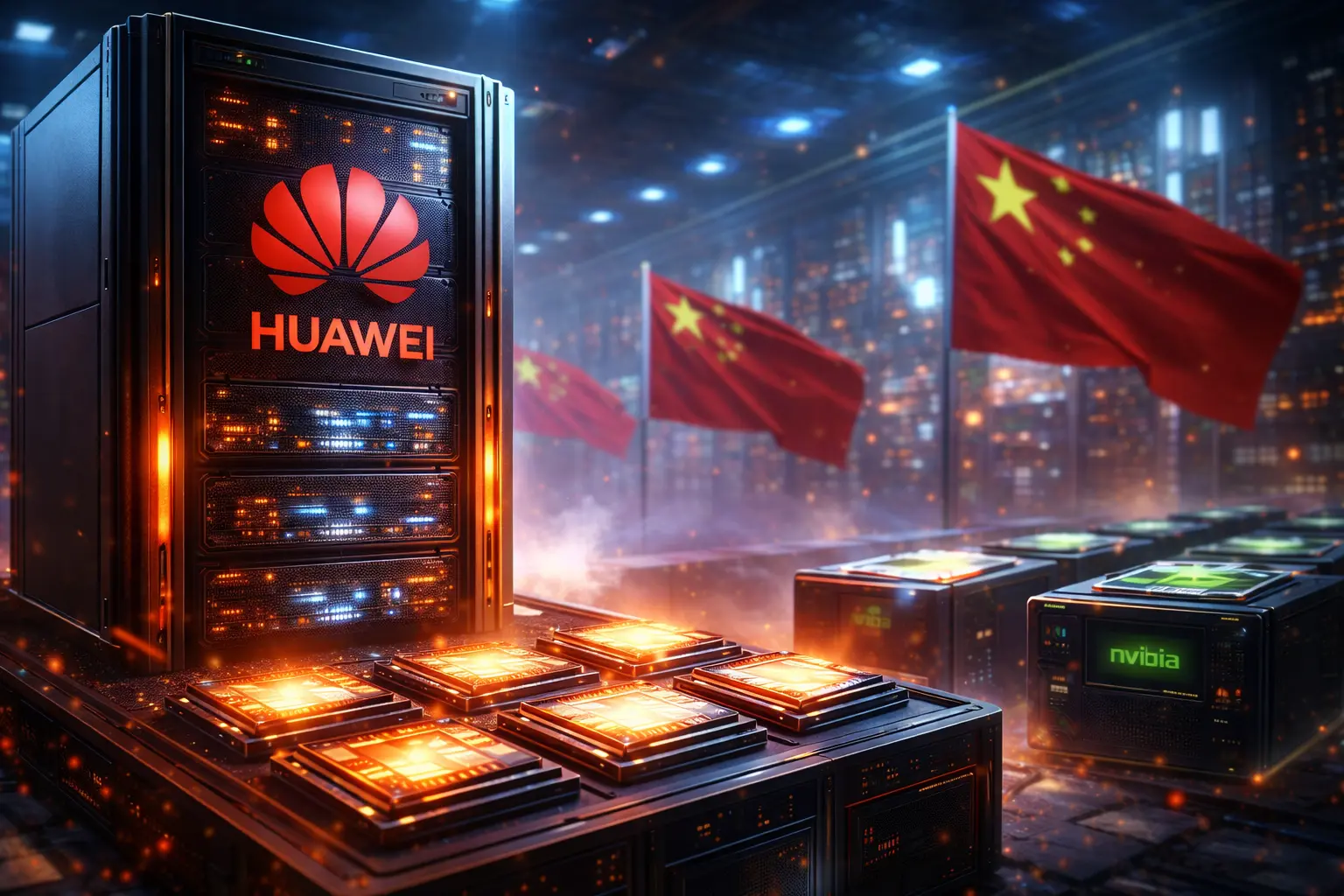
Chinese AI startup DeepSeek is running its latest V4 model on Huawei chips. It sounds technical, but it’s a geopolitical break. China is showing it can build AI without Nvidia’s American hardware.
DeepSeek pushes ahead
With V4, DeepSeek built a large language model that runs on Huawei’s Ascend chips—sidestepping Nvidia’s grip on AI hardware. Nvidia GPUs are the global default for training and inference.
Context matters. Since 2022, the United States has restricted exports of advanced chips to China. Nvidia could no longer ship its most powerful parts. China has since raced to assemble its own AI stack.
That stack has three layers:
- Hardware: chips from Huawei and other Chinese makers
- Software: homegrown frameworks and optimizations
- Models: like DeepSeek V4
DeepSeek V4 shows those three layers are finally locking together. Not perfectly—but well enough to compete.
Why it matters
AI isn’t just about models. It’s about infrastructure power. Control the chips, and you control the capacity to build and scale AI.
Nvidia’s dominance handed the US a strategic edge:
- Access to compute decided who could play
- Export controls could slow development
- Companies worldwide became dependent on US tech
DeepSeek V4 shifts that. China is showing it can:
- deploy alternative chips
- optimize software around less powerful hardware
- build its own ecosystems
It alters the dynamics of the so-called chip war. The US bets on delay through export limits; China bets on substitution and self-reliance.
Think energy politics: countries dependent on foreign energy are exposed. The same now applies to AI capacity.
What does this mean?
The key takeaway: Nvidia’s dominance is no longer a given. That triggers three immediate effects.
1. Strategic dependence is laid bare
European companies and governments largely run on Nvidia hardware via cloud providers. Efficient, yes—but it locks them into a single tech path. As alternatives emerge, the balance of power shifts.
2. AI development turns multipolar
Until now, AI largely ran on American infrastructure. With China building a full stack, a parallel ecosystem is forming. That means:
- different standards
- different optimizations
- potentially different governance models
Interoperability and collaboration get harder.
3. Export controls lose punch
The US strategy hinged on choking access to high-end chips. DeepSeek shows that optimization plus alternative hardware can partially blunt that approach. Not by being better—by being “good enough.”
And “good enough” often scales.
Europe: bystander or player?
For Europe, this exposes an uncomfortable truth. The continent has minimal native AI hardware capacity. European firms depend on:
- US chips and cloud
- US AI models
- and increasingly, Chinese alternatives
That creates a double risk: dependency on US tech and policy, and the risk of China building a rival ecosystem beyond Europe’s influence.
The debate on strategic autonomy gets a new layer. It’s not just about data or regulation, but physical infrastructure:
- chips
- data centers
- energy supply for AI
Without that base, Europe stays a user, not a builder.
The shift is structural
DeepSeek V4 isn’t the finish line. It’s a signal. China doesn’t need to beat Nvidia to matter—only to be independent enough.
That fundamentally reshapes the AI contest:
- from dominance to block-by-block competition
- from dependency to parallel ecosystems
- from pure tech race to geopolitical instrument
The question is no longer who has the best model. It’s who controls the entire chain.
DeepSeek and Huawei double down
What’s happening with DeepSeek and Huawei is a tipping point. AI is less a software race and more an infrastructure fight.
For Europe, waiting is no longer neutral. If you don’t build your own position, you’re choosing dependency by default.
And in a world where AI is the new energy, dependency is a risky place to be.

Popular news
AI breathes new life into an old game: ask for your own Fallout 2 mods

Two Critical PHP Flaws Put Millions of Websites at Risk — AI Helped Find Them

Goldman Sachs Predicts AI IPOs Could Add 100 Billion Dollars to Indian Market Capitalization

NVIDIA Advances Artificial Intelligence Defined Fabs With New CUDA X Libraries

AI Helps Expose Critical PHP Flaws

Developer points to Codex after nearly $89,000 cloud bill
Latest comments
Loading