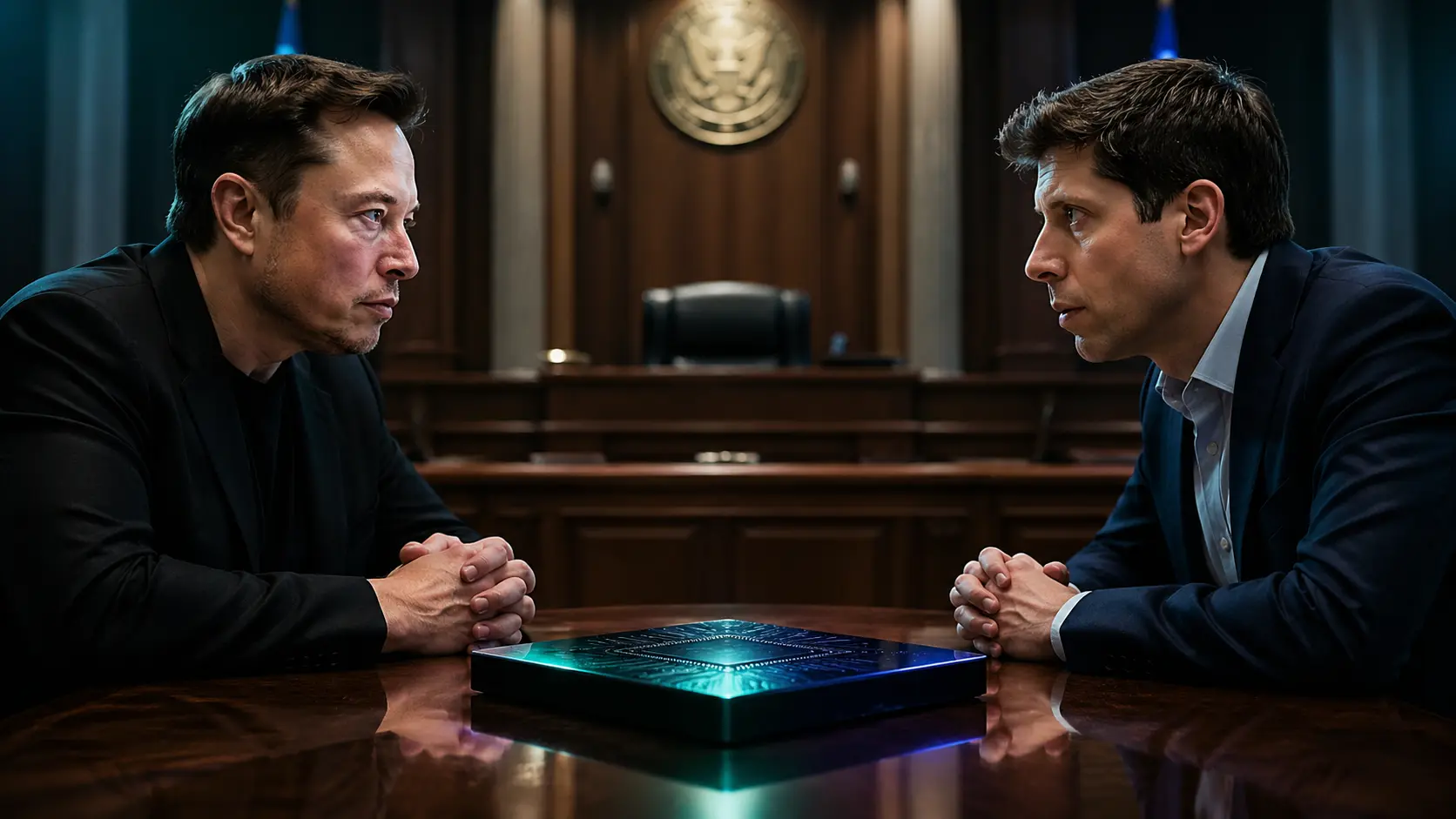
The structure of OpenAI may be rewritten in court this week, as Elon Musk and Sam Altman face off in a case that goes beyond corporate conflict. At stake is not just leadership, but the governance model behind one of the most influential AI systems in the world, and by extension, how frontier AI is controlled, financed, and deployed.
What Musk is actually asking for
Musk’s legal case is often framed as a personal dispute. The filings suggest something more structural.
He is asking the court to:
- Remove Altman and Greg Brockman from leadership
- Force OpenAI to abandon its current public benefit, profit-linked structure
- Redirect potential damages, reportedly up to $150 billion, to the nonprofit entity
At its core, Musk’s argument is that OpenAI violated its founding agreement by shifting from a mission-driven nonprofit into a commercially driven AI company. OpenAI disputes this characterization and argues the lawsuit is an attempt to slow a direct competitor, particularly as Musk builds xAI.
Notably, Musk dropped fraud claims ahead of trial, narrowing the case to governance and mission alignment. That shift reinforces that this is less about past deception and more about present control.
OpenAI is not happy with how things are going, they made a post on X (owned by Elon Musk):
"We can't wait to make our case in court where both the truth and the law are on our side. This lawsuit has always been a baseless and jealous bid to derail a competitor. We'll also finally have the chance to question Mr. Musk under oath before a jury of Californians about this attempt to undermine our work to ensure that artificial general intelligence benefits all of humanity."
Why this matters for enterprise buyers and partners
For enterprise customers, the outcome is not abstract.
OpenAI sits deep inside enterprise workflows through APIs, copilots, and integrations. A forced restructuring could introduce:
- Contract uncertainty around long-term partnerships
- Product roadmap disruption if leadership or governance changes
- Procurement risk for companies embedding OpenAI models into core systems
If the court mandates structural changes, enterprise buyers may need to reassess vendor concentration risk. This is particularly relevant for CIOs and CTOs who have standardized on OpenAI-powered tools.
More broadly, the case highlights a growing issue: AI vendors are not just technology providers, they are governance systems. Changes at the top can cascade into operational risk.
IPO ambitions and capital flows are in play
The timing of the trial intersects with a critical phase for AI capital markets.
Both OpenAI and Musk’s broader ecosystem, including SpaceX, are tied to large-scale funding strategies. OpenAI has been widely associated with potential future public market activity, while Musk is consolidating AI efforts across his companies.
A ruling that constrains OpenAI’s ability to operate as a profit-generating entity could:
- Complicate or delay any IPO trajectory
- Reduce investor confidence in hybrid governance models
- Shift capital toward competitors such as Google or Anthropic
Conversely, a clear legal validation of OpenAI’s structure could strengthen its position in attracting large-scale institutional capital.
This is why investors are watching closely. The case may indirectly define how investable frontier AI companies are.
A precedent for AI governance
The deeper significance of the trial lies in precedent.
AI companies have largely operated in a governance gray zone, balancing mission statements, investor demands, and rapid technological escalation. This case forces those tensions into a legal framework.
Key questions the court may implicitly answer include:
- Can founding mission statements constrain future business models?
- How enforceable are nonprofit-origin commitments in hybrid entities?
- Who ultimately has fiduciary responsibility in AI organizations with dual mandates?
The answers will not stay confined to OpenAI. Competitors, startups, and policymakers will adapt based on the outcome.
For regulators, the case provides a real-world stress test of AI governance structures. For founders, it signals that early architectural decisions may carry long-term legal consequences.
Competitive dynamics are part of the backdrop
While the case is framed around OpenAI, it unfolds within an intensifying competitive landscape.
Musk’s xAI is positioning itself directly against OpenAI’s models. At the same time, companies like Google and Anthropic are building alternative ecosystems around enterprise AI.
The trial introduces a new competitive dimension: legal leverage. If governance structures become contestable in court, future competition may extend beyond product performance into legal strategy.
That shift would mark a maturation of the AI industry, from rapid experimentation to contested institutional power.

What to watch next
The trial is expected to run through May, with opening statements following jury selection. Several developments will shape its impact:
- Testimony from Musk and Altman, which will clarify intent and narrative
- Judicial interpretation of OpenAI’s structure and obligations
- Any indication that the court is willing to intervene in governance
The broader takeaway is already visible. This case is not about personalities. It is about who controls frontier AI, and under what rules.
For decision-makers, that question is no longer theoretical. It is being decided in court.

Popular news

Anthropic Secures Thirty Two Billion Dollar Queensland Data Centre Deal for Claude

Zuckerberg Rejects AI Slowdown Calls Amid Industry Safety Debate

Crusoe Secures Nearly Four Billion Dollars to Scale Factory Built AI Data Centers

Amazon Secures Generac Stake in Massive Eight Billion Dollar Generator Pact

Spain Registers First End-to-End Autonomous AI Data Breach

MIT and Suffolk Unveil How AI is Reshaping Construction Productivity
Latest comments
Loading