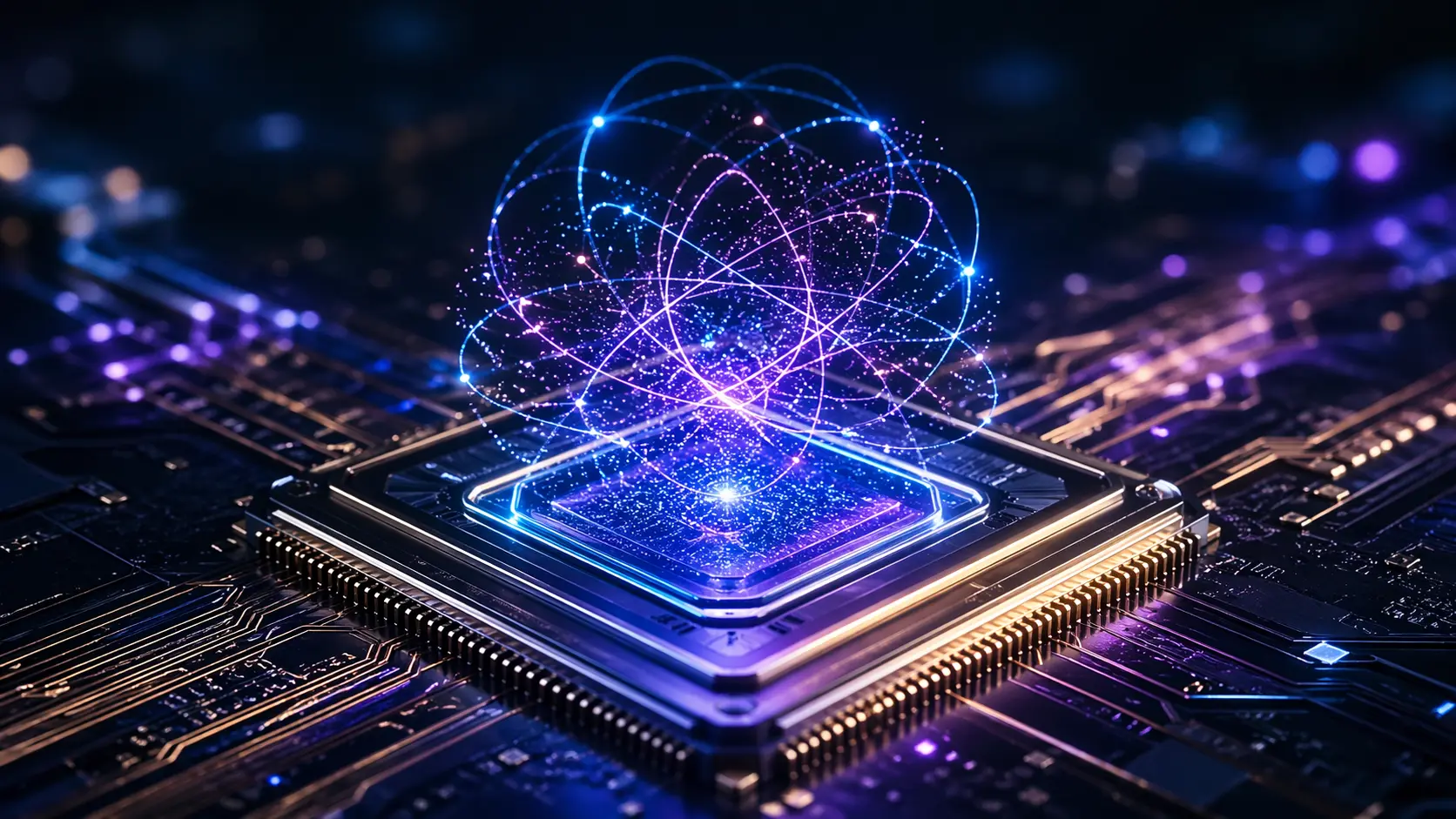
The most consequential idea in artificial intelligence may no longer be about better models, but about better physics. In a wide-ranging interview, Hartmut Neven, who leads quantum efforts at Google, outlines a view that challenges the current trajectory of AI development: scaling software alone may not be enough. The next leap could require fundamentally different computation, rooted in quantum mechanics.
Why quantum computing is moving from theory to strategy
Neven’s core argument is operational, not philosophical. Classical computing, built on binary logic, is reaching structural limits in certain domains. Quantum computing replaces that logic with the laws of quantum physics, enabling entirely different types of operations.
That difference matters most for a specific class of problems:
- optimization at scale
- molecular and material simulation
- complex probabilistic systems
In these areas, quantum systems can reduce the number of required computational steps dramatically. A task that takes a classical system millions of iterations could, in principle, be reduced to thousands.
This is not a universal advantage. Most everyday computing tasks will remain classical. But for high-impact domains such as drug discovery, logistics, and advanced materials, the performance gap becomes strategically meaningful.
For decision-makers, the implication is clear: quantum is not a replacement for AI infrastructure, but a future layer inside it.
The convergence point: AI, optimization, and quantum systems
Neven’s path into quantum computing started from a practical observation. Modern AI systems rely heavily on optimization. Training models, tuning parameters, and solving search problems are all forms of large-scale optimization.
Quantum systems offer a structural advantage in exactly that domain.
This creates a convergence point:
- AI depends on optimization
- quantum computing accelerates optimization
- therefore, quantum becomes a potential multiplier for AI capability
This is why Neven suggests that advanced AI systems, including potential general intelligence, may eventually require access to quantum resources.
Not as a theoretical add-on, but as a practical dependency.
A history of being early, and often wrong before right
Neven’s career reflects a pattern that is increasingly relevant in AI: working on technologies before they are commercially viable.
He contributed to early computer vision systems, helped develop foundational work on adversarial examples, and was involved in initiatives like Google Glass. Many of these efforts were initially dismissed or underperformed in market terms.
The lesson he draws is not about prediction accuracy, but about positioning. Breakthrough systems often require long periods of technical immaturity before becoming economically relevant.
Quantum computing is still in that phase.
For executives and investors, this creates a familiar tension. The technology is not ready for broad deployment, but the underlying trajectory suggests eventual impact. Ignoring it entirely risks being late to a structural shift.
The deeper layer: quantum mechanics as a model of reality
Beyond engineering, Neven takes a clear stance on one of the most debated topics in physics: the nature of reality itself.
He supports the “many-worlds” framework, which suggests that quantum systems do not collapse into a single outcome, but instead evolve into multiple parallel states.
This is not just abstract theory in his view. Quantum computing, if it scales, could provide indirect evidence for this model by demonstrating how computation exploits these parallel configurations.
For the purposes of industry, this matters less as philosophy and more as validation. If quantum systems behave as predicted, they will unlock computational pathways that classical systems cannot replicate.
The most controversial idea: linking quantum systems to consciousness
The interview moves into more speculative territory when discussing consciousness.
Neven proposes that conscious experience may be linked to quantum processes, specifically the formation of quantum superposition states. He suggests that testing this idea requires moving from theory to experiment.
The proposed approach is unconventional:
- connect quantum systems to biological processes in the brain
- increase the scale of quantum states involved
- observe whether subjective experience changes in measurable ways
If such experiments succeed, they would not only redefine neuroscience, but also reshape how we think about computation, perception, and human-machine interaction.
At this stage, these ideas remain unproven and technically distant. Even Neven acknowledges that the engineering challenges alone are formidable.
What this means for AI strategy today
It is easy to dismiss parts of this conversation as speculative. That would miss the more immediate signal.
The practical takeaway is not about consciousness or multiverses. It is about architecture.
AI is increasingly constrained by:
- compute availability
- energy consumption
- optimization limits
Quantum computing directly targets at least one of these constraints.
In the near term, the likely model is hybrid:
- classical systems handle general workloads
- quantum systems handle specialized subroutines
Over time, this division could reshape data center design, cloud infrastructure, and the economics of computation itself.
What to watch next
Three developments will determine whether quantum computing becomes strategically relevant in AI:
1. Demonstrable advantage in real-world problems
Not theoretical speedups, but measurable gains in production-relevant tasks.
2. Integration into existing compute infrastructure
Quantum systems will need to plug into cloud and enterprise workflows, not operate as isolated research tools.
3. Cost and reliability improvements
Error rates, stability, and operational costs remain the main bottlenecks.
If these conditions are met, quantum computing shifts from experimental science to competitive infrastructure.
The broader signal
The interview reflects a shift in how leading researchers think about AI progress.
The frontier is no longer just algorithms and data. It is increasingly about the physical substrate of computation itself.
For most organizations, quantum computing is not an immediate priority. But as AI systems push against classical limits, the question will change from “if” to “when.”
And at that point, the organizations that understood the trajectory early will have a structural advantage.

Popular news

AI Phone Agents Still Get Names Wrong | AI World Daily News

AI Phone Agents Still Make a Surprising Number of Mistakes with Names and Addresses

Chinese AI Maker Moonshot Limits Hacking Capabilities in New Kimi Model

AI Bot Accessed Public Voter Data Through Georgia Data Hub
Elon Musk SpaceX Secures 40 Billion Dollars for AI GPU Infrastructure

AI Financial Payoff Zero for Most Companies Outside Tech Sector
Latest comments
Loading