
DeepSeek’s V4 release matters less as a leaderboard moment than as a test of whether China can build high-end AI around domestic chips, open weights and lower-cost long-context models. The new system arrives in Pro and Flash versions, both with one-million-token context windows, and with Huawei Ascend support at the center of the story.
DeepSeek is no longer just competing on models
DeepSeek has released a preview of DeepSeek V4, its next major open-weight AI model series. The headline figures are large: V4-Pro has 1.6 trillion total parameters with 49 billion activated, while V4-Flash has 284 billion total parameters with 13 billion activated. Both use a mixture-of-experts architecture and both support a one-million-token context length.
That makes V4 a capability release, but the more important signal is operational. DeepSeek is trying to prove that near-frontier AI can be delivered through a stack that is increasingly Chinese, from model weights to Huawei Ascend infrastructure.
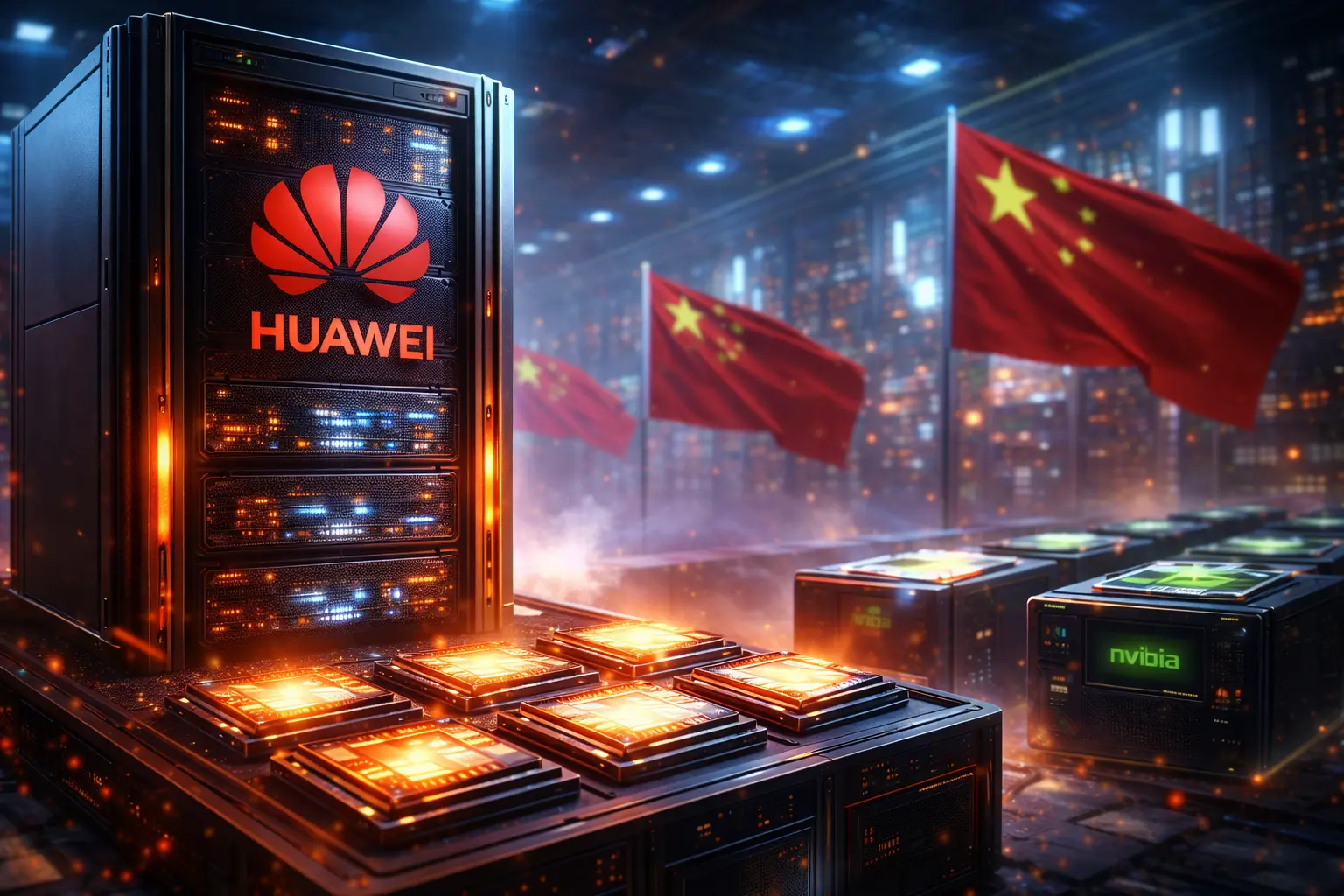
Reuters reports that V4 has been adapted to run on Huawei’s Ascend chips, with Huawei saying its Ascend 950-based supernode clusters support the V4 series. Huawei chips were also used for part of V4-Flash training, according to the report.
The one-million-token context window is the business feature
A one-million-token context window means a model can process very large documents, codebases or case files in a single session. DeepSeek says V4’s architecture reduces long-context compute and memory costs, with V4-Pro requiring only 27 percent of the single-token inference FLOPs and 10 percent of the KV cache used by DeepSeek V3.2 in a one-million-token setting.
For decision-makers, that is the part to watch. Long context is moving from a premium feature to a deployment assumption. If cheaper models can handle large files, compliance archives, technical documentation and software repositories, the economics of AI workflows shift.
The Flash model is especially relevant here. It is weaker than Pro on the hardest knowledge and agentic tasks, but DeepSeek presents it as faster and more economical, with reasoning performance that can approach Pro when given a larger thinking budget.
The benchmark story is strong, but not simple
DeepSeek says V4-Pro-Max is now the strongest open model across several knowledge, reasoning, coding and agentic tasks. Its own model card shows large gains over DeepSeek V3.2-Base in areas such as MMLU-Pro, SimpleQA Verified, FACTS Parametric and LongBench-V2.
The company also positions V4-Pro as competitive with leading closed systems, especially in coding, STEM and agentic workflows. Reuters notes, however, that DeepSeek’s own paper still shows V4-Pro trailing systems such as Gemini 3.1 Pro and OpenAI’s GPT-5.4 in some areas.
That distinction matters. V4 does not need to beat every closed model to change procurement decisions. For enterprises, the more practical question is whether an open-weight model with strong reasoning, long context and lower operating cost is good enough for internal coding, document analysis, agent workflows and sovereign deployment.
Huawei support changes the strategic meaning
The V4 launch lands in the middle of a larger infrastructure contest. China is trying to reduce reliance on Nvidia hardware after years of U.S. export controls. DeepSeek’s earlier V3 and R1 models were trained on Nvidia chips, but V4 is being aligned more directly with Huawei’s domestic AI stack.
That does not mean China has closed the hardware gap. Reuters quotes Omdia analyst Lian Jye Su saying Huawei still trails Nvidia technologically and that moving developers away from Nvidia’s ecosystem remains difficult. But he also described DeepSeek’s pivot as tangible progress toward AI infrastructure self-sufficiency.
This is why V4 matters beyond benchmark charts. If Chinese developers can build credible AI applications entirely on domestic hardware and open-weight models, the global AI market becomes more fragmented. Western firms will still lead in many frontier capabilities, but China may build a parallel ecosystem that is good enough, cheaper and politically aligned for its domestic market and partner countries.
The limits are still visible
DeepSeek has not removed the biggest constraint: high-end compute. Reuters reports that DeepSeek said Pro can cost up to 12 times more than Flash because of limited high-end compute capacity, with pricing potentially falling once Huawei Ascend 950 supernodes scale in the second half of the year.
There are also product gaps. The current release is focused on text generation and agentic workflows, not a broad multimodal platform. For some enterprise buyers, that makes V4 less of a full replacement for closed frontier systems and more of a specialist option for coding, reasoning, long-context analysis and controlled deployments.
Read also

What to watch next
The next test is not whether DeepSeek can win a benchmark row. It is whether developers actually build on V4, whether Huawei can scale the infrastructure behind it, and whether Flash becomes cheap enough to pressure the economics of closed-model APIs.
For executives, CIOs and policymakers, DeepSeek V4 is a reminder that the AI race is no longer only about model intelligence. It is about cost, hardware independence, deployment control and who owns the infrastructure beneath the software.
You can find the model at Hugging Face.

Popular news

AI Phone Agents Still Get Names Wrong | AI World Daily News

AI Phone Agents Still Make a Surprising Number of Mistakes with Names and Addresses

Chinese AI Maker Moonshot Limits Hacking Capabilities in New Kimi Model

AI Bot Accessed Public Voter Data Through Georgia Data Hub

Elon Musk SpaceX Secures 40 Billion Dollars for AI GPU Infrastructure

AI Financial Payoff Zero for Most Companies Outside Tech Sector
Latest comments
Loading