AI Runs on Cobalt: The Hidden Supply Chain Powering the Next Wave of Intelligence
ExplainersMonday, 27 April 2026 at 22:11
Updated at Monday, 27 April 2026 at 22:15
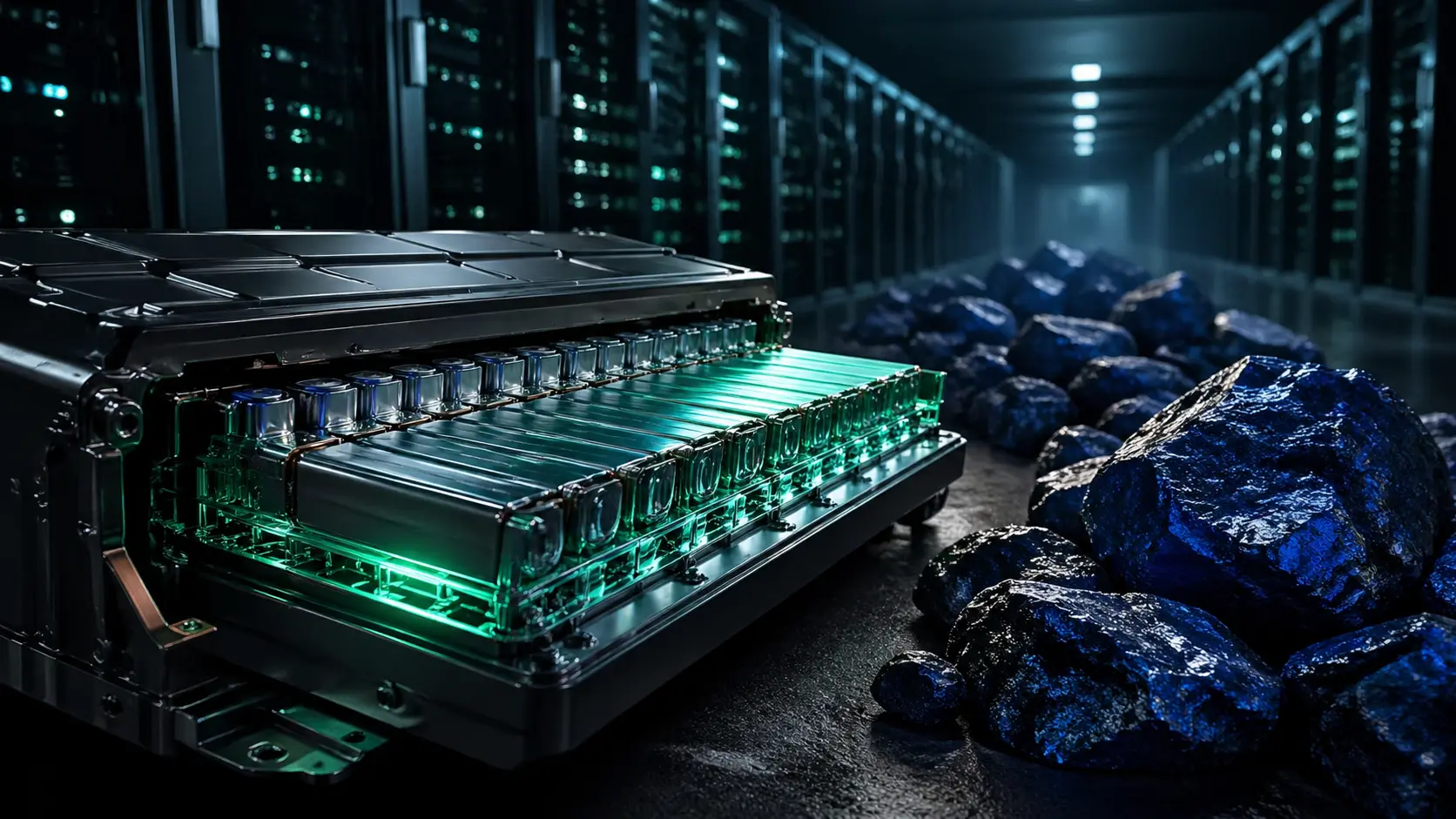
Artificial intelligence may look like software, but its future is being shaped by something far more physical: minerals. The same lithium-ion battery ecosystem that powers smartphones and electric vehicles is becoming a foundational constraint for AI infrastructure, robotics, and autonomous systems. That reality is forcing a shift in how AI should be understood, not as a purely digital revolution, but as an industrial system dependent on fragile, global supply chains.
AI’s Physical Layer Is Becoming the Bottleneck
The dominant narrative around AI still focuses on models, chips, and software capabilities. But beneath that layer sits a less visible dependency: energy storage and mobility systems powered by lithium-ion batteries.
Those batteries rely on a mix of minerals, particularly cobalt, lithium, and nickel. A large share of these materials originates in the Democratic Republic of Congo, where mining conditions remain difficult to regulate and often involve informal or “artisanal” extraction. The materials are then refined, mostly in China, before being turned into battery components and shipped into global technology products.
This matters for AI for a simple reason. As AI moves beyond cloud-based tools into physical systems such as robots, drones, autonomous vehicles, and edge computing devices, it becomes inseparable from battery technology. That shifts the constraint from compute alone to a combination of compute, energy, and materials.
In other words, the future of AI is no longer just about who has the best model. It is also about who controls the supply chains that power those systems.
From Cloud AI to Embodied AI
For the past decade, AI has largely been a data center story. Large models trained on centralized infrastructure, accessed through APIs and software interfaces.
That is now changing.
A new phase of AI is emerging, often described as “embodied AI.” This includes:
- Autonomous robots in logistics and manufacturing
- Drone-based systems in defense and infrastructure inspection
- Consumer devices with persistent AI capabilities
- Industrial automation integrated with real-time decision-making
All of these systems share a common requirement: mobility and energy independence. And that means batteries.
Without reliable, scalable battery systems, these applications cannot operate effectively. A humanoid robot or autonomous drone tethered to a power source is not commercially viable at scale.
This is where lithium-ion technology becomes strategically critical. It is not just enabling convenience in consumer electronics, it is enabling the physical deployment of AI systems in the real world.
The Supply Chain Few AI Leaders Talk About
Despite its importance, the battery supply chain remains largely absent from mainstream AI discussions.
The typical lifecycle looks like this:
- Extraction: Minerals such as cobalt are mined, often in regions with limited oversight
- Initial processing: Materials are refined into intermediate forms such as hydroxides
- Advanced processing: Further refinement into battery precursor materials, primarily in China
- Manufacturing: Batteries are assembled into cells and integrated into devices
- Deployment: Batteries power everything from smartphones to EVs to AI-enabled systems
China currently dominates several stages of this chain, particularly processing and refinement, in some cases controlling up to 90 percent or more of global capacity for key materials.
This creates a structural imbalance.
While Western economies lead in AI research, software, and semiconductor design, they remain dependent on external supply chains for critical physical components.
That dependency introduces risk across multiple dimensions:
- Geopolitical: Supply disruptions or export controls
- Economic: Price volatility in key minerals
- Operational: Limited control over upstream production
- Reputational: Exposure to labor and environmental concerns
For AI leaders, this is no longer a peripheral issue. It is becoming central to execution.
Energy, Not Just Compute, Defines AI Scale
Another overlooked implication is energy.
AI systems, particularly large models and real-time inference systems, require significant power. As these systems move closer to the edge, into factories, cities, and devices, energy storage becomes critical.
Batteries are not just a convenience. They are an infrastructure layer.
This creates a convergence between three systems:
- AI compute
- Energy infrastructure
- Materials supply chains
Any constraint in one affects the others.
For example:
- A shortage of battery materials limits the rollout of autonomous systems
- Energy instability constrains deployment of edge AI
- Supply chain disruptions increase costs and slow adoption
This is already visible in adjacent industries. Electric vehicle growth, renewable energy storage, and consumer electronics are all competing for the same underlying resources.
AI is entering that competition.
The Cost of Abstraction
One reason this issue has remained under-discussed is what could be described as “abstraction bias.”
For years, technology narratives have emphasized the immaterial nature of digital systems. Software was seen as scalable, clean, and detached from physical constraints.
That view is increasingly inaccurate.
Every AI system ultimately runs on hardware, and that hardware depends on materials, manufacturing, and logistics. The more AI integrates into the physical world, the less it can be abstracted away from those realities.
This has strategic consequences.
Companies that treat AI purely as a software problem risk missing critical dependencies. Those that understand the full stack, from materials to deployment, are better positioned to scale.
China’s Structural Advantage
One of the most significant outcomes of the past two decades is China’s position in this ecosystem.
Through a combination of state support, long-term industrial planning, and aggressive investment, Chinese firms have built dominance across key parts of the battery supply chain.
This includes:
- Ownership stakes in mining operations
- Control over refining and processing
- Large-scale battery manufacturing capacity
- Integration with downstream industries such as electric vehicles
This is not an accidental outcome. It reflects sustained investment in low-margin, high-scale industries that many Western economies deprioritized.
For AI, this creates a structural asymmetry.
While innovation in models and software remains distributed globally, the physical infrastructure supporting next-generation AI systems is increasingly concentrated.
That has implications for:
- National security
- Industrial policy
- Supply chain resilience
- Competitive positioning of AI companies
The Ethical Dimension Is Not Peripheral
Beyond economics and geopolitics, there is a growing ethical dimension.
Mining conditions in parts of the world supplying key battery materials have been widely documented as problematic. Issues include:
- Informal labor practices
- Limited safety standards
- Environmental degradation
- Weak regulatory enforcement
As AI becomes more embedded in everyday systems, the question is no longer just about what AI can do, but how it is built.
For companies deploying AI at scale, this introduces reputational and regulatory risks.
It also raises broader questions about the sustainability of current supply chains.
What This Means for AI Decision-Makers
For executives, investors, and policymakers, the implications are becoming clearer.
AI strategy can no longer be confined to software capabilities or model performance. It needs to account for:
1. Supply chain exposure
Understanding dependencies on critical materials and where they originate.
2. Infrastructure integration
Aligning AI deployment with energy and hardware constraints.
3. Geopolitical risk
Assessing how global tensions could affect access to key components.
4. Cost structures
Recognizing that material inputs can influence the economics of AI deployment.
5. Ethical sourcing
Preparing for increased scrutiny on how underlying systems are built.
This is particularly relevant for Europe and other regions seeking technological sovereignty. Without addressing upstream dependencies, downstream innovation remains constrained.
What to Watch Next
Several developments will shape how this evolves:
- Battery innovation: Alternatives to cobalt-heavy chemistries could reduce dependency
- Recycling systems: Circular supply chains may ease pressure on raw materials
- Industrial policy: Government investment in domestic processing and manufacturing
- Supply diversification: New mining projects outside traditional regions
- AI hardware evolution: Changes in energy efficiency and system design
None of these will resolve the issue quickly. But they will determine how tightly AI remains coupled to current supply chains.
The central shift is straightforward but underappreciated.
AI is no longer just a software story. It is an infrastructure story, a materials story, and increasingly a geopolitical story.
The companies and countries that understand that full stack will shape the next phase of AI. Those that do not may find that their most advanced systems are constrained not by algorithms, but by the physical world beneath them.

Popular news

Anthropic Secures Thirty Two Billion Dollar Queensland Data Centre Deal for Claude

Zuckerberg Rejects AI Slowdown Calls Amid Industry Safety Debate
Crusoe Secures Nearly Four Billion Dollars to Scale Factory Built AI Data Centers

Amazon Secures Generac Stake in Massive Eight Billion Dollar Generator Pact

Spain Registers First End-to-End Autonomous AI Data Breach

MIT and Suffolk Unveil How AI is Reshaping Construction Productivity
Latest comments
Loading