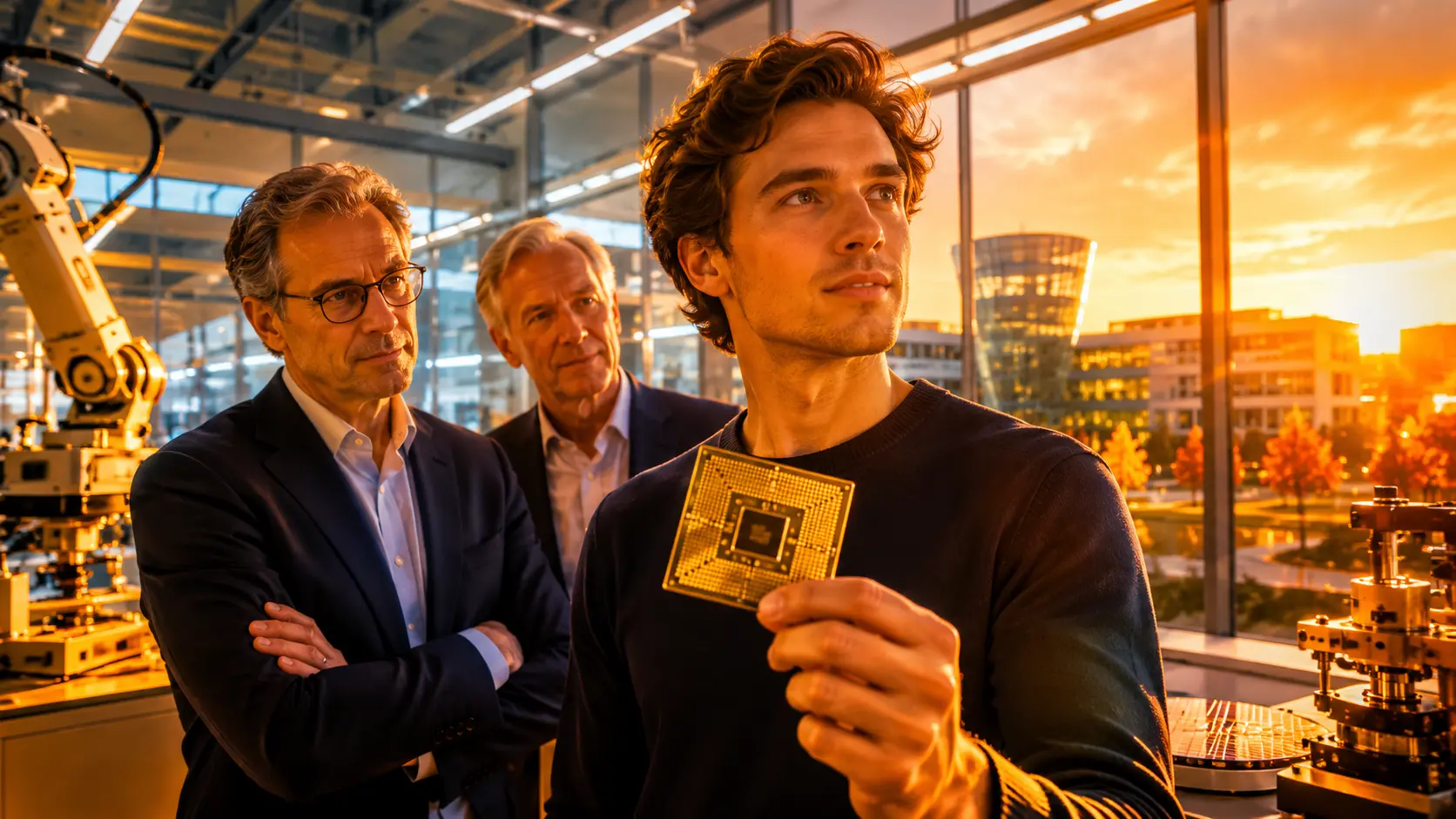
A Dutch alumni-backed investment fund wants to spin up AI and deeptech companies faster from universities like TU Delft, TU Eindhoven, Wageningen University and potentially the University of Twente. The fund, Graduate Ventures, is going national while raising a new €80 million seed fund.
According to the Financieele Dagblad, the goal is to help the Netherlands produce more breakthrough tech companies that could grow into “the next ASML.”
Graduate Ventures is backed by prominent Dutch founders and investors, including Frans van Houten and Michiel Muller. The fund targets startups emerging from universities and research institutes, with a focus on AI, quantum tech, semiconductors, healthtech and other deeptech fields.
Why the Netherlands is doubling down on deeptech and AI
Deeptech refers to startups born from fundamental scientific research—think artificial intelligence, quantum computing, semiconductors or biotech. These companies often take years to reach profitability but can be strategically vital for the economy and technology leadership.
That focus aligns with a broader European push to reduce reliance on American and Chinese tech giants, especially in AI infrastructure, chips and advanced software. The Netherlands plays an outsized role thanks to ASML, which is crucial to producing the world’s most advanced chips.
Graduate Ventures argues the Netherlands needs more university-born companies that can scale into international tech leaders. The fund explicitly cites Silicon Valley playbooks—Stanford and MIT—where alumni networks have financed and coached startups for decades.
Universities as the new AI powerhouses
Graduate Ventures began around TU Delft and Erasmus University Rotterdam, and is now expanding to Amsterdam and Eindhoven. Wageningen has also joined. The University of Amsterdam formally confirmed a partnership with the fund this week.
The result is a network where universities, alumni and investors work together to scale startups.
Each region brings a different edge:
- Delft and Eindhoven: strong in deeptech and chips
- Amsterdam: leading in AI and software
- Wageningen: focused on agri- and climate tech
- Twente: seen as a key hub for healthtech and hardware
That geographic spread is strategic. European policymakers worry AI talent will keep decamping to the United States for better funding and bigger markets.
Graduate Ventures aims to counter that by giving researchers and students early capital and hands-on support.
From lab bench to scalable AI company
The fund invests at the very earliest stages. Through a non-profit pre-seed vehicle, startups can receive up to €75,000. Larger seed funds follow with investments up to several million euros.
Money is only part of the model. Over 200 alumni help startups with international expansion, patent strategy, sales and follow-on funding.
That matters because the Netherlands excels in research but struggles to scale tech companies. Many startups stay small or turn to foreign investors once bigger rounds are needed.
Graduate Ventures sees this scaling gap as the core challenge for Dutch AI and deeptech.
AI startups move to the geopolitical front line
The timing is no accident. European governments are pouring billions into AI infrastructure, chips and strategic technologies—pushing to build European alternatives to dominant U.S. players like OpenAI, Google and Nvidia.
The Netherlands holds a unique position thanks to ASML’s role in global chip production. That puts fresh attention on Dutch universities as sources of new AI and semiconductor ventures.
Graduate Ventures points to quantum startup QuantWare as a case in point: a university spin-out that recently raised over €150 million in growth capital from international investors.
For investors and policymakers, deeptech is increasingly treated as strategic infrastructure—on par with energy, telecom and defense.
This is bigger than startups
Graduate Ventures’ expansion signals a push to build a more structural innovation ecosystem around universities, alumni and private capital in the Netherlands.
That’s crucial as AI and deeptech become ever more capital-intensive. Only the biggest tech companies typically have the resources to build cutting-edge AI systems or chip technology. European countries are racing to grow homegrown ecosystems faster.
Universities sit at the center of that effort—not just as research hubs, but as engines of AI talent, intellectual property and new startups.
Graduate Ventures is positioning itself not just as an investment fund, but as a bid to build a Dutch spin on the Silicon Valley model.

Latest comments
Loading