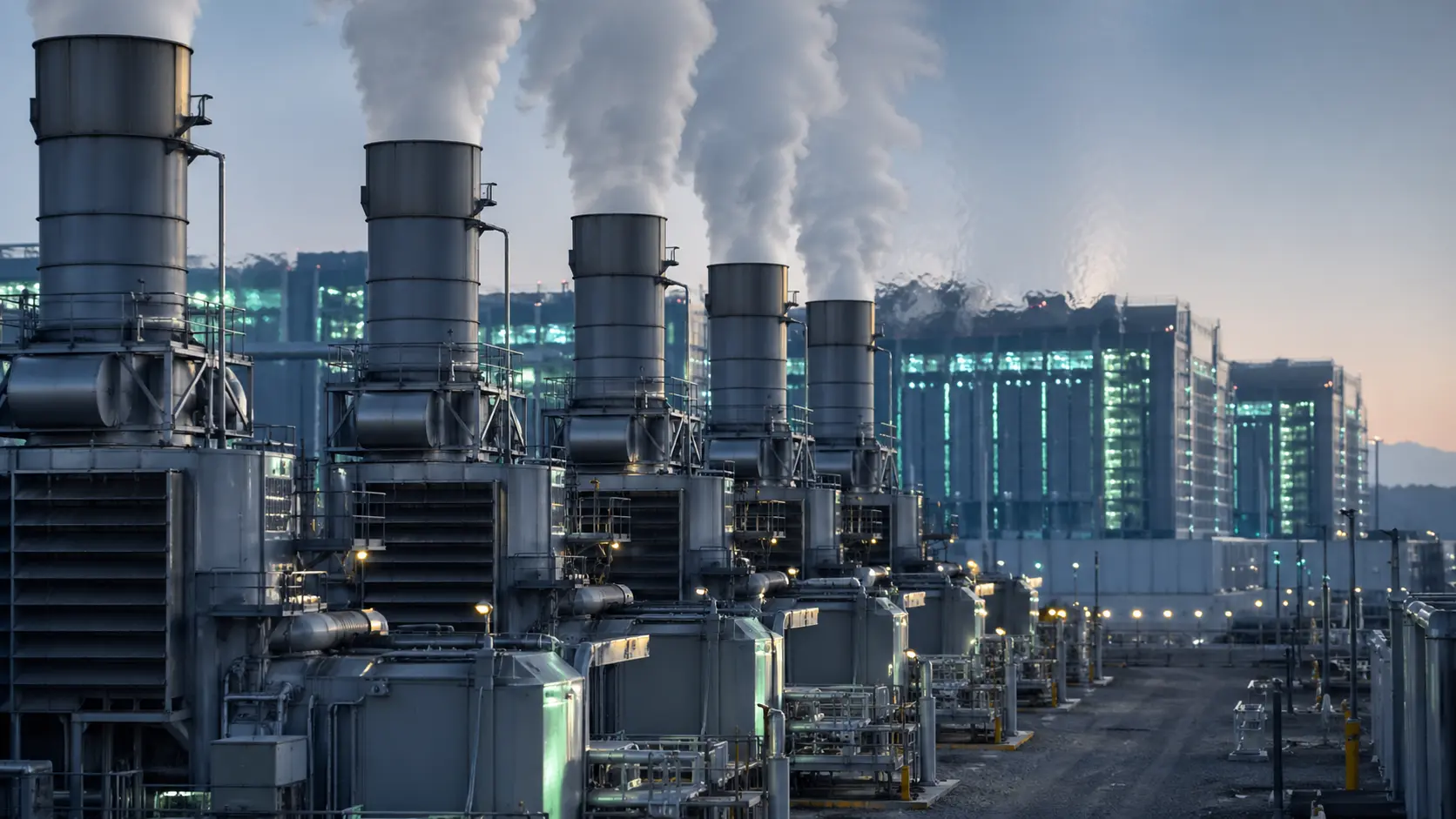
The next constraint in the AI race is no longer models or chips, but energy. A growing number of data center projects tied to major AI companies are turning to dedicated natural gas power, with emissions that could rival entire countries. That shift is forcing a more direct question: can the industry scale AI without breaking its own climate commitments?
Data centers are quietly becoming major emitters
A review of US air permit filings shows that just eleven gas-powered data center campuses could emit more than 129 million tons of greenhouse gases annually under maximum operating conditions. Wired is keeping track of all the American permits for big data centers.
Even accounting for the fact that permit estimates are theoretical ceilings, the scale remains significant. At half capacity, emissions could still exceed those of countries like Norway. The implication is not marginal. A relatively small number of AI infrastructure projects can materially shift national-level emissions profiles.
This marks a structural change in how digital infrastructure is built. Data centers are no longer passive consumers of grid electricity. Increasingly, they are becoming vertically integrated energy operators.
Why AI companies are building their own power
The shift toward “behind-the-meter” power, where companies generate electricity on-site rather than drawing from the grid, is driven by constraints rather than preference.
Three pressures stand out:
- Grid delays: Connecting large data centers to existing utilities can take years
- Reliability demands: AI workloads require stable, continuous power
- Political sensitivity: Utilities passing infrastructure costs to consumers face growing resistance
Building dedicated gas plants solves these issues in the short term. It guarantees capacity, avoids grid bottlenecks, and isolates cost. But it also locks in fossil fuel dependency at a moment when many of the same companies have made aggressive climate pledges.
The tension between AI growth and climate commitments
Major AI players including OpenAI, Microsoft, Meta, and xAI are all linked, directly or indirectly, to projects that rely on natural gas generation.
Publicly, these companies continue to position gas as a temporary bridge. The argument is consistent: near-term reliability requires fossil fuels, while long-term plans include renewables, nuclear, and grid modernization.
The problem is timing. AI demand is accelerating faster than clean energy infrastructure can be deployed.
That creates a gap where emissions rise precisely when companies have committed to reducing them.
In some cases, the numbers are large enough to offset years of progress. A handful of projects can meaningfully erode previously reported emissions reductions, even under conservative assumptions.
This is not just a US problem
The dynamic playing out in the United States is not an outlier. It is an early signal of a broader constraint that is beginning to surface across Europe and other regions.
European data center markets are already running into similar limits: grid congestion, long connection queues, and growing political scrutiny over energy use. In countries such as Ireland and the Netherlands, new data center approvals have been slowed or restricted precisely because of pressure on national electricity systems. The UK and Germany are facing parallel debates as AI workloads begin to scale.
The underlying pattern is consistent. AI demand is rising faster than power infrastructure can adapt. That gap forces the same set of trade-offs everywhere:
- build new capacity faster, often using gas as a bridge
- compete with households and industry for limited grid supply
- or slow down deployment
In Europe, the response is likely to look different in form but not in substance. Regulatory pressure is higher, and there is stronger emphasis on renewables and grid coordination. But the physical constraint remains the same: large-scale AI requires large-scale, always-on power.
That creates a tension that European policymakers and companies cannot avoid. Pushing aggressively on AI competitiveness risks increasing emissions or energy prices. Holding the line on climate targets risks falling behind in AI infrastructure.
What is emerging is not a regional anomaly, but a structural reality. AI is becoming an energy-intensive industry, and every major economy will have to decide how to balance speed, sustainability, and sovereignty.
A different kind of power plant
There is also a technical distinction that matters. Traditional power plants connected to the grid ramp output up and down based on demand. Data center power plants do not.
AI workloads are relatively constant. That means turbines can run continuously at high capacity, pushing actual emissions closer to permitted levels than in typical grid scenarios.
At the same time, supply chain constraints are introducing another risk. Shortages of high-efficiency gas turbines are leading some developers to consider less efficient models, increasing both runtime and emissions.
The economic logic is clear. The value generated by AI workloads is perceived to outweigh the cost of inefficiency in power generation.
Infrastructure, not models, is becoming the strategic layer
This shift reframes the competitive landscape. The limiting factor in AI is moving away from software capability toward physical infrastructure:
- Access to power
- Speed of deployment
- Capital to build at scale
- Regulatory positioning
Companies that can secure energy fastest gain a structural advantage. Those that cannot face delays, higher costs, or dependency on constrained utilities.
Energy is becoming a gating function for AI growth.
What happens next
Not all proposed projects will be built. Permits do not guarantee execution, and factors like financing, turbine supply, and policy shifts could slow development.
At the same time, companies are investing heavily in alternatives, including nuclear and large-scale renewables. The direction is clear, but the transition is not immediate.
In the near term, natural gas is filling the gap.
The open question is whether this is a temporary phase or the start of a longer-term hybrid model where AI infrastructure permanently relies on a mix of clean and fossil energy.
Read also


The underlying signal
This is no longer just a climate story or a technology story. It is an infrastructure story with direct implications for cost, regulation, and competitive positioning.
AI’s expansion is colliding with the physical limits of energy systems.
For decision-makers, the takeaway is straightforward: the future of AI will be shaped as much by power availability as by model performance.

Popular news

AI Phone Agents Still Get Names Wrong | AI World Daily News

AI Phone Agents Still Make a Surprising Number of Mistakes with Names and Addresses

Chinese AI Maker Moonshot Limits Hacking Capabilities in New Kimi Model

AI Bot Accessed Public Voter Data Through Georgia Data Hub

Elon Musk SpaceX Secures 40 Billion Dollars for AI GPU Infrastructure

AI Financial Payoff Zero for Most Companies Outside Tech Sector
Latest comments
Loading