Nvidia AI: Complete Guide to GPUs, CUDA and AI Infrastructure
GuidesSaturday, 08 August 2026 at 17:00
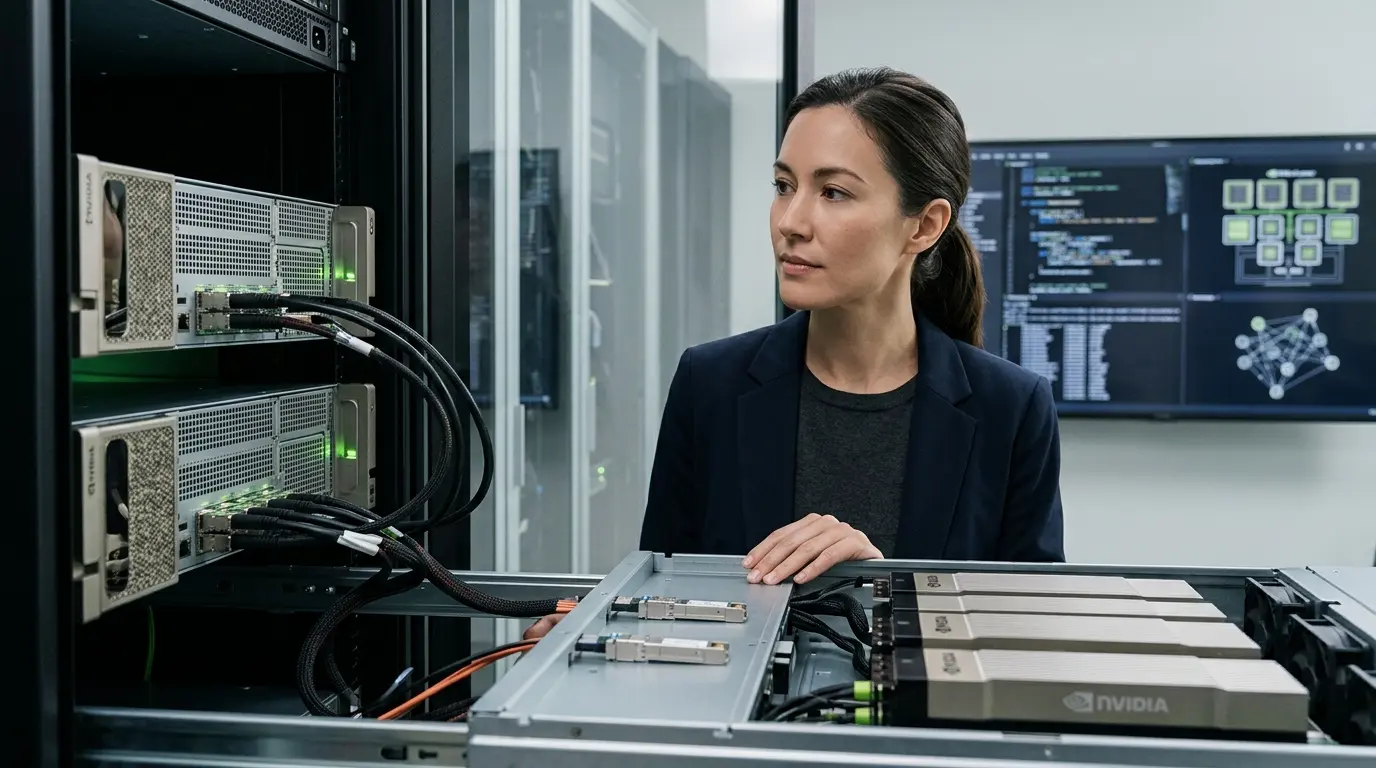
Nvidia AI is a complete computing platform rather than a single graphics processor. Its data-centre GPUs perform the parallel calculations used to train and run modern artificial-intelligence models. CUDA and related libraries make those processors programmable. NVLink, InfiniBand and Ethernet move data between accelerators. DGX and rack-scale systems combine the parts into deployable infrastructure. Nvidia AI Enterprise packages supported software for organizations that need to operate models in production.
That breadth explains both Nvidia's strength and the confusion surrounding it. “An Nvidia GPU” can mean a chip inside a server, an accelerator module, a complete eight-GPU system, a rack with dozens of accelerators or a cloud instance rented by the hour. CUDA can mean the programming model, the toolkit or the wider software ecosystem. An “AI factory” is not a new type of chip; it is Nvidia's term for infrastructure designed to turn data and energy into model training, inference and useful AI output.
This guide maps the entire stack. For the company, its history and the strategy behind the platform, read what Nvidia does. For a generation-by-generation hardware comparison, use our guide to Nvidia AI GPUs. For the software layer that helped make those GPUs the industry default, see what Nvidia CUDA is and how it works.
Nvidia AI at a glance
| Question | Short answer |
| What is Nvidia AI? | A full-stack platform of processors, networking, systems, software, models and services for accelerated computing and artificial intelligence |
| Why are GPUs used for AI? | They can execute many mathematical operations in parallel, which suits the matrix calculations behind neural networks |
| What is CUDA? | Nvidia's parallel-computing platform and programming model, supported by a large toolkit and library ecosystem |
| What are DGX systems? | Nvidia-designed AI servers and rack-scale systems that integrate accelerators, CPUs, networking, software and management |
| What is an AI factory? | A data-centre environment optimized to train, fine-tune and run AI models at scale |
| Does Nvidia manufacture its own chips? | Nvidia designs its products but uses outside foundries and manufacturing partners under a fabless model |
| Is Nvidia only for training? | No. Nvidia systems support training, fine-tuning, inference, data processing, simulation, robotics and other accelerated workloads |
| Can companies rent Nvidia infrastructure? | Yes. Nvidia hardware is available through major clouds, specialist GPU clouds, hosting providers and Nvidia's own cloud offerings |
| What is Nvidia AI Enterprise? | A paid enterprise software suite with supported tools and runtimes for developing and operating AI applications |
| Who competes with Nvidia? | AMD, Google, Amazon, Microsoft, Huawei, Intel and specialist accelerator companies compete at different layers of the stack |
What does Nvidia provide for artificial intelligence?
Nvidia's AI platform can be understood as six connected layers.
1. Processors
The best-known layer is the GPU. Nvidia's data-centre accelerators include generations such as Ampere, Hopper, Blackwell, Blackwell Ultra and Vera Rubin. These processors are designed for workloads that can divide calculations across many parallel execution units.
Modern Nvidia systems also use:
- Grace CPUs to handle general-purpose processing and feed accelerators;
- BlueField DPUs to offload networking, storage and infrastructure tasks;
- NVLink switch silicon to connect accelerators at high bandwidth;
- and network adapters and switch chips for scale-out clusters.
A processor alone does not create a useful AI platform. Memory capacity, memory bandwidth, interconnects and software determine how much of the chip's theoretical capability can be used by a real model.
2. Networking and interconnects
Large models rarely fit efficiently on one accelerator. Training and serving therefore distribute work across GPUs, nodes and sometimes entire data-centre halls.
Nvidia's connectivity portfolio includes:
- NVLink for high-bandwidth communication among accelerators;
- NVLink switches for larger scale-up domains;
- InfiniBand networking acquired through Mellanox;
- Spectrum-X Ethernet for AI-oriented Ethernet deployments;
- ConnectX network adapters;
- and BlueField DPUs for infrastructure acceleration and isolation.
The network is not a secondary accessory. When accelerators wait for data or synchronization, expensive compute sits idle. That is why Nvidia increasingly sells complete systems rather than asking customers to assemble unrelated components.
3. Systems and rack-scale infrastructure
Nvidia packages its technology at several levels:
- accelerator cards and modules;
- HGX baseboards and reference platforms used by server manufacturers;
- DGX servers designed by Nvidia;
- rack-scale products such as GB200 and GB300 NVL systems;
- DGX SuperPOD architectures for larger clusters;
- and validated partner systems built around Nvidia reference designs.
Our dedicated guide to Nvidia DGX systems and AI factories explains the differences among a GPU, HGX platform, DGX server, rack and SuperPOD, together with the power, cooling, storage and networking needed to operate them.
4. CUDA and accelerated libraries
CUDA is the developer foundation of the platform. It lets software use Nvidia GPUs for general-purpose parallel computing and provides tools for compiling, debugging, profiling and optimizing workloads.
The wider software environment includes CUDA-X libraries for deep learning, linear algebra, data science, image processing and scientific computing. Major frameworks such as PyTorch can use these libraries behind familiar high-level interfaces.
This matters commercially because organizations do not choose hardware only by a specification sheet. They choose the platform that can run their code, frameworks, dependencies and operational tools reliably. Nvidia's software depth reduces the work required to use each new hardware generation, while also increasing switching costs.
5. Enterprise AI software
Nvidia AI Enterprise adds supported production software. Its portfolio includes model-serving runtimes, model-development tools, orchestration, registries and domain frameworks.
Important components include:
- Nvidia NIM microservices for deploying supported models;
- NeMo for developing and customizing generative AI;
- TensorRT and TensorRT-LLM for optimized inference;
- Triton Inference Server for model serving;
- NGC for distributing containers, models and software;
- Run:ai for scheduling and managing AI compute;
- Omniverse for simulation and physical-AI workflows;
- and Nvidia Blueprints and reference workflows.
The exact product map, licensing and current prices belong in our Nvidia AI Enterprise guide.
6. Cloud, models and industry platforms
Organizations do not have to own Nvidia systems. They can obtain capacity through public clouds, specialist GPU clouds, colocation providers and managed platforms. Nvidia also publishes models, frameworks and industry-specific stacks for robotics, autonomous vehicles, healthcare, telecommunications and scientific computing.
The cloud route makes access faster, but it changes the economics. A rented instance avoids a large capital purchase and facility work. It can also create variable costs, capacity constraints and dependence on the cloud provider's available configurations.
Why are Nvidia GPUs so important to AI?
Neural networks rely heavily on operations that can be expressed as matrix multiplication and other parallel numerical work. A conventional CPU is designed to handle a wide range of tasks with a relatively small number of powerful cores. A GPU uses many execution units to process large amounts of similar work in parallel.
The basic advantage is not that a GPU is universally “faster than a CPU.” It is that the architecture fits particular workloads. A CPU remains essential for operating systems, data preparation, control flow, databases and parts of an AI pipeline. Accelerators perform the highly parallel sections.
Nvidia reinforced that hardware fit with specialized capabilities:
- Tensor Cores for matrix operations used in AI;
- support for lower-precision formats that can increase throughput;
- high-bandwidth memory close to the processor;
- interconnects that let many accelerators behave more like one system;
- and libraries that map common framework operations onto optimized kernels.
The result is a platform optimized across hardware and software rather than a loose collection of fast chips.
Training, fine-tuning and inference
“AI compute” hides several different workloads.
Training
Training creates or substantially updates a model by processing large datasets and adjusting model parameters. Large distributed training jobs need high accelerator utilization, rapid communication among devices, reliable checkpoints and fast storage.
Fine-tuning and adaptation
Fine-tuning adapts an existing model to a domain or task. It may use full-parameter training, parameter-efficient methods or preference optimization. The required infrastructure can range from a single workstation to a distributed cluster.
Inference
Inference runs a trained model to generate an answer, classify an input, create an image or take an action. It often emphasizes latency, throughput, memory capacity, uptime and cost per accepted output.
Reasoning and agentic systems blur the old assumption that inference is always the lighter phase. A single task may trigger long contexts, repeated model calls, tool use and multiple candidate paths. Nvidia's current platform strategy therefore focuses heavily on inference economics and rack-scale systems, not only frontier-model training.
What is an Nvidia AI factory?
Nvidia uses AI factory to describe infrastructure that repeatedly converts data into AI outputs. The analogy is industrial: a conventional factory turns raw materials and energy into physical products; an AI factory turns data, models, compute and electricity into tokens, predictions, simulations or actions.
A functioning AI factory needs more than accelerators:
- compute for training and inference;
- high-speed memory and interconnects;
- scale-out networking;
- storage that can feed the workload;
- orchestration and scheduling;
- model-development and serving software;
- identity, security and observability;
- electrical capacity and backup power;
- cooling suited to dense racks;
- and operational staff able to maintain the environment.
This is where the Nvidia strategy becomes larger than GPU sales. By providing networking, systems, reference architectures and software, the company can capture more value from each data-centre deployment.
AI factories also create difficult infrastructure questions. Our broader AI infrastructure explainer covers the complete physical stack, while our guide to why AI uses so much electricity examines the power and cooling burden.
Nvidia hardware names: chip, module, server and rack
Nvidia product names are easy to compare incorrectly because they describe different levels.
| Level | What it is | Example type |
| Architecture | A generation of underlying design choices | Hopper, Blackwell, Rubin |
| GPU | The accelerator processor or product | H100, H200, B200, B300 |
| Superchip or module | Closely integrated processors | Grace Hopper or Grace Blackwell configuration |
| Baseboard/platform | Multiple accelerators and interconnects supplied to system builders | HGX platform |
| Server | A complete deployable server | DGX B300 |
| Rack-scale system | Multiple compute trays, switches and cooling designed as one system | GB300 NVL72 |
| Cluster | Multiple racks plus network, storage and management | DGX SuperPOD or partner AI factory |
| Cloud instance | Time-bounded access to a provider's configuration | A cloud GPU virtual machine or managed cluster |
A buyer should compare equivalent levels. The price of a GPU card cannot be compared directly with a rack that includes CPUs, switches, network adapters, cooling components and support.
How Nvidia's software advantage works
Nvidia's strongest advantage is often summarized as “CUDA,” but the moat is broader than a programming language.
It includes:
- mature drivers and developer tools;
- optimized libraries used by major frameworks;
- documentation and training;
- prebuilt containers and reference workflows;
- a large developer community;
- broad cloud and server availability;
- debugging and performance-profiling tools;
- compatibility experience accumulated across many hardware generations;
- and enterprise support.
That ecosystem can shorten deployment time and reduce engineering risk. It can also make migration harder. Code may depend on CUDA-specific libraries, custom kernels, container images, monitoring tools and operational assumptions. Portability therefore has to be designed and tested; it does not appear automatically because a framework supports another accelerator in principle.
The trade-off is examined directly in our Nvidia versus AMD comparison, where software maturity, hardware availability, networking and total cost matter more than isolated peak-performance numbers.
Who uses Nvidia AI?
Nvidia sells directly and indirectly into several groups.
Hyperscalers and large internet companies
Major cloud and consumer-internet companies deploy large Nvidia clusters and rent capacity to their own customers. Some also design internal accelerators to reduce cost and dependence on Nvidia.
AI laboratories and model developers
Frontier-model companies need dense training and inference infrastructure. They may buy through clouds and system integrators rather than directly from Nvidia.
Enterprises
Enterprises use Nvidia hardware and software for private models, search, document processing, analytics, digital twins, recommendation systems and industry applications. Most do not need a frontier-scale training cluster; they need a supported environment with predictable governance and operations.
Governments and sovereign AI projects
Countries increasingly treat compute capacity as strategic infrastructure. Sovereign AI programs can include domestic data centres, language models, research clusters and public-sector deployments.
Robotics, automotive and industrial users
Nvidia extends its platform from data-centre training and simulation to embedded systems and edge deployment. Robotics and autonomous vehicles connect its AI models, simulation tools and physical-computing hardware.
How does Nvidia make money from AI?
The largest source is the sale of data-centre compute platforms, but the economic model is wider:
- GPUs and accelerator modules;
- complete systems and rack-scale infrastructure;
- networking adapters, switches, DPUs and interconnect technology;
- paid enterprise software and support;
- cloud and managed-service access;
- automotive and edge platforms;
- and strategic ecosystem investments that can stimulate future demand.
Nvidia's first quarter of fiscal 2027 showed how dominant the data-centre business has become: the company reported $81.6 billion in total quarterly revenue, including $75.2 billion from Data Center. Those figures are a dated snapshot rather than a permanent description. Our separate guide to how Nvidia makes money from AI owns the current financial tables and business-model analysis.
Does Nvidia manufacture its own chips?
Nvidia is a fabless semiconductor company. It designs processors, systems and software but relies on external partners for wafer fabrication, memory, advanced packaging, assembly and testing.
Its fiscal 2026 filing identifies foundry relationships including TSMC and Samsung, memory suppliers including SK Hynix, Micron and Samsung, CoWoS advanced packaging, and contract-manufacturing partners including Hon Hai, Wistron and Fabrinet.
That arrangement lets Nvidia concentrate capital and engineering on design and platforms. It also creates dependence on external capacity, geographic concentration and specialized manufacturing steps. The full chain is mapped in our guide to Nvidia, TSMC and the AI chip supply chain.
Nvidia's main advantages
A complete platform
Nvidia can combine processors, interconnects, networking, systems and software. A complete platform can be easier to qualify and operate than a set of individually strong components.
CUDA and developer adoption
Years of software investment make Nvidia the default target for many AI applications. More than hardware market share, this influences which libraries, skills and deployment patterns organizations build around.
Broad availability
Nvidia systems appear across public clouds, GPU clouds, OEM servers, enterprise platforms and research infrastructure. Availability reduces the risk that a project is trapped in one delivery channel.
Fast product cadence
Nvidia has moved toward a rapid architecture and system release cycle. That can improve performance and efficiency, although it also makes procurement, depreciation and migration planning more difficult.
Networking and system design
The Mellanox acquisition and subsequent networking portfolio let Nvidia address the communication bottlenecks that emerge when thousands of accelerators work together.
Nvidia's main risks and limitations
Cost and capacity
High-end systems are expensive to acquire and operate. Cloud access can also be costly, especially when utilization is poor or workloads run continuously.
Power, cooling and facilities
Dense AI racks can require liquid cooling, major electrical upgrades and specialized operations. A processor order is not the same as a functioning data centre.
Vendor dependence
CUDA-specific software and Nvidia-oriented infrastructure can increase switching costs. Buyers should separate genuine productivity gains from avoidable lock-in.
Supply-chain concentration
Advanced wafers, HBM and packaging depend on a limited number of suppliers and regions. A delay in one stage can constrain complete system output.
Export controls and geopolitics
Restrictions on advanced chips affect product design, sales and access to markets, especially China. Policy can change faster than an evergreen article.
Competition and custom silicon
AMD is strengthening its accelerator and rack-scale platform. Google, Amazon and Microsoft use custom silicon inside their clouds. Huawei is building an alternative ecosystem in China. Specialist systems target particular inference or model-size problems. See our complete guide to Nvidia's competitors.
How to choose an Nvidia AI route
Do not begin with “Which Nvidia GPU should we buy?” Begin with the workload.
- Define the outcome. Training, fine-tuning, batch inference, interactive serving, simulation and robotics have different requirements.
- Measure the model. Record parameter count, active parameters, context length, precision and memory needs.
- Set service targets. Define latency, throughput, concurrency, availability and acceptable cost per result.
- Audit the software. Identify CUDA dependencies, framework versions, containers, custom kernels and model-serving requirements.
- Choose ownership or rental. Compare cloud, hosted dedicated capacity, colocation and on-premises systems.
- Model the complete system. Include networking, storage, CPU, memory, power, cooling, support and staff.
- Benchmark the real workload. Use production-like inputs and measure accepted outputs, not only synthetic throughput.
- Plan failure and upgrades. Define checkpointing, spare capacity, rollback, driver updates and migration paths.
- Negotiate support and availability. A list specification does not guarantee delivery, cloud quota or replacement time.
- Reassess utilization. Expensive accelerators create value only when the full pipeline keeps them usefully occupied.
Frequently asked questions
Is Nvidia an AI company or a chip company?
It is both, but “chip company” is incomplete. Nvidia designs processors and also provides networking, complete systems, cloud access, software libraries, enterprise products, models and industry platforms.
Why does AI use Nvidia GPUs?
GPUs suit highly parallel numerical workloads, and Nvidia combines that hardware with CUDA, optimized libraries, frameworks, tools and broad system availability.
Is CUDA required for artificial intelligence?
No. AI can run on AMD ROCm, Google TPUs, AWS Trainium, Microsoft Maia, Huawei Ascend, CPUs and other accelerators. CUDA is dominant because many frameworks, libraries and production workflows already support it deeply.
What is the difference between H100 and H200?
Both use Nvidia's Hopper architecture. H200 adds substantially more and faster HBM memory, which can improve workloads constrained by model size or memory bandwidth. Article 3 provides the complete comparison.
Is Blackwell newer than Hopper?
Yes. Blackwell followed Hopper, and Blackwell Ultra extended that generation. Vera Rubin is the next major platform generation entering its rollout after Blackwell.
What is the difference between DGX and a GPU?
A GPU is an accelerator. DGX is a complete Nvidia system that combines multiple accelerators with CPUs, memory, networking, storage interfaces and supported software.
Can a small business use Nvidia AI?
Yes, usually through a cloud service, API provider, hosted model or workstation rather than a large owned cluster. The right route depends on workload, data, latency and utilization.
Does Nvidia own TSMC?
No. TSMC is an independent foundry that manufactures wafers for Nvidia and many other chip designers.
Is Nvidia AI Enterprise included with every Nvidia GPU?
No. Some qualifying systems or GPU SKUs include an entitlement, while others require a separate subscription. Check the current licensing documentation for the exact product.
Is Nvidia always faster than AMD or custom chips?
No universal answer is possible. Performance depends on the model, precision, batch size, software version, system topology, utilization and service target. Benchmark equivalent systems on the intended workload.
Bottom line
Nvidia's position in AI comes from the interaction of several layers. GPUs provide parallel compute. High-bandwidth memory and NVLink help scale the workload. InfiniBand and Ethernet connect systems. DGX and rack-scale platforms turn components into infrastructure. CUDA and libraries make the hardware usable. Enterprise software and cloud routes help organizations move from an experiment to production.
That integration is the advantage—and the dependency. Buyers should evaluate Nvidia as a complete system, measure the real workload and account for software, networking, energy, cooling, support and migration. The important question is not whether an accelerator has the highest theoretical number. It is whether the platform produces reliable, accepted AI output at a competitive total cost.
For current launches and company news, follow AI World Today's Nvidia coverage.

byDavid Porter
Latest comments
Loading