Nvidia vs AMD for AI: GPUs, Software, Performance and Cost Compared
GuidesMonday, 10 August 2026 at 20:00
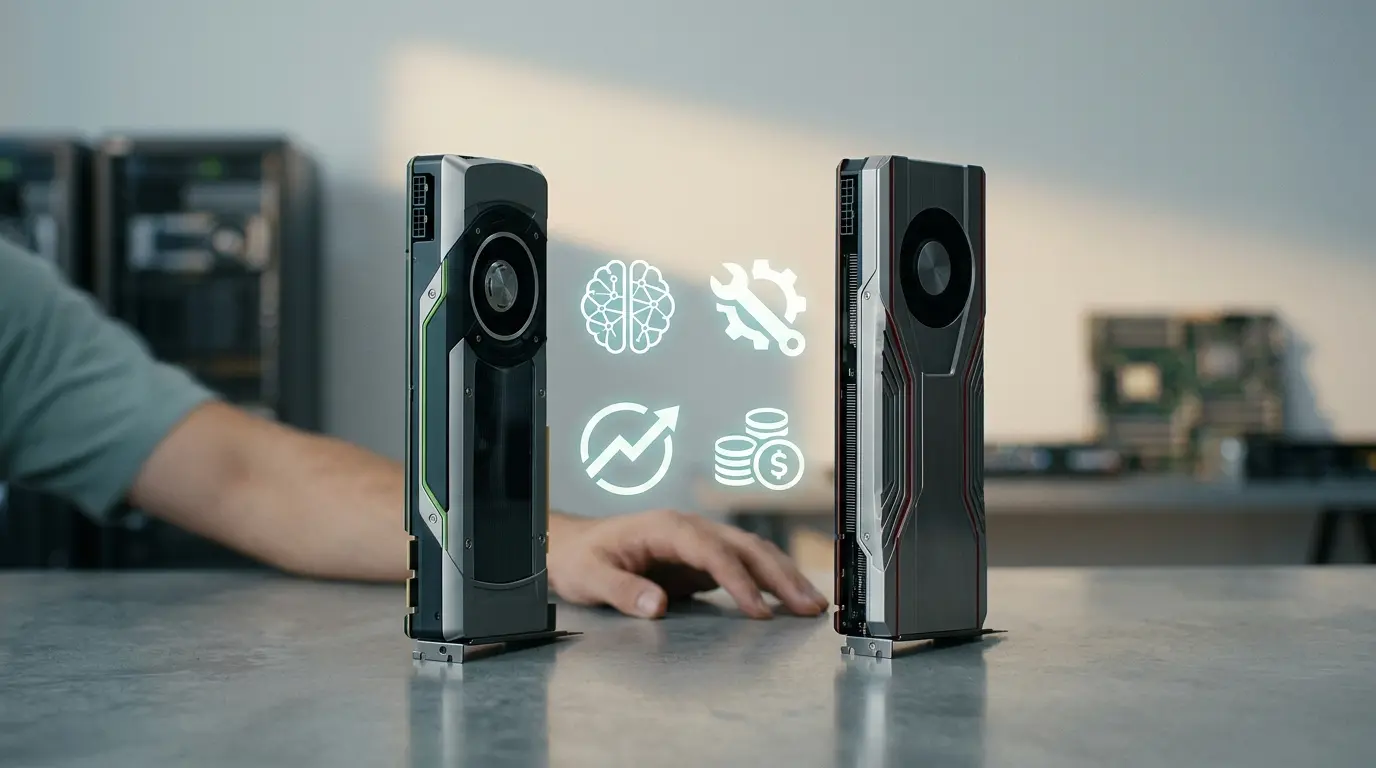
Nvidia is the stronger default for most organizations that want the broadest AI software compatibility, the largest pool of experienced engineers and the most mature path from a single GPU to a complete rack-scale system. AMD is the strongest direct alternative when memory capacity, open standards, supply diversification or negotiated total cost justify the additional validation work.
That is a starting conclusion, not a universal winner. A model-training team with years of CUDA code has a different decision from a cloud buyer deploying a standard PyTorch model. An inference service constrained by high-bandwidth memory has a different bottleneck from a research cluster constrained by interconnect efficiency. A specification table cannot settle those cases.
This guide compares Nvidia and AMD as complete AI platforms: accelerators, memory, interconnects, rack designs, software, cloud availability, support and migration. For Nvidia's wider hardware and software map, read our complete Nvidia AI guide. For every other challenger beyond AMD, use our Nvidia competitors guide.
Nvidia versus AMD for AI at a glance
| Decision area | Nvidia | AMD | Practical interpretation |
| Current accelerator families | Hopper, Blackwell, Blackwell Ultra and the Rubin transition | MI300, MI350/MI355X and the MI400/MI455X transition | Compare products that are actually available in the same region and form factor |
| Main software platform | CUDA and CUDA-X | ROCm | CUDA has the broader mature ecosystem; ROCm has improved rapidly and emphasizes open development |
| Framework path | Extensive native and vendor-optimized support across mainstream AI software | Strong PyTorch support plus expanding JAX, TensorFlow and serving support | Test every framework, library, custom operator and extension in the actual application |
| High-bandwidth memory | Strong across H200, Blackwell Ultra and Rubin systems | AMD frequently emphasizes larger per-GPU memory configurations | More memory can reduce sharding, but it does not automatically produce higher end-to-end performance |
| Scale-up fabric | NVLink and NVLink Switch | Infinity Fabric, UALink and UALink over Ethernet in Helios | Nvidia supplies a highly integrated proprietary route; AMD emphasizes open industry standards |
| Scale-out networking | InfiniBand and Spectrum-X Ethernet, plus BlueField DPUs | Pensando Ethernet, UEC-oriented networking and partner ecosystems | Network behavior can decide distributed training performance more than peak chip FLOPS |
| Rack-scale platform | HGX, DGX, GB200/GB300 NVL systems and future Rubin systems | Helios reference architecture and OEM systems | Compare deliverable systems, not only reference diagrams |
| Cloud availability | Broad across all major cloud providers and specialist GPU clouds | Available through a growing but smaller set of cloud and OEM routes | Availability, reservation terms and support may outweigh theoretical chip advantages |
| Developer familiarity | Very high | Growing | Existing code and operational knowledge have economic value |
| Portability strategy | Deep vertical integration; substantial platform switching cost | More explicit use of open standards; ROCm still creates its own compatibility requirements | “Open” does not mean zero migration work |
| Best default fit | Fast deployment, broad compatibility and large existing CUDA estates | Second-source strategy, memory-heavy workloads and buyers willing to validate | Benchmark the complete service before standardizing |
The first rule: compare equivalent products
“Nvidia GPU versus AMD GPU” is often too vague to be useful. Each company sells processors inside several levels of product:
- a bare accelerator or module;
- a PCIe card;
- an eight-GPU server platform;
- a rack-scale system;
- a complete cluster with scale-out networking;
- or a cloud instance with provider-specific CPUs, storage, networking and software.
An Nvidia H200 PCIe card is not a direct equivalent to a liquid-cooled GB300 NVL72 rack. An AMD MI355X module is not the same purchasing object as the 72-GPU Helios reference architecture. Even two cloud instances using the same accelerator can have different CPU ratios, network bandwidth, local storage and tenancy.
Build the comparison at the level being purchased. If the procurement unit is a cloud service, compare cloud services. If it is a rack, include the rack. If it is a production endpoint, compare the endpoint's accepted tokens, latency and cost rather than the accelerator alone.
Current Nvidia and AMD AI hardware
Product roadmaps move quickly. The summary below is current through August 7, 2026 and should be checked before publication or purchase.
Nvidia's current path: Blackwell Ultra to Rubin
Nvidia's deployed high-end platform centers on Blackwell and Blackwell Ultra. Products include individual accelerators, HGX server platforms, DGX systems and NVL rack-scale configurations that combine GPUs, Grace CPUs, NVLink switches and networking.
The GB300 NVL72 combines 72 Blackwell Ultra GPUs and 36 Grace CPUs in one liquid-cooled rack-scale system. Nvidia describes approximately 20 TB of GPU memory and 130 TB/s of aggregate NVLink bandwidth for the rack. The DGX B300 packages eight Blackwell Ultra GPUs in a 10U system with roughly 2.1 TB of total GPU memory.
Nvidia's Vera Rubin platform is the next transition. Nvidia says Rubin chips are in production and partner systems are scheduled for the second half of 2026. Procurement teams should distinguish announced silicon, qualification samples, partner system availability and capacity they can actually reserve.
For the generation and form-factor detail, use our Nvidia AI GPU guide.
AMD's current path: MI355X to MI455X and Helios
AMD's MI350 series includes the Instinct MI355X. AMD publishes 288 GB of HBM3E memory, 8 TB/s of peak memory bandwidth and a 1,400-watt typical board power for the OAM module.
The next-generation MI400 series includes the MI455X, which AMD positions for training, fine-tuning and inference in the Helios rack-scale design. AMD publishes up to 432 GB of HBM4 per MI455X and 23.3 TB/s of peak theoretical memory bandwidth.
AMD's Helios is a 72-GPU rack-scale reference architecture combining MI455X accelerators, EPYC CPUs and Pensando networking. It is based on standards including Open Rack Wide, UALink and Ultra Ethernet. AMD itself describes Helios as a reference design, so a buyer must identify the OEM system, delivery date, supported configuration and service contract rather than treating the web page as a universally orderable product.
Do not compare vendor performance bars as neutral benchmarks
Both vendors publish favorable performance comparisons. Those figures can be useful for identifying a workload to test, but they are not a substitute for a neutral benchmark.
Check:
- whether both systems use the same model and model version;
- precision and quantization;
- batch size and sequence length;
- input and output token mix;
- latency target;
- software versions;
- number of accelerators;
- sparsity assumptions;
- power limit;
- and whether the result is measured, projected or peak theoretical.
A higher peak FP4 number does not prove faster BF16 training. A high token-throughput figure can conceal unacceptable time to first token. A benchmark optimized by the hardware vendor can differ substantially from an internal application with custom operators and imperfect data pipelines.
Memory capacity: AMD's clearest hardware argument
High-bandwidth memory determines how much model state, activation data and key-value cache can remain close to the accelerator. Insufficient memory can force tensor or pipeline parallelism, CPU offload, smaller batches or more aggressive quantization.
AMD has made memory capacity a central part of its competitive position:
- MI355X: 288 GB HBM3E per accelerator;
- MI455X: up to 432 GB HBM4 per accelerator, according to AMD's published specification;
- Helios: 31 TB of aggregate HBM4 across 72 MI455X GPUs, according to AMD.
Nvidia's H200, Blackwell Ultra and Rubin platforms also supply very large HBM pools, especially at system and rack scale. The relevant question is not “which vendor has the largest number?” It is whether the target workload fits efficiently at the required parallelism.
Larger local memory can help when it:
- keeps a model or larger shard on one accelerator;
- supports longer context and larger key-value caches;
- reduces cross-device communication;
- accommodates mixture-of-experts routing and activation peaks;
- or allows a useful batch size without offload.
It may offer little benefit if the workload is compute-bound, the serving engine cannot exploit the capacity, or the system's network and software become the bottleneck.
CUDA versus ROCm
The software comparison is more important than most hardware tables.
Nvidia CUDA
CUDA is Nvidia's parallel-computing platform and programming model. Its advantage is not only the compiler. It includes mature drivers, profiling tools and optimized libraries for dense linear algebra, deep learning, communication, inference, data processing and many domain-specific workloads.
Mainstream frameworks usually support Nvidia first. Many open-source projects publish CUDA containers, kernels, installation instructions and benchmark paths before other backends. Organizations also benefit from a large labor pool familiar with CUDA debugging and operations.
That maturity creates switching cost. A workload may depend on:
- custom CUDA C++ kernels;
- CUDA-specific extensions;
- NCCL communication behavior;
- TensorRT or TensorRT-LLM;
- Triton kernels tested only on Nvidia;
- third-party tools certified for particular CUDA versions;
- or container images built around Nvidia drivers.
Our separate guide explains what CUDA is and why it matters.
AMD ROCm
ROCm is AMD's open software platform for GPU computing. It includes drivers, compilers, communication libraries, math libraries, developer tools and framework integrations.
ROCm has improved substantially. AMD documents mainstream PyTorch support and a growing environment for JAX, TensorFlow, Hugging Face, vLLM and distributed training. AMD also publishes source and works through upstream projects rather than relying only on a closed application layer. Its release history reached ROCm 7.14.0 by August 2026.
The remaining question is not whether ROCm “supports PyTorch” in the abstract. It is whether the exact workload works at production quality:
- correct accelerator and operating-system support;
- required PyTorch or JAX release;
- custom operations;
- quantization library;
- serving engine;
- distributed-training stack;
- profiler and observability;
- Kubernetes integration;
- security patch cadence;
- and commercial support.
A model that launches successfully is only the beginning. It must train or serve reliably at the required scale.
HIP is not an automatic CUDA conversion
AMD's HIP can help port CUDA-like code to a portable C++ environment. Automated conversion tools can replace many APIs and provide a starting point.
They cannot guarantee equivalent behavior or performance. Manual work may still be required for:
- vendor-specific intrinsics;
- hand-tuned kernels;
- memory-layout assumptions;
- warp- versus wavefront-level behavior;
- assembly or low-level code;
- proprietary libraries;
- and performance tuning.
Treat porting as an engineering project with test coverage and a maintained second backend, not a one-time search-and-replace exercise.
Framework and model compatibility
A platform should be evaluated against the software inventory, not a generic logo list.
Usually straightforward
Common PyTorch models using standard operators can often run on both platforms with limited application changes. Containers and framework packages are increasingly available for AMD, especially for popular language-model and inference workloads.
Often requires more validation
The risk rises with:
- custom CUDA extensions;
- rapidly changing research repositories;
- uncommon quantization formats;
- fused kernels tied to one backend;
- sparse or graph workloads;
- specialist scientific libraries;
- reinforcement-learning stacks;
- and vendor-specific serving optimizations.
Create a dependency bill of materials before the benchmark. Record every framework, library, kernel, driver, plugin and container. A hardware alternative is not real until that software chain is reproducible.
Interconnect and rack-scale architecture
Large models make the fabric part of the computer.
Nvidia: tightly integrated NVLink plus scale-out networking
Nvidia combines NVLink and NVLink Switch for scale-up communication with InfiniBand or Spectrum-X Ethernet for scale-out. BlueField DPUs can offload infrastructure and security functions. Nvidia controls more of the stack, which can simplify integration and optimization.
The cost is dependence on Nvidia-specific technologies and validated configurations. A customer can use standard Ethernet in many deployments, but the highest-end rack designs are deeply co-engineered.
AMD: Infinity Fabric, UALink and Ethernet-led scale-out
AMD combines its own Infinity Fabric with UALink-oriented scale-up and Pensando Ethernet networking in Helios. The design emphasizes OCP, UALink and Ultra Ethernet standards, potentially allowing a broader supplier and system ecosystem.
Open standards can improve choice over time. They do not guarantee that the first implementation has the same maturity, tooling or operational history as Nvidia's established route. Validate collective performance, congestion behavior, fault recovery and service procedures on the specific OEM system.
Network questions that belong in every benchmark
Measure:
- all-reduce and all-to-all performance;
- effective bandwidth, not only link rate;
- latency under load;
- collective-compute overlap;
- topology-aware scheduling;
- congestion and incast behavior;
- link and switch failure recovery;
- checkpoint time;
- and performance after one node degrades.
A cluster that wins a clean benchmark but collapses during partial failure is not the better production platform.
Cloud and system availability
Nvidia's largest commercial advantage can be simple availability. Nvidia instances, systems and software are broadly offered by hyperscalers, specialist GPU clouds, server manufacturers and integrators. That provides more regions, purchasing models and engineers with operational experience.
AMD availability is expanding through clouds and OEMs, but it is less uniform. A product announcement does not prove that the desired instance can be reserved at scale in the required region.
Ask each supplier for:
- capacity available now;
- reservation start and minimum term;
- exact accelerator SKU;
- host CPU and memory;
- scale-up and scale-out topology;
- local and parallel storage;
- network oversubscription;
- support responsibility;
- replacement time;
- and software image versions.
The best accelerator that cannot be delivered is not the best infrastructure decision.
Performance: use the workload, not peak FLOPS
Peak operations per second are useful architectural indicators. They do not predict the complete service.
For training, measure
- time to train to a defined quality target;
- samples or tokens per second;
- scaling efficiency from one node to the target cluster;
- checkpoint overhead;
- failure and restart time;
- convergence behavior at the chosen precision;
- and consumed energy or cloud spend per completed run.
For inference, measure
- time to first token;
- inter-token latency;
- throughput at a fixed latency service level;
- tokens per second per accelerator and per rack;
- output quality at the chosen quantization;
- memory headroom at realistic context lengths;
- and cost per accepted million tokens.
For scientific and non-LLM workloads, measure
- the actual solver, simulation, recommender or analytics pipeline;
- required numeric precision;
- library coverage;
- host-device data movement;
- and end-to-end wall-clock time.
A system can dominate one transformer benchmark and underperform on a workload limited by CPU preprocessing, storage, communication or an unsupported operator.
Cost: purchase price is not total cost
A credible Nvidia-versus-AMD cost comparison includes at least:
- hardware or cloud rate;
- reservation and financing terms;
- networking;
- storage;
- power and cooling;
- software licenses;
- support;
- engineering and migration;
- utilization;
- downtime and replacement;
- and the number of systems required to meet the service level.
AMD may offer aggressive commercial terms to win strategic deployments. Nvidia may justify a higher acquisition price when software maturity, faster delivery or better utilization reduces engineering and idle capacity. Either claim has to be demonstrated in the complete workload.
Calculate cost per accepted result
For training:
Total run cost ÷ number of completed models meeting the quality target
For inference:
Total monthly platform cost ÷ accepted output volume at the required latency and quality
Include human repair and rejected output when AI quality differs between software paths. A cheaper token that produces more failures is not necessarily cheaper.
Power, cooling and facility compatibility
Both vendors' highest-end accelerators and racks can demand substantial power and liquid cooling. Compare the complete electrical and thermal design.
Check:
- rack power envelope;
- facility voltage and distribution;
- cooling-loop temperature and capacity;
- water and heat-rejection requirements;
- redundant power path;
- floor loading and dimensions;
- cable and service access;
- and the performance mode supported by the site.
A data centre may be able to host eight-GPU servers but not a dense 72-GPU liquid-cooled rack. In that case, cloud or a lower-density system can be the practical choice regardless of chip preference. Our DGX and AI-factory guide explains the surrounding infrastructure.
Support and operational maturity
Support must cover the complete failure chain. A production incident can involve an accelerator, firmware, driver, framework, communication library, network switch, container or model server.
Ask:
- who owns first response;
- whether the vendor can reproduce the complete configuration;
- escalation targets and response times;
- support for the selected framework versions;
- security advisory and patch process;
- replacement inventory;
- and whether the cloud, OEM and silicon vendor have coordinated support.
Nvidia benefits from a long-established ecosystem and integrated enterprise offerings such as Nvidia AI Enterprise. AMD can be fully supportable, but the buyer should verify who owns each layer in the chosen route.
When Nvidia is the better choice
Nvidia is usually the better starting point when:
- the organization already operates a significant CUDA estate;
- the workload uses CUDA-specific libraries or custom kernels;
- rapid deployment matters more than multi-vendor portability;
- broad cloud and OEM availability is required;
- the team wants an integrated rack and networking route;
- third-party enterprise software is certified primarily for Nvidia;
- or the cost of engineering delay is greater than a potential hardware discount.
When AMD is the better choice
AMD deserves serious evaluation when:
- per-GPU memory capacity can reduce parallelism or offload;
- the organization wants a credible second source;
- open rack and network standards are strategic requirements;
- the workload uses mainstream frameworks with limited custom CUDA code;
- AMD capacity is available sooner or under better commercial terms;
- a sovereign or large cloud deployment wants more control over the platform;
- or the buyer is willing to invest in ROCm optimization to reduce long-term dependency.
A practical dual-vendor strategy
A second platform is most valuable before the primary supplier becomes unavailable, not after.
A realistic dual-vendor plan can include:
- portable model definitions in PyTorch or JAX;
- backend-specific containers and lockfiles;
- a controlled set of supported accelerators;
- automated correctness tests on both backends;
- common service APIs above the runtime;
- separate performance baselines;
- a monthly or quarterly failover exercise;
- and procurement capacity on both platforms.
Do not pretend the stacks are identical. Preserve a shared application layer while allowing optimized backend implementations.
Benchmark checklist
Before choosing Nvidia or AMD:
- Select the exact deliverable system or cloud instance.
- Freeze the model, data, framework and precision.
- Define quality and latency acceptance criteria.
- Use production sequence lengths and batch distributions.
- Include data loading, checkpointing and output handling.
- Scale to the intended cluster size.
- Measure steady state and cold start.
- inject one realistic component failure.
- Price software, networking, staff and facility changes.
- Repeat the test with a second team reviewing the methodology.
Publish enough benchmark detail for another engineer to reproduce the result.
Common comparison mistakes
Comparing announced products with available systems
A roadmap processor is compared with a rack that can be deployed today.
Treating memory capacity as performance
Memory determines what can fit, not how fast every operation completes.
Treating peak low-precision FLOPS as application throughput
Precision, sparsity and utilization assumptions may not match the model.
Ignoring software migration
The hardware discount is counted; months of porting and ongoing dual-backend maintenance are not.
Benchmarking one GPU and buying hundreds
Distributed communication, storage and failures change the result.
Comparing list prices without commercial terms
Enterprise hardware is frequently sold through contracts, cloud reservations and bundles.
Letting the vendor choose the only benchmark
Use vendor help for optimization, but retain an internally controlled workload and acceptance criteria.
Frequently asked questions
Is Nvidia better than AMD for AI?
Nvidia is the safer general default because CUDA, third-party software, cloud access and operational experience are broader. AMD can be better for a specific workload, especially when memory capacity, open standards, availability or negotiated economics matter.
Is AMD a real alternative to Nvidia for AI training?
Yes. AMD Instinct accelerators and ROCm support large-scale training, and AMD is building a rack-scale platform around Helios. The exact model, libraries and cluster must still be validated before migration.
What is the AMD equivalent of CUDA?
ROCm is AMD's GPU-computing software platform. HIP provides a C++ programming route that can help port CUDA-oriented code, but ROCm and CUDA are not identical.
Can PyTorch run on AMD GPUs?
Yes, supported PyTorch builds run on ROCm. Compatibility depends on the accelerator, operating system, ROCm release, framework version and any custom extensions.
Does AMD have more memory than Nvidia?
Some current and announced AMD Instinct products publish more HBM per accelerator than directly compared Nvidia products. Compare the exact product and workload; rack memory, bandwidth, software and communication also matter.
Is ROCm as mature as CUDA?
ROCm has improved rapidly, but CUDA still has the broader mature ecosystem and longer production history. The meaningful test is whether the complete required software stack is stable and supported on the chosen AMD system.
Is AMD cheaper than Nvidia for AI?
It can be, particularly under negotiated contracts or when a memory advantage reduces system count. Public prices rarely provide a complete comparison. Include migration, support, utilization, networking, facility and operational cost.
Can the same model run on Nvidia and AMD?
Many standard PyTorch and JAX models can. Custom CUDA extensions, proprietary runtimes and backend-specific optimizations can require porting or replacement.
Which is better for AI inference?
It depends on model size, context, quantization, latency target, batch distribution and serving software. Benchmark time to first token, inter-token latency, throughput and cost at the required quality.
Should a company use both Nvidia and AMD?
A dual-vendor strategy can reduce supply and platform concentration when the workload and engineering organization can support it. It creates real testing and maintenance cost, so use it for selected services rather than assuming every workload must be portable.
Bottom line
Nvidia wins the default decision through software depth, ecosystem breadth and deliverable full-stack infrastructure. AMD wins the right to be tested through serious accelerators, large memory configurations, an improving ROCm stack and an open-standards rack strategy.
Choose neither from a marketing chart. Compare equivalent systems, run the production workload, include migration and facilities, test failure behavior and calculate cost per accepted result. The better AI platform is the one that meets the service level repeatedly—not the one with the largest isolated number.

byDavid Porter
Latest comments
Loading