What Does Nvidia Do? Company, Products and AI Strategy Explained
GuidesSaturday, 08 August 2026 at 23:00
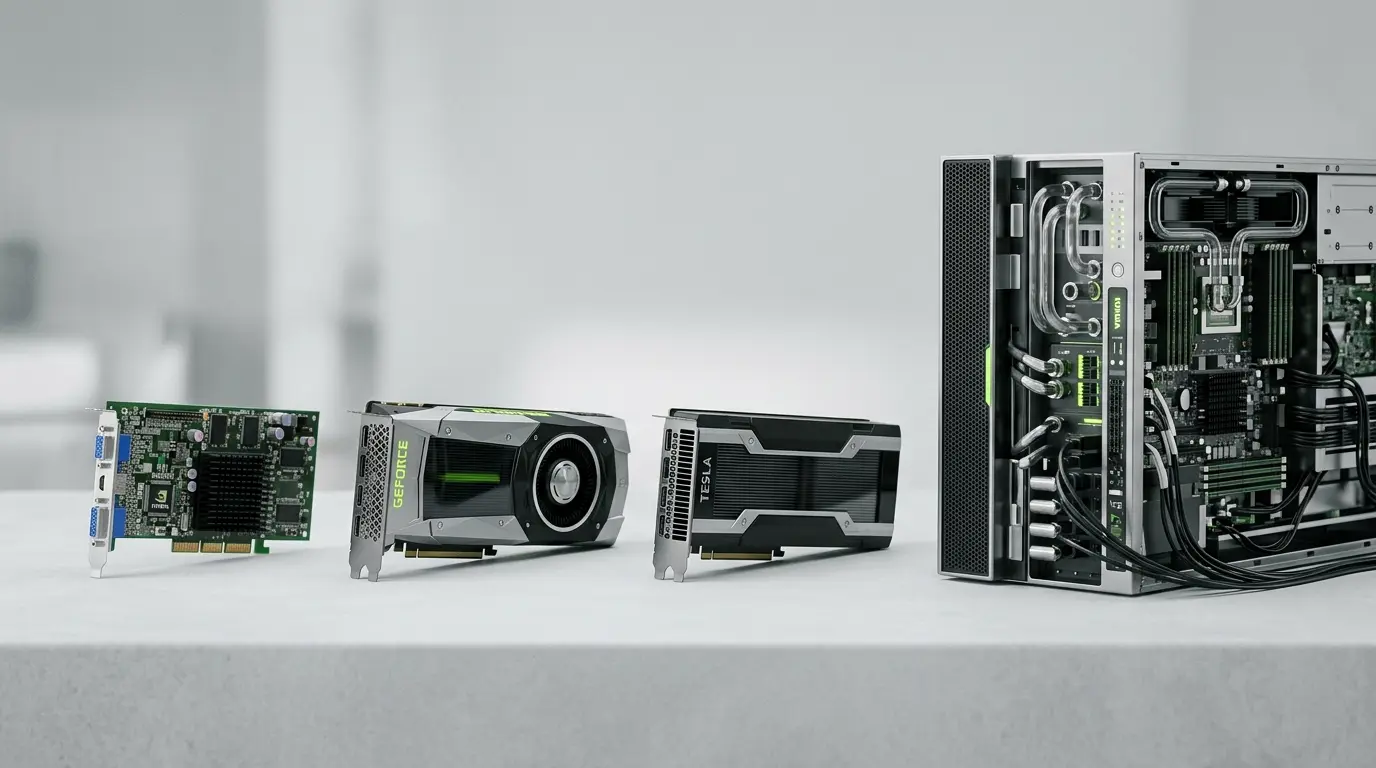
Nvidia designs computing platforms for artificial intelligence, graphics, data centres, robotics, vehicles and other accelerated workloads. The company is best known for graphics processing units, but its modern business also includes CPUs, networking, complete servers and racks, cloud services, developer tools, enterprise software, simulation platforms and embedded computers.
The simplest description—“Nvidia makes GPUs”—is therefore correct but incomplete. Nvidia increasingly designs the complete environment around the accelerator. It wants a customer to use Nvidia processors, connect them through Nvidia interconnects and networking, operate them through Nvidia systems and run software optimized for CUDA.
That strategy helped turn a company founded for PC graphics into the dominant supplier of infrastructure for the generative-AI boom. For the product stack itself, start with our complete Nvidia AI guide. This article focuses on the company: what it sells, how it developed and how the parts support one another.
Nvidia at a glance
| Question | Answer |
| What is Nvidia? | A US computing company that designs processors, networking, systems and software for accelerated computing and AI |
| Founded | April 5, 1993 |
| Founders | Jensen Huang, Chris Malachowsky and Curtis Priem |
| Headquarters | Santa Clara, California |
| CEO | Jensen Huang |
| Publicly traded? | Yes, on Nasdaq under NVDA |
| Best-known technology | Graphics processing units and CUDA |
| Largest current business | Data-centre computing and networking |
| Does Nvidia manufacture chips? | It uses a fabless model and relies on outside foundries and manufacturing partners |
| Main markets | Data centres, edge computing, gaming, professional visualization, automotive, robotics and industrial computing |
| Main strategic advantage | A tightly integrated hardware, networking and software platform with broad developer adoption |
Company facts and financial scale can change. This profile is current to August 7, 2026.
What products does Nvidia sell?
Nvidia's portfolio stretches from individual processors to data-centre-scale systems.
Data-centre GPUs and accelerated computing
Data-centre accelerators are the core of Nvidia's AI business. Product generations such as A100, H100, H200, Blackwell, Blackwell Ultra and Vera Rubin support model training, fine-tuning, inference, scientific computing and data processing.
The hardware guide to Nvidia AI GPUs explains those generations without mixing a GPU with the larger systems in which it is installed.
CPUs, DPUs and interconnects
Nvidia also designs:
- Grace data-centre CPUs;
- BlueField data-processing units;
- NVLink and NVLink switch technology;
- network adapters and switch silicon;
- InfiniBand systems;
- and Spectrum-X Ethernet infrastructure.
These products address the bottlenecks around the GPU. A fast accelerator is wasted when data, synchronization, storage or network traffic cannot keep pace.
DGX, HGX and rack-scale systems
Nvidia sells complete systems and supplies reference platforms to server manufacturers. DGX systems integrate compute, networking and software. HGX platforms are used by OEMs and cloud providers. NVL rack-scale products connect dozens of accelerators and CPUs into one designed unit.
The complete deployment layer—including storage, power and cooling—is covered in our guide to Nvidia DGX and AI factories.
CUDA and developer software
CUDA is Nvidia's parallel-computing platform and programming model. It is supported by compilers, libraries, debuggers, profilers, containers and integrations with major AI frameworks.
Nvidia says more than half of its engineers work on software. That statistic captures an important point: software is not merely included to help sell a chip. It is a strategic layer intended to make each generation easier to adopt and harder to replace. Read our dedicated explanation of Nvidia CUDA for the programming model and portability trade-offs.
Enterprise AI software
Nvidia sells paid software and support through Nvidia AI Enterprise and related products. It provides supported runtimes, model deployment, orchestration and development components for organizations that do not want to assemble a production stack from unsupported open-source pieces alone.
Our Nvidia AI Enterprise guide owns the current component, entitlement and pricing details.
Gaming and creator products
GeForce RTX remains Nvidia's consumer gaming brand. RTX technology also supports creators, 3D rendering and local AI. Gaming is no longer the largest source of revenue, but it remains strategically important for graphics innovation, distribution and developer relationships.
Professional visualization
Nvidia RTX professional products serve engineers, designers, researchers and media professionals. Omniverse connects visualization, simulation and collaborative industrial workflows with Nvidia's broader physical-AI strategy.
Automotive, robotics and edge computing
Nvidia DRIVE combines automotive compute and software. Jetson and related platforms support robotics and embedded AI. Isaac provides robotics tools and models, while Omniverse supports simulation and synthetic environments.
These products extend Nvidia beyond the data centre. Models can be trained and simulated on large systems, then deployed into vehicles, robots, factories, telecom infrastructure and other edge devices.
How did Nvidia become an AI company?
Nvidia did not begin by building artificial-intelligence data centres. Its transformation occurred through several compounding decisions.
1993: Nvidia is founded
Jensen Huang, Chris Malachowsky and Curtis Priem founded Nvidia on April 5, 1993. The initial opportunity was accelerated computer graphics, particularly for gaming and multimedia PCs.
1999: the GPU category
Nvidia promoted the GeForce 256 as the first GPU, helping establish graphics processing as a distinct, programmable computing category. The term later became much broader than consumer graphics.
2006: CUDA
Nvidia introduced CUDA as a way to use GPUs for general-purpose parallel computing. Researchers and developers could apply the hardware to scientific work, simulation, numerical processing and eventually deep learning.
CUDA was a long-term investment. A software ecosystem, libraries and developer skills had time to mature before generative AI created enormous commercial demand.
2012: AlexNet and deep learning
The AlexNet image-recognition result demonstrated the value of GPU acceleration for deep neural networks. It did not create Nvidia's AI business overnight, but it helped convince researchers that GPU-based training could unlock a new scale of machine learning.
2020: Mellanox expands networking
Nvidia acquired Mellanox, adding InfiniBand, Ethernet and networking expertise. This became increasingly important as AI moved from individual GPUs to clusters containing thousands of accelerators.
2024 onward: Blackwell and rack-scale computing
Blackwell represented more than another GPU generation. Nvidia designed platforms around large scale-up domains, liquid cooling, networking, Grace CPUs and complete racks. The company now describes the data centre as the unit of computing.
The shift continued with Blackwell Ultra and Vera Rubin, alongside inference software and new networking products. Nvidia's stated goal is to optimize the entire AI factory rather than compete on a single processor specification.
Is Nvidia a chip manufacturer?
Nvidia designs chips, but it does not operate the leading-edge fabrication plants that physically manufacture its advanced wafers. It follows a fabless model.
Nvidia's fiscal 2026 filing names TSMC and Samsung as foundry partners, SK Hynix, Micron and Samsung as memory suppliers, CoWoS as an advanced-packaging technology, and Hon Hai, Wistron and Fabrinet among its assembly, testing and packaging partners.
This model provides several advantages:
- Nvidia can concentrate engineering and capital on design, systems and software;
- it can use specialized manufacturing companies with enormous fabrication expertise;
- it avoids the fixed cost of owning advanced fabs;
- and it can work across multiple manufacturing and assembly partners.
It also creates dependency. Leading-edge wafer capacity, HBM supply, advanced packaging, substrates and system assembly can all limit delivery. Read the full guide to Nvidia, TSMC and the AI chip supply chain for the physical flow from design to data centre.
How is Nvidia organized as a business?
Historically, Nvidia reported two accounting segments:
- Compute & Networking, covering data-centre platforms, networking, AI software and automotive;
- Graphics, covering gaming and professional visualization.
In the first quarter of fiscal 2027, Nvidia announced a new market-platform framework centered on Data Center and Edge Computing. Within Data Center, it planned to distinguish Hyperscale from ACIE, a category combining AI clouds, industrial and enterprise customers. Edge Computing covers PCs, consoles, workstations, robotics, automotive, telecom and other devices where AI is processed closer to use.
The reporting change reflects how management now sees the company. Gaming, graphics, automotive and robotics have not disappeared. They are increasingly connected through one accelerated-computing strategy.
How does Nvidia make money?
Nvidia earns most of its current revenue from selling data-centre compute and networking platforms, directly or through server manufacturers, distributors, system integrators and cloud providers.
Additional revenue comes from:
- gaming GPUs and related products;
- professional visualization;
- automotive platforms and development arrangements;
- networking hardware;
- enterprise software subscriptions and support;
- cloud and hosted services;
- and other platform products.
Fiscal 2026 revenue reached $215.9 billion, with $193.7 billion attributed to Data Center under the then-current market reporting. In the first quarter of fiscal 2027, Nvidia reported $81.6 billion in total revenue and $75.2 billion in Data Center revenue.
Those figures demonstrate scale but age quickly. Our guide to how Nvidia makes money from AI owns the dated financial tables, margins, customer concentration and business risks.
What is Nvidia's AI strategy?
Nvidia's strategy has five connected parts.
Sell a platform, not an isolated component
A customer can buy or rent Nvidia compute, networking, systems and software together. That increases the amount Nvidia can earn from an AI deployment and reduces integration risk for the buyer.
Make software portable across Nvidia generations
CUDA and Nvidia libraries help applications move from one Nvidia generation to the next without starting over. Backward and forward compatibility are not perfect, but the ecosystem protects customer investment better than a completely new programming environment each cycle.
Increase the unit of sale
The business moved from add-in graphics cards toward accelerator modules, eight-GPU systems and complete racks. The larger unit lets Nvidia optimize communication and capture more of the infrastructure budget.
Support every delivery channel
Nvidia works with public clouds, specialist GPU clouds, OEMs, sovereign projects, enterprises and data-centre operators. This broad availability makes Nvidia a default target for software developers.
Expand AI into industries and the physical world
Nvidia develops platforms for healthcare, manufacturing, robotics, telecom, vehicles and scientific computing. The same underlying accelerated-computing model can support many markets.
Who buys Nvidia products?
Nvidia's direct customers are often not the final users. A cloud provider, system integrator or server manufacturer can buy systems that are then used by an AI laboratory or enterprise.
Major customer groups include:
- hyperscale cloud and internet companies;
- AI model developers;
- server and system manufacturers;
- specialist GPU-cloud providers;
- national and sovereign AI programs;
- enterprises and industrial companies;
- universities and research laboratories;
- automotive manufacturers;
- game developers and consumers;
- and robotics and edge-computing developers.
This channel structure creates reach but also concentration. Nvidia disclosed that in fiscal 2026 one direct customer represented 22% of revenue and another represented 14%, primarily in Compute & Networking. The named end users behind indirect demand are not necessarily the same as the invoiced direct customers.
Who owns Nvidia?
Nvidia is a public company. Its shares are owned by institutional investors, funds, employees, executives and individual shareholders. No single founder owns the entire company.
Jensen Huang is a co-founder, chief executive and significant shareholder, but “Nvidia is owned by Jensen Huang” would be inaccurate. Public-company ownership changes continuously as shares trade.
What makes Nvidia difficult to compete with?
Hardware and software are co-designed
Nvidia can optimize processors, memory, interconnects, libraries and frameworks together. A competitor with a strong chip still has to deliver a usable software and system environment.
CUDA has accumulated adoption
Developers, universities, models, containers and enterprise workflows have been built around CUDA for years. Migration requires engineering time and testing, not merely a purchase order for another accelerator.
Networking closes the cluster gap
Nvidia's networking portfolio helps it sell the complete data-centre architecture. This is increasingly important as model performance depends on communication among large numbers of devices.
The ecosystem reinforces itself
Clouds stock Nvidia because customers request it. Developers optimize for Nvidia because the hardware is widely available. Customers request it because software and talent are available. Breaking that cycle requires a competitor to win across several layers at once.
Nvidia's principal risks
Customer concentration
A small number of direct and indirect buyers can influence quarterly demand. Hyperscalers may also develop custom chips.
Supply-chain dependence
Nvidia relies on external foundries, memory suppliers, packaging and manufacturers. Rapid demand can create non-cancellable commitments and inventory risk as well as shortages.
Export controls and China
US restrictions have repeatedly limited which advanced products Nvidia can sell to China. Chinese policy and domestic competitors add another layer of uncertainty.
Competition
AMD competes in merchant accelerators. Google, Amazon and Microsoft build custom silicon. Huawei develops an alternative Chinese platform. Intel and specialist companies target particular workloads. Our guide to Nvidia's competitors maps the complete field.
Technology cycles
Nvidia has committed to a rapid release cadence. Delays, design problems, poor yields or a competitor's architectural breakthrough could disrupt the platform.
AI investment returns
Nvidia benefits when customers keep expanding infrastructure. If AI services fail to produce enough economic value, capital spending could slow even while AI usage continues.
Power and construction constraints
A delivered rack is not useful without grid capacity, cooling, networking, land and operational readiness. Data-centre constraints can delay demand or shift it among regions.
Frequently asked questions
What does Nvidia actually do?
Nvidia designs accelerated-computing platforms: GPUs, CPUs, networking, systems and software used in data centres, gaming, visualization, vehicles, robotics and industrial applications.
Does Nvidia make AI models?
Yes. Nvidia publishes and supports models and model frameworks, including families for generative and physical AI. Its primary business, however, is the infrastructure and platform used to build and operate AI.
Is Nvidia only a hardware company?
No. CUDA, libraries, development tools, enterprise software, cloud services and domain platforms are central to its strategy.
Who founded Nvidia?
Jensen Huang, Chris Malachowsky and Curtis Priem founded the company in 1993.
Who is the CEO of Nvidia?
Jensen Huang is co-founder, president and chief executive.
Does Nvidia own TSMC?
No. TSMC is an independent foundry and a major manufacturing partner.
Why did Nvidia buy Mellanox?
Mellanox added high-performance networking and interconnect expertise, helping Nvidia design complete data-centre-scale systems rather than only accelerators.
Is gaming still important to Nvidia?
Yes. Gaming remains a large business and an important technology and developer ecosystem, even though Data Center is now much larger financially.
Is Nvidia a monopoly?
Nvidia has a powerful position, but it faces competition from merchant GPUs, custom cloud chips, Chinese accelerators, CPUs and specialist systems. Whether conduct raises competition-law concerns is a legal and market-specific question, not answered by market share alone.
Can Nvidia keep growing at the same rate?
No growth rate is guaranteed. Future results depend on AI spending, customer returns, supply, competition, export rules, product execution and data-centre construction.
Bottom line
Nvidia designs the computing platform on which much of modern AI runs. Its evolution from graphics to artificial intelligence was not a sudden rebranding. Programmable GPUs, CUDA, deep-learning adoption, networking and complete systems accumulated over decades.
The company now tries to optimize and monetize the whole AI factory: accelerator, CPU, interconnect, network, rack, software and support. That integration is its greatest competitive strength. It is also why Nvidia depends on continued infrastructure investment, a concentrated manufacturing chain and customers willing to build around its platform.
For current earnings, launches, investments and policy developments, follow AI World Today's Nvidia news.

byDavid Porter
Latest comments
Loading