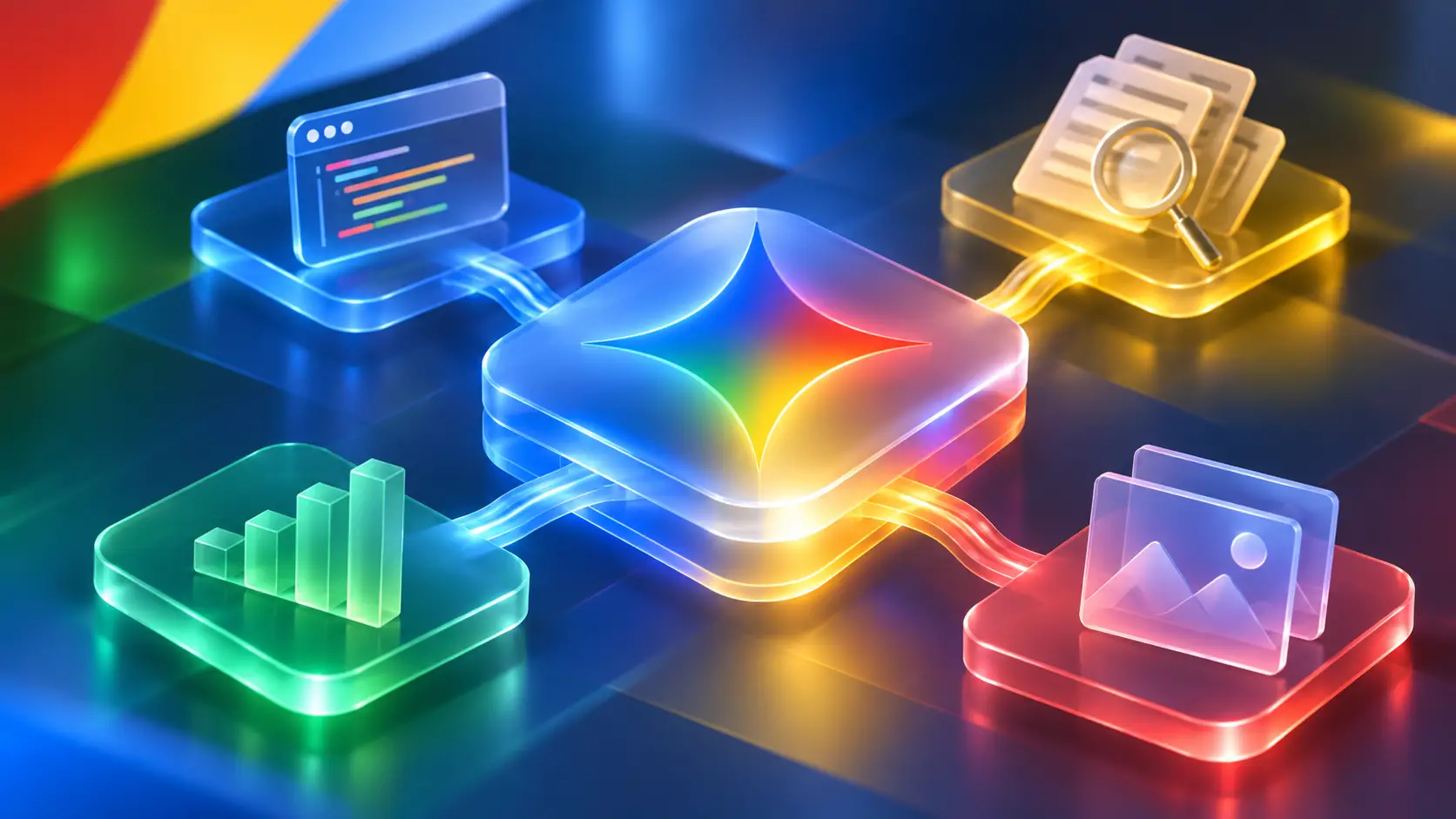
Google is making its new AI model, Gemini 4 Carbon, more widely available. Developers and business customers can use it through paid services, while Google AI Ultra subscribers can access it through the Gemini app, Google Antigravity and more.
At the same time, Google is introducing a new feature that lets multiple AI agents work on the same task. Called /swarm, it is currently available as a preview in the Antigravity development environment.
Gemini 4 Carbon takes on complex tasks
Google describes Gemini 4 Carbon as its most powerful model to date.
It is built for tasks that go beyond a quick answer, requiring an AI model to conduct in-depth research, write code, check its work and carry out multiple steps.
That could mean analyzing large volumes of documentation, investigating complex software bugs, or preparing technical and scientific analyses.
Google first introduced Carbon to a select group of security specialists in late October. AI Wereld covered that limited initial launch of Gemini 4 Carbon.
With its latest announcement, Google is expanding access.
Google positions Carbon alongside Gemini 4 Argon. Argon remains the better fit for many everyday coding and knowledge tasks, the company says, while Carbon is designed for work that demands deeper reasoning and sustained checking.
That distinction matters economically, too. Not every AI request needs an expensive model that reasons at length.
One task can put a team of AI agents to work
The standout new feature is /swarm in Google Antigravity.
It lets developers break a large task into smaller jobs handled by multiple AI agents. Each agent gets a clearly defined role, while the system coordinates their work.
For example, one agent could investigate how an application should work, while others write code, test components and look for bugs.
According to Google, different AI models can work together. Carbon can handle the more demanding reasoning, while lighter models take on other tasks.
The agents work in separate environments and can check one another’s results.
Google has shown demos in which agents use historical photos, technical drawings and other documents to build interactive 3D environments.
These demos show what the system can produce under the conditions presented. They do not prove that any user can create a flawless application with a single prompt.
For larger software projects, architecture, permissions, testing and human review still matter. A working demo does not guarantee that an application is secure or easy to maintain.
The swarm feature is also still in preview, so users should expect limitations and changes.
How much does Gemini 4 Carbon cost?
Google is making Carbon available through the paid version of its API in Google AI Studio.
The introductory price is $2 per million input tokens and $10 per million output tokens. Google says that matches Gemini 4 Argon’s introductory pricing.
Tokens are small pieces of information an AI model processes. The more text, code or other information an application handles and generates, the higher the bill can be.
For longer tasks, then, the price per token is only part of the equation. The number of steps and the amount of reasoning required also affect the total cost.
An agent that runs multiple checks or repeatedly reviews large documents can use far more tokens than a standard chatbot prompt.
For consumers, Carbon is available through Google AI Ultra. Google lists the Gemini app, Google Antigravity and AI Mode in Search as ways to access it.
Access is rolling out gradually. That does not mean every free Gemini user can select Carbon right away.
Features may also vary by country, account and product.
Google touts strong results in coding and research
Google has published several benchmark results in which Carbon performs well.
According to the official announcement, the model ranks first on benchmarks including CursorBench 4.0, Perplexity WANDR and Zapier AutomationBench.
These tests measure aspects of coding, research and automation.
Google also says that, on those specific benchmarks, the average cost per completed task is more than twice as low as that of the next-best external competitor.
That is a narrower claim than saying Carbon is the best or cheapest AI model in every situation.
The results depend on the test, how success is defined, how costs are calculated, and how a model uses its tools.
Google also reports strong results in financial analysis, report writing, and processing complex documents.
In a multimodal test developed with Artificial Analysis, Carbon ranks second. The test measures how well agents handle information across different file types.
Real-world use will show how well these results translate into everyday tasks for businesses and individual users.
More capabilities bring new safety concerns
A model that can conduct research, write code, and operate other software autonomously could take on a lot of work.
But when AI agents are allowed to make changes, the risks go beyond those posed by a chatbot that only provides answers.
A misunderstood instruction, for example, could introduce a bug into a program. If an agent also has access to files or external systems, the consequences could be more serious.
Google says Carbon has undergone extensive safety testing, including assessments of capabilities relevant to cybersecurity.
That cuts both ways. A more capable model could help security experts find vulnerabilities, but similar skills could also be misused.
For Antigravity users, the key questions are what permissions agents receive, how their actions are monitored, and whether mistakes can be easily undone.
With Carbon and /swarm, Google is taking another step toward AI systems that can work on a task autonomously for longer. The new features are now available to the paid user groups mentioned, but organizations will need to test for themselves how reliable they are over extended use.

Popular news
AI Engineer Compiles RISC-V Processor Inside Qwen 3.5 LLM Weights

AI stocks rebound, but Nvidia falls as AMD jumps 13%

White House Signals Conditional Openness To AI Guardrails Following Midterm Shifts

Homelabber Runs Massive AI Model on Discontinued Memory While Battling Severe Heat

Goldman Sachs Pulls the Plug on Vibe Coding for Traders