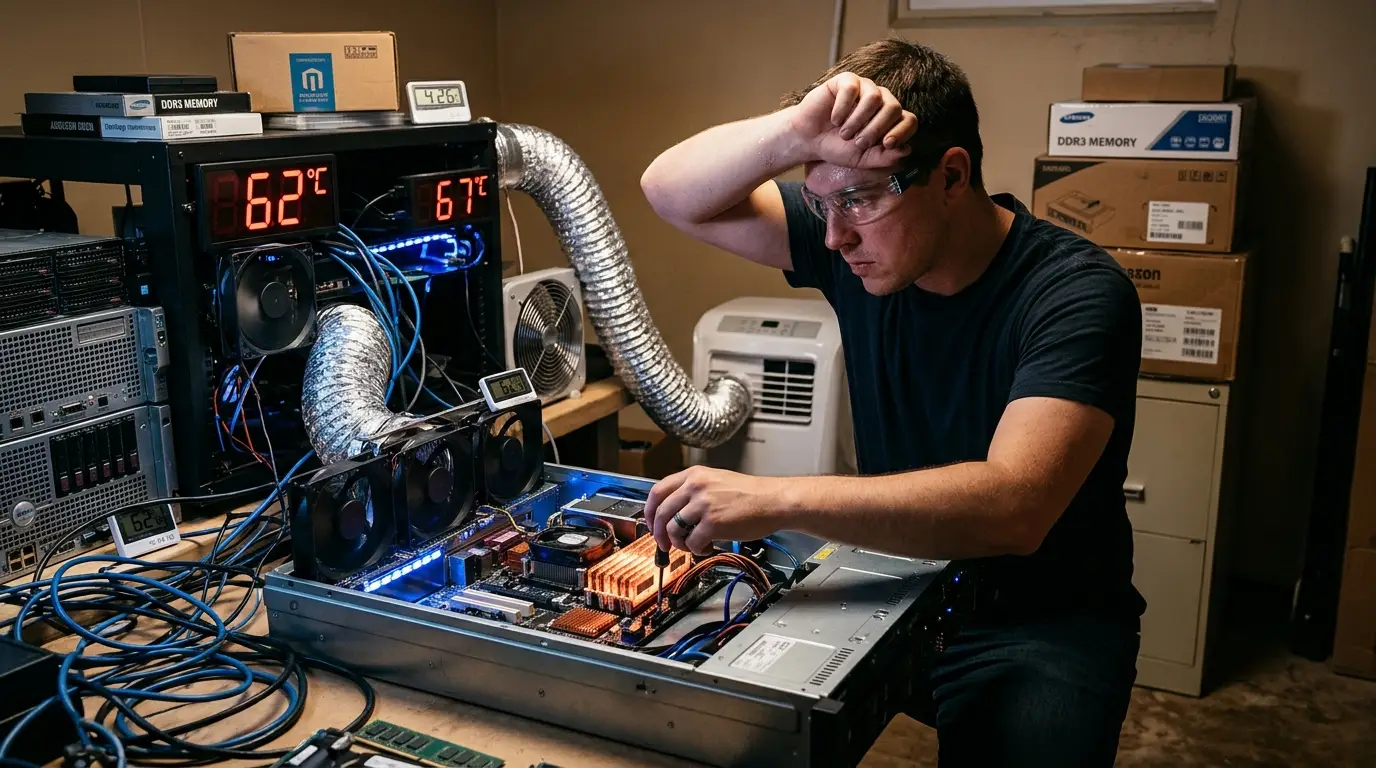
Running massive artificial intelligence models locally usually requires a cluster of expensive GPUs. However, one dedicated hardware enthusiast proved that sheer stubbornness and discontinued enterprise gear can get the job done. According to a recent report by Tom's Hardware, a homelab builder successfully executed Moonshot AI's colossal 2.8-trillion-parameter Kimi K3 model entirely on a CPU setup.
The secret sauce? Discontinued Intel Optane Persistent Memory (PMem 200) sticks. By cramming the massive neural network into these high-capacity memory modules and utilizing aggressive 1-bit quantization, the builder managed to squeeze out a processing speed of roughly 0.85 tokens per second. It is incredibly slow compared to modern GPU inference, but it fundamentally proves that massive language models can run without dedicated graphics silicon if you have enough system memory.
The Thermal Nightmare of High-Density Memory
Pushing legacy enterprise hardware to its absolute limits comes with severe physical consequences. Intel originally designed Optane to bridge the gap between standard RAM and NVMe storage, but the technology was notorious for running exceptionally hot. The builder issued a stark warning to the community: the sheer thermal load generated by the PMem 200 sticks under continuous AI workloads was enough to literally melt adjacent components.
To stop the extreme heat from frying the standard DRAM sitting right next to it, the enthusiast had to rig up custom blower fans directly over the memory slots. Without this aggressive, targeted airflow, the ambient heat inside the server chassis would quickly cause the surrounding memory modules to fail or catch fire.
Hardware Trade-Offs at Scale
While the feat is a massive flex for the DIY server community, it highlights the brutal reality of local AI deployment. Running multi-trillion parameter models on CPUs requires massive amounts of RAM, which brings immense power draw and thermal challenges. Below is a breakdown of how different high-capacity memory architectures stack up for local inference builds.
| Memory Architecture | Maximum Module Density | Thermal Profile | Ideal AI Workload |
| Optane PMem 200 | 512GB per stick | Extremely High (Requires active cooling) | Ultra-large CPU-based batch processing |
| Standard DDR5 RDIMM | 256GB per stick | Moderate (Passive chassis airflow) | Mid-sized fine-tuning and vector databases |
| HBM3e | 36GB per stack | High (Liquid cooled) | Real-time GPU tensor operations |
| CXL Attached Memory | 4TB+ per node | Low to Moderate | Distributed memory pooling |
Is Slower AI Worth the Hardware Hustle
Generating output at less than a single word per second means watching the cursor crawl across the terminal window. For most users, this is entirely impractical. Yet, for researchers and tinkerers, bypassing the artificial memory ceilings imposed by consumer graphics cards is a thrilling challenge. It also serves as a fascinating post-mortem for Optane, a brilliant technology that Intel ultimately killed off due to lack of mainstream profitability, but which lives on in the dusty, overheated server racks of hardcore builders everywhere.

Popular news

The Hidden Technical Debt Crisis Behind Prompt Driven Development
AI Engineer Compiles RISC-V Processor Inside Qwen 3.5 LLM Weights

South Korea Bets Big On Sovereign AI Infrastructure With NVIDIA Partnership

Amazon Shuts Down AI Educator Account Following Bulk Nvidia Hardware Orders

Asahi Linux Tightens Its License After AI Copying Complaints