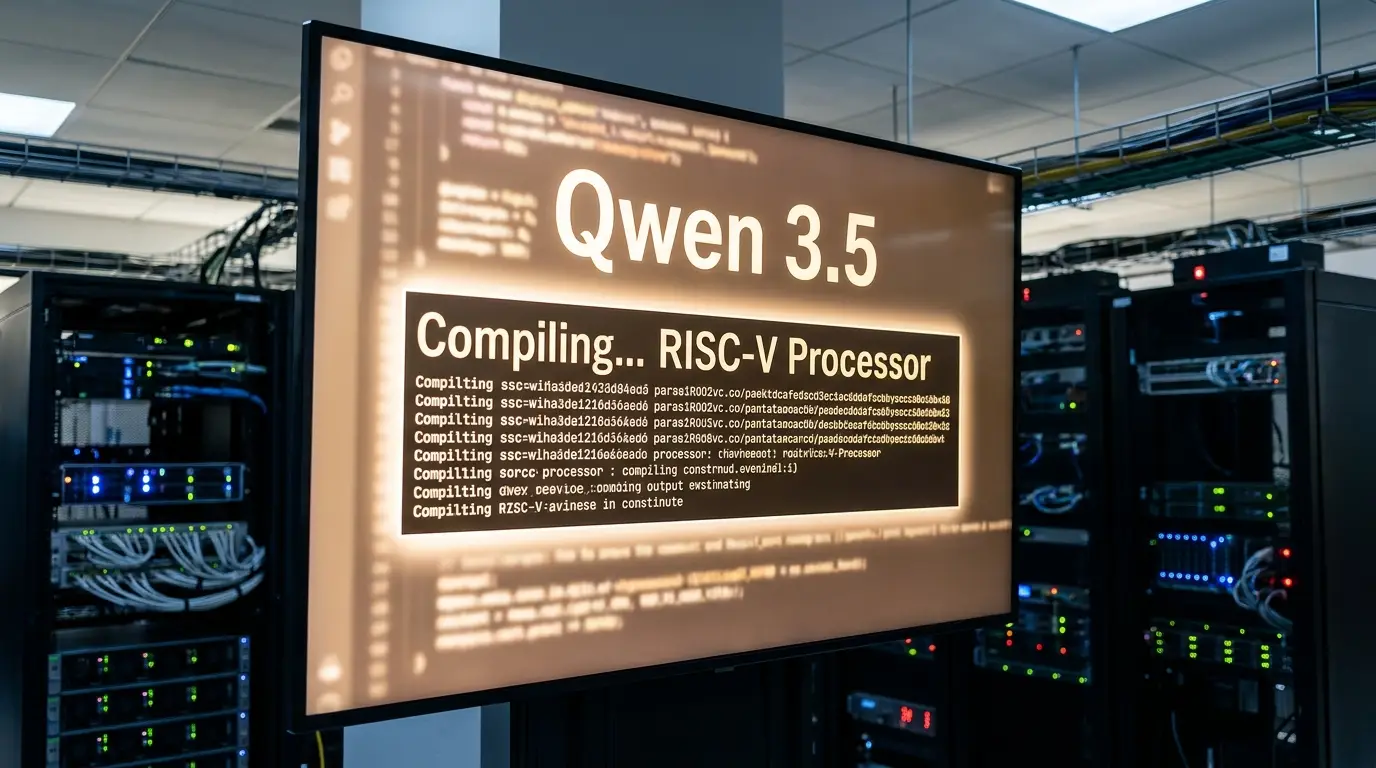
Large language models usually rely on external plugins, vector databases, or isolated Python sandboxes to execute code, but one developer decided to bypass the sandbox entirely. AI engineer Divyansh Agrawal recently built an experimental project called Qwenputer that literally compiles a functional computer into the neural matrices of a stock Qwen 3.5 4B model. Instead of generating text that tells an external interpreter what to do, the model actually processes machine code natively during standard inference. This turns a probabilistic text generator into a deterministic computing engine.
How a CPU Lives Inside Neural Weights
Getting a processor to run inside a neural network requires bending transformer architecture to mimic hardware logic gates. According to a detailed technical breakdown by Tom's Hardware, Agrawal managed to embed a full RV32IM RISC-V instruction set architecture directly into 11 extra transformer layers. The system cleverly uses a Gated DeltaNet state to function as system RAM, allowing the model to read and write memory states just like a physical motherboard. Because the logic is permanently baked into the model parameters, there are no API tool calls, network requests, or external dependencies required to run bare-metal binaries. It just runs.
Architectural Breakdown of Embedded Processing
| Component | Standard LLM Approach | Qwenputer Implementation |
| Execution Environment | External Python sandbox or API tool call | Internal transformer layer matrices |
| Memory Management | Vector database or context window | Gated DeltaNet state acting as RAM |
| Instruction Set | Python scripts or JSON formatting | Native RV32IM with Zba extension |
| Processing Overhead | Network latency to external interpreters | Zero-latency tensor multiplications |
| State Persistence | Cleared after each generation cycle | Maintained within recurrent hidden states |
Running Doom and Bare-Metal Code
The ultimate stress test for any unconventional computing environment is the classic 1993 shooter, and Qwenputer passes it with flying colors. The internal processor successfully renders the floor plan of Doom's E1M1 level entirely through raw tensor calculations, proving that graphical rendering can happen inside a language model's hidden states. Beyond retro gaming, the embedded core handles standard C code execution and MicroPython scripts natively. Every single arithmetic operation, register swap, and logic gate is executed purely via the language model's forward pass.
This approach proves that transformer weights can be hijacked to act as deterministic silicon. While not meant to replace your desktop processor, it opens up bizarre but fascinating pathways for localized, offline code execution. If an AI can simulate an entire operating system bare-metal within its own synapses, the line between software generation and actual hardware emulation has officially blurred.

Popular news

The Hidden Technical Debt Crisis Behind Prompt Driven Development

Amazon Shuts Down AI Educator Account Following Bulk Nvidia Hardware Orders

Developers Test Free Local AI Stack Against Premium Cloud Coding Agents

Global Media Leaders Forge AI Action Plan at Beijing Summit

South Korea Bets Big On Sovereign AI Infrastructure With NVIDIA Partnership