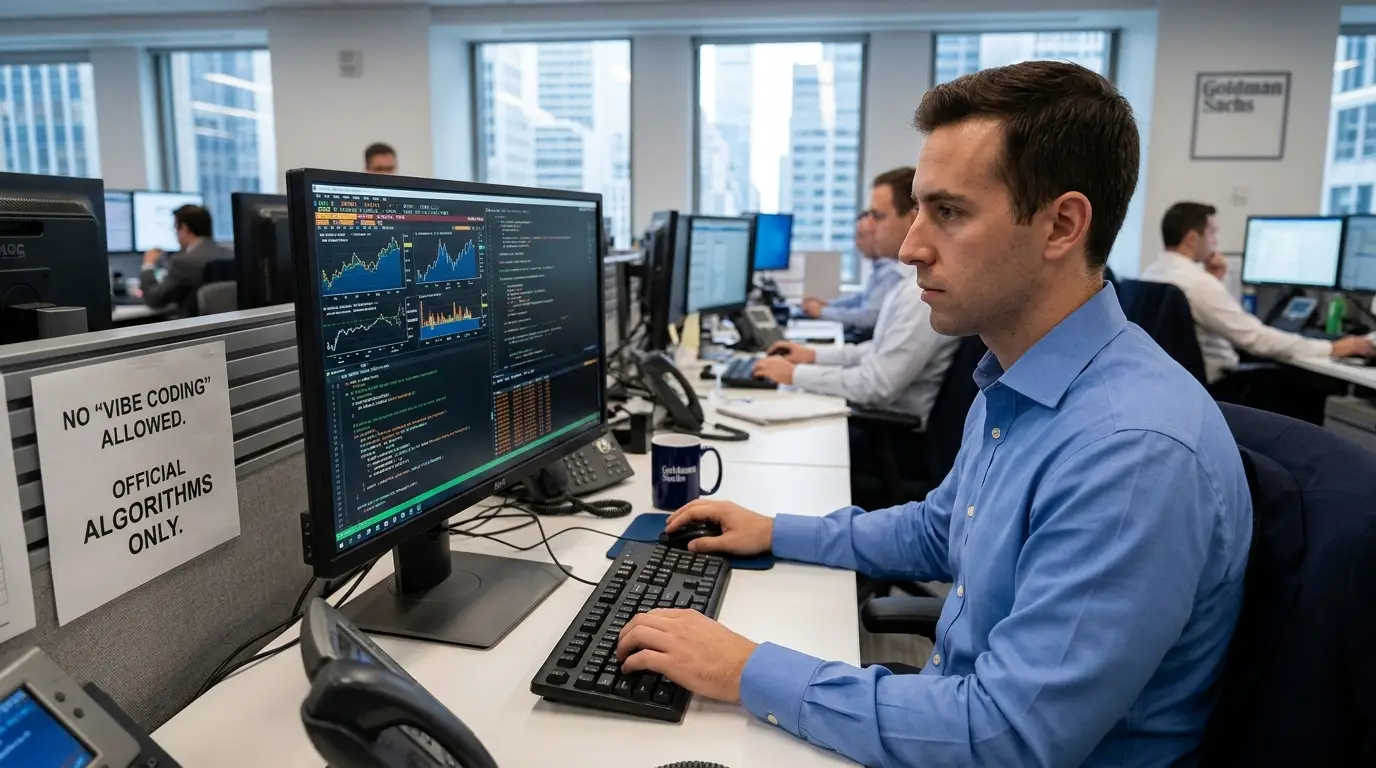
The era of letting Wall Street dealmakers write their own software with the help of generative AI is hitting a major speed bump at one of the world's largest banks. Goldman Sachs has officially restricted access to advanced coding assistants, effectively banning the controversial practice known as "vibe coding" for its non-technical staff.
The U-Turn on Wall Street's Favorite AI Trend
Coined earlier this year, vibe coding involves surrendering to AI suggestions and forgetting the underlying code even exists. As recently as July 2026, the firm was actively encouraging this workflow. Chief Information Officer Marco Argenti publicly praised the trend, noting that bankers and traders were building custom scripts to solve immediate problems, subsequently handing those raw creations over to Goldman's massive pool of 12,000 engineers for polishing and deployment.
That experimental phase has abruptly ended. Internal guidance updated this October explicitly limits the use of Anthropic's Claude Code and GitHub Copilot strictly to credentialed software engineers and "strats"—the hybrid quantitative strategists who sit at the intersection of trading and mathematics.
Why the Sudden Ban?
The reversal stems from an internal review of productivity metrics and mounting cybersecurity risks. Traders who relied on these AI assistants to monitor client flows, simulate market shifts, and generate visual data are now frustrated by the sudden loss of autonomy.
"We make certain AI tools available to our people to determine the best use cases across different parts of the firm," Goldman spokesperson Nick Carcaterra stated regarding the policy shift. "After a period of experimentation where we assess a variety of factors including productivity and risk management, we put them in the hands of those who are best suited to leverage them for the long term."
This isn't the first time the bank has reined in AI usage. Earlier this year, the firm implemented a location-specific restriction that blocked staff in Hong Kong from utilizing Anthropic’s Claude entirely due to regional data compliance mandates.
| Access Tier | Authorized Personnel | Permitted AI Capabilities | Primary Use Case |
| Tier 1: Unrestricted | Core Engineering Teams | Full IDE integration, deployment pipelines | Core application development |
| Tier 2: Sandboxed | Quantitative Strategists | Data modeling, script automation | Algorithmic trading models |
| Tier 3: Read-Only | Traders and Bankers | Text generation, market summaries | Client communications |
A Broader Industry Reckoning
Goldman’s crackdown highlights a massive governance headache sweeping through global finance. Banks are pouring billions into AI infrastructure while simultaneously battling "shadow IT"—unauthorized, AI-generated code running unchecked on corporate servers.
Across the street, JPMorgan Chase recently instituted a strict cost-allocation mandate, forcing employees to match specific tasks to appropriately priced AI models rather than burning expensive compute power on basic text summaries. Meanwhile, Goldman continues to profit massively from the AI boom, recently serving as the lead underwriter for Anthropic's highly anticipated initial public offering. Yet within its own trading floors, the message is clear: the vibe is over, and the compliance department is back in charge.

Popular news

The Hidden Technical Debt Crisis Behind Prompt Driven Development
AI Engineer Compiles RISC-V Processor Inside Qwen 3.5 LLM Weights
Asahi Linux Tightens Its License After AI Copying Complaints

AI stocks rebound, but Nvidia falls as AMD jumps 13%

Homelabber Runs Massive AI Model on Discontinued Memory While Battling Severe Heat