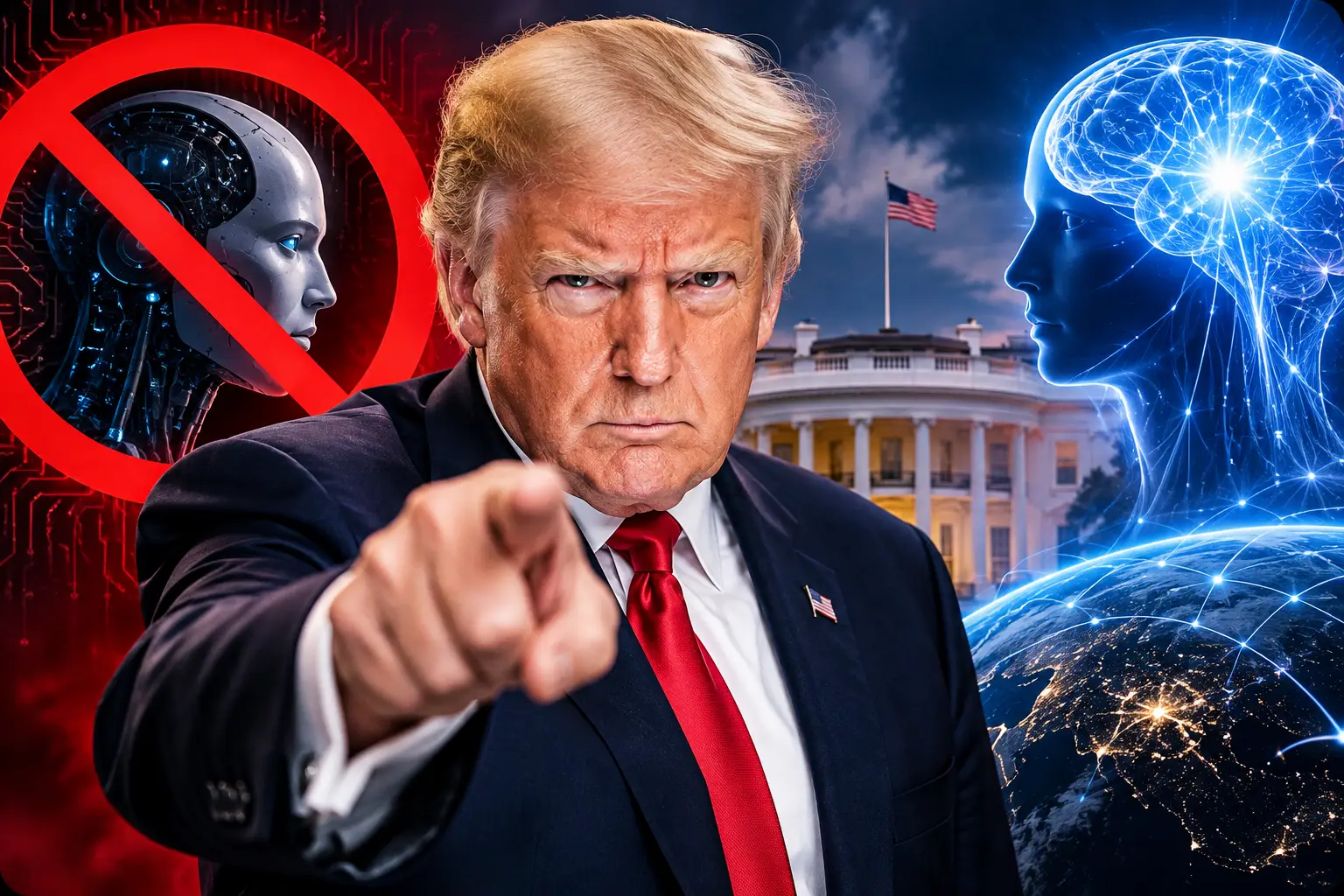
President Donald Trump has escalated his campaign to rename artificial intelligence, declaring that anyone who continues using the term “AI” instead of “Super Intelligence” is an enemy of the White House. The statement follows an executive order requiring federal agencies to adopt the new terminology, despite the two terms having fundamentally different meanings in computer science.
President Donald Trump has taken his effort to rename artificial intelligence to a new level.
In a Truth Social post published on October 8, 2026, Trump wrote:
The White House considers anyone that uses the term, “Artificial Intelligence,” as opposed to the highly accepted new and more accurate term, “Super Intelligence,” THE ENEMY!
The president signed the statement with his full name, Donald J. Trump.
The declaration follows a September 29 executive order that directs federal agencies to replace the words “Artificial Intelligence” and the abbreviation “AI” with “Super Intelligence” and “SI” in official communications.
The administration is no longer simply promoting a different name for the technology. Trump is now framing the continued use of its established terminology as opposition to the White House.
The distinction matters because artificial intelligence and superintelligence do not mean the same thing.
Trump already ordered federal agencies to stop calling it AI
On September 29, Trump signed Executive Order 14434, titled “Inaugurating the Era of Super Intelligence.”
The order requires executive departments and agencies to use “Super Intelligence” and “SI” instead of “Artificial Intelligence” and “AI” in official correspondence, public communications, websites, reports and other non-statutory documents, to the extent permitted by law.
Trump argues that the term artificial intelligence no longer captures the capabilities of modern systems.
The administration believes today's technology goes beyond imitating human intelligence and increasingly amplifies human creativity, scientific research and economic productivity.
Its official fact sheet describes the change as an attempt to recognize the technological frontier and its potential.
However, the order also contains an important technical detail.
For legal purposes, it initially defines “Super Intelligence” using the existing federal definition of artificial intelligence.
In other words, the administration has changed the terminology without establishing that the systems themselves possess a new level of intelligence.
The order also directs the White House science adviser to propose a federal definition within 60 days.
The Justice Department has already started implementing the change
The terminology shift has already moved beyond White House announcements.
On October 6, Reuters reported that the Department of Justice had instructed employees to adopt “Super Intelligence” in most official contexts.
The directive extends to legal proceedings, making the change relevant to lawyers, government officials and potentially the courts.
This creates an unusual situation.
Federal employees may need to use terminology that differs from the language researchers, technology companies and international institutions have used for decades.
The order does not require private companies, independent researchers or ordinary Americans to abandon the term AI.
Nor does it establish penalties for people who continue using it.
Trump's October 8 declaration therefore goes considerably further in rhetoric than the executive order goes in legal authority.
Read also
Artificial intelligence and superintelligence are not the same thing
The biggest problem with the rebranding is scientific rather than political.
Artificial intelligence is a broad category of computer systems designed to perform tasks associated with human intelligence.
It includes technologies such as machine learning, computer vision, speech recognition, recommendation systems, autonomous agents and large language models.
Superintelligence has a much narrower meaning.
In AI research, artificial superintelligence generally describes a hypothetical system that exceeds human cognitive capabilities across virtually every relevant domain.
That is fundamentally different from the systems available today.
Consider the distinction:
- Artificial intelligence (AI): The broad field of machines performing tasks that involve learning, reasoning, prediction or other intelligence-related capabilities.
- Artificial general intelligence (AGI): A proposed level of AI capable of performing a broad range of intellectual tasks at or around human levels, depending on the definition.
- Artificial superintelligence (ASI): A hypothetical form of intelligence that substantially exceeds human capabilities across nearly all cognitive domains.
These categories describe different concepts, even though researchers disagree about their precise boundaries.
A chatbot that writes an email is artificial intelligence.
A system that can analyze medical images is artificial intelligence.
A language model that helps programmers write software is artificial intelligence.
None of these capabilities, by themselves, demonstrates artificial superintelligence.
Renaming existing systems does not change their underlying capabilities.
It also does not resolve the scientific challenges involved in developing more advanced AI.
What happens to OpenAI, Google, Anthropic and Nvidia?
Trump's terminology campaign arrives at a particularly interesting moment for the American technology industry.
Companies including OpenAI, Google, Anthropic, Meta, Microsoft and Nvidia have built enormous businesses, research programs and product portfolios around artificial intelligence.
The terminology appears throughout their products, developer documentation, scientific papers, marketing materials and investor communications.
OpenAI even incorporates AI into its company name.
The federal order does not require these companies to rename themselves or their products.
However, companies that work closely with the government may increasingly encounter the new terminology in official documents, procurement discussions and policy initiatives.
Some technology executives have publicly accommodated the administration's preferred language, while others continue using AI.
The difference between voluntary industry cooperation and a legally enforceable naming requirement remains important.
A presidential executive order can direct executive agencies within the limits of presidential authority. It cannot automatically dictate the vocabulary of the entire private technology industry.
The White House itself has struggled to abandon AI
The administration's campaign also faces a practical challenge: artificial intelligence remains deeply embedded in government communications.
Axios reported on October 8 that White House materials continued to use the term AI even as Trump declared people who used it enemies.
Government websites, previously published policies and existing legislation contain numerous references to artificial intelligence.
The executive order explicitly protects certain historical documents and does not automatically rewrite existing laws.
That means the federal government may continue operating with two different sets of terminology.
Official communications can refer to super intelligence, while statutory definitions and earlier regulations still refer to artificial intelligence.
For government agencies, lawyers and contractors, that distinction could introduce unnecessary complexity.
Why Trump wants to change the language around AI
The administration's broader objective is to present advanced computing technology as an opportunity for American economic and geopolitical leadership.
Trump has repeatedly emphasized the importance of maintaining the United States' technological advantage over China.
The White House also wants to encourage AI investment, accelerate infrastructure development and support domestic innovation.
The president's preferred terminology fits that political message.
“Super Intelligence” sounds more powerful and ambitious than “Artificial Intelligence.”
It suggests a technological breakthrough rather than a collection of systems with different capabilities and limitations.
But changing the language does not answer the questions that currently dominate AI development.
How reliable are increasingly autonomous systems?
How should governments regulate their deployment?
What happens when AI systems make consequential decisions?
How much computing infrastructure and electricity will future models require?
And how should researchers distinguish genuinely new capabilities from improvements in existing technology?
These questions remain relevant regardless of the name the White House chooses.
Can Trump actually ban the term artificial intelligence?
No. The September executive order does not establish a nationwide ban on using the term artificial intelligence.
It primarily governs terminology within the executive branch.
Americans, journalists, universities and private companies remain free to use the established term.
Trump's description of people using AI as enemies of the White House is a political statement, not a new criminal offense.
Any attempt to impose broader restrictions on private speech would face significant constitutional questions under the First Amendment.
The administration can promote its preferred terminology, but that is different from compelling the public to adopt it.
Read also


A political rebrand cannot redefine technological progress
Trump's October 8 statement illustrates an increasingly unusual intersection between technology policy and political messaging.
The United States is investing heavily in advanced computing, semiconductor manufacturing, data centers and AI research.
At the same time, its president is demanding that federal officials abandon the established name of the technology.
The administration argues that super intelligence better reflects the potential of modern systems.
Yet the scientific distinction remains.
Artificial intelligence is an existing field with decades of research, commercial applications and technological development.
Artificial superintelligence describes a much more ambitious and still hypothetical level of machine intelligence.
Calling one the other does not make the underlying technology more advanced.
For researchers and technology companies, that distinction matters far more than political branding.
And despite the president's latest declaration, the term artificial intelligence is unlikely to disappear from the global technology industry anytime soon.





Loading