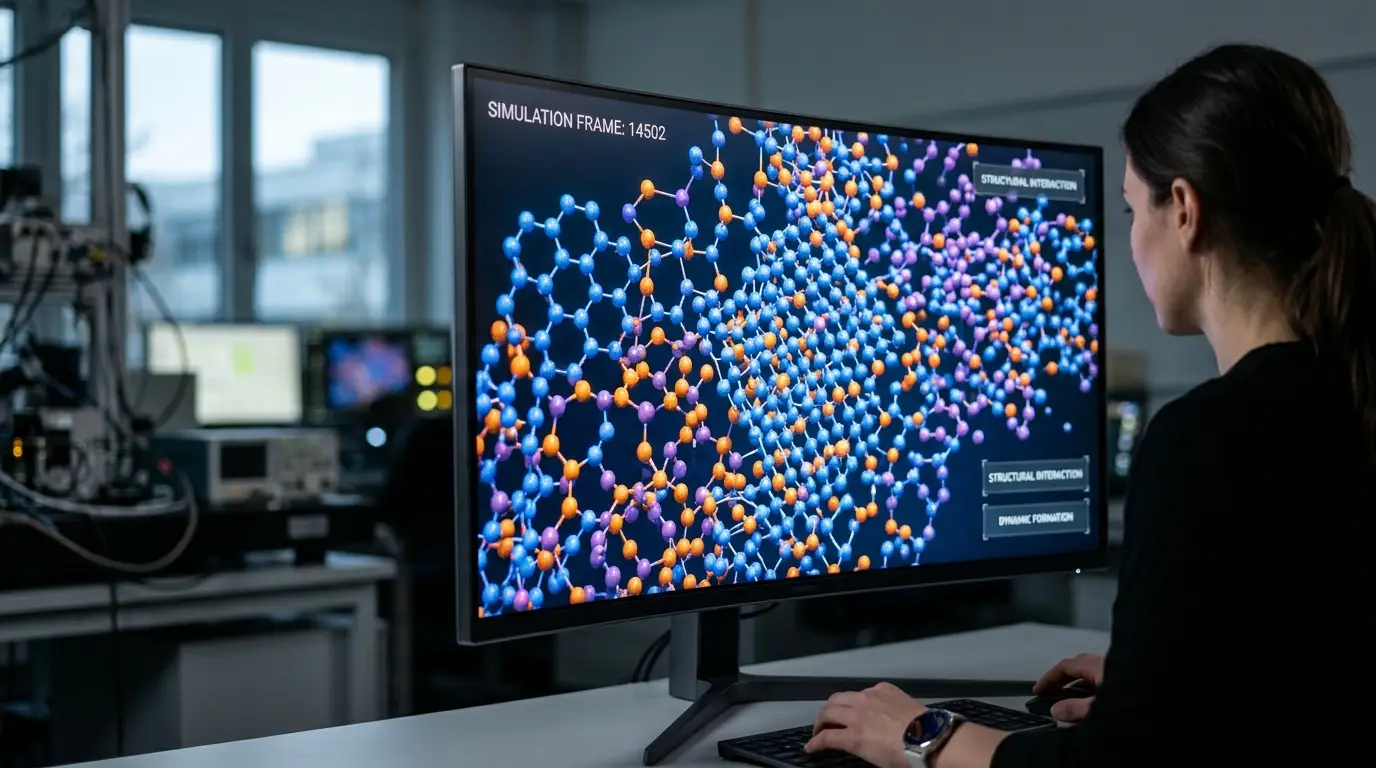
For decades, computational physicists and engineers have relied on a frustrating patchwork of specialized software to model the physical world. If you wanted to simulate sloshing oil in a storage tank, you needed one hand-coded solver. If you wanted to track the folding of a protein molecule, you needed an entirely different mathematical engine.
Now, a collaborative team from MIT CSAIL and the University of British Columbia has thrown out the rigid rulebook of classical numerical equations. They have developed WorldParticle, a unified deep-learning foundation model capable of simulating wildly different physical phenomena—from sliding sand dunes to elastic soft robotics using a single, adaptable architecture.
Ditching the Mathematical Rulebook
Instead of forcing scientists to manually derive and code the governing differential equations for every new material they study, WorldParticle learns the underlying dynamics directly from data. The system breaks down any object into thousands or millions of tiny 3D dots using a technique known as Lagrangian representation.
Much like how large language models predict the next word in a sentence, this neural network predicts the next spatial position and velocity of every particle frame by frame. By integrating external forces—like an ocean wave slamming into a seawall—into its step-by-step predictions, the architecture effortlessly adapts to unseen materials and shifting environmental conditions without requiring a ground-up software rewrite.
| Simulation Paradigm | Multi-Physics Compute Overhead | Equation Formulation Requirement | Cross-Material Adaptability |
| Traditional Numerical Solvers | High (Requires separate grids/meshes) | Strict Manual Derivation | None (Hardcoded per material) |
| WorldParticle Transformer | Low (Unified spatial tokenization) | Automated via Deep Learning | High (Generalizes to unseen forces) |
| Graph Neural Networks | Moderate (Requires complex edge mapping) | Partially Automated | Medium (Struggles with macroscopic fluids) |
Triggering a Generational Shift in Physics
The performance gains are staggering. According to the open-access research published ahead of the ACM SIGGRAPH Asia conference, the foundation model mapped complex protein structural changes roughly 100 times faster than conventional numerical simulators. Furthermore, where baseline methods notoriously struggle with granular physics—often leaving digital sand floating in mid-air—WorldParticle flawlessly captured the collapse and piling behavior of granular materials.
The implications for scientific discovery are massive. Because the computational design framework does not rely on hardcoded physics, engineers can finally model coupled scenarios that were previously computationally impossible, such as a highly deformable soft robot navigating through dense, shifting soil.
The researchers ultimately hope this breakthrough serves as the foundational step toward a universal simulation pipeline. By bridging the gap between microscopic molecular motion and macroscopic astrophysical events like merging galaxies, a single AI brain might soon allow humanity to witness and understand physical realities that traditional math simply cannot calculate.

Popular news

Singapore General Hospital Wins Global Healthcare Award For Antibiotic AI Tool

Nvidia CEO Jensen Huang Admits to an Affair as Company Probes Possible Chinese Espionage

Global Media Leaders Forge AI Action Plan at Beijing Summit

Nvidia Board Launches Probe Into Foreign Intelligence Reports Targeting CEO

Developers Test Free Local AI Stack Against Premium Cloud Coding Agents