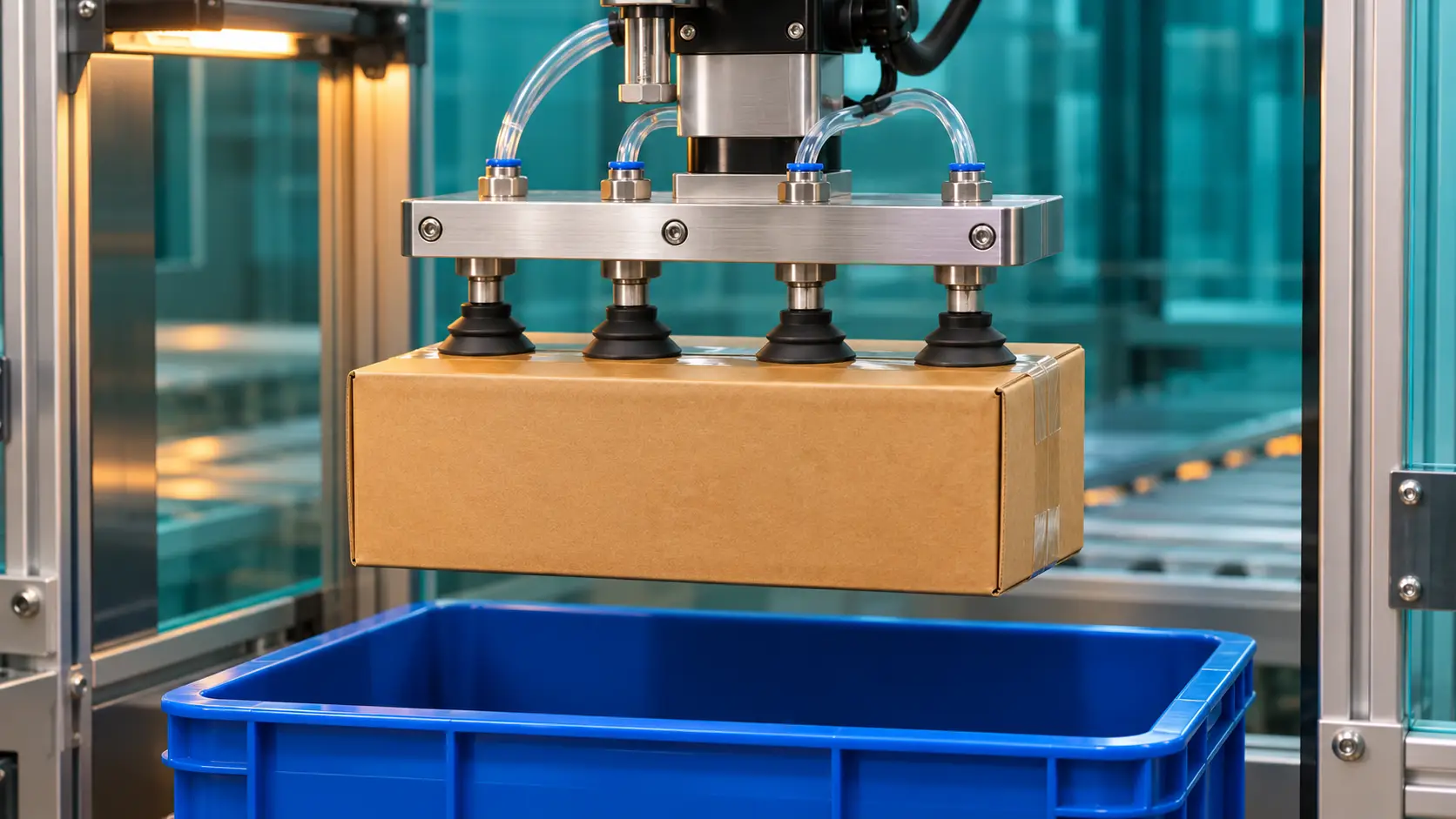
Editorial illustration of a carton being lifted by vacuum cups at a warehouse picking station.
A warehouse picking robot can lift a flat carton time after time and still struggle with a clear bottle in the same bin. Part of that gap comes from what its camera sees. The rest can come from how well its tool holds the item.
Moving stock and picking one item are separate jobs
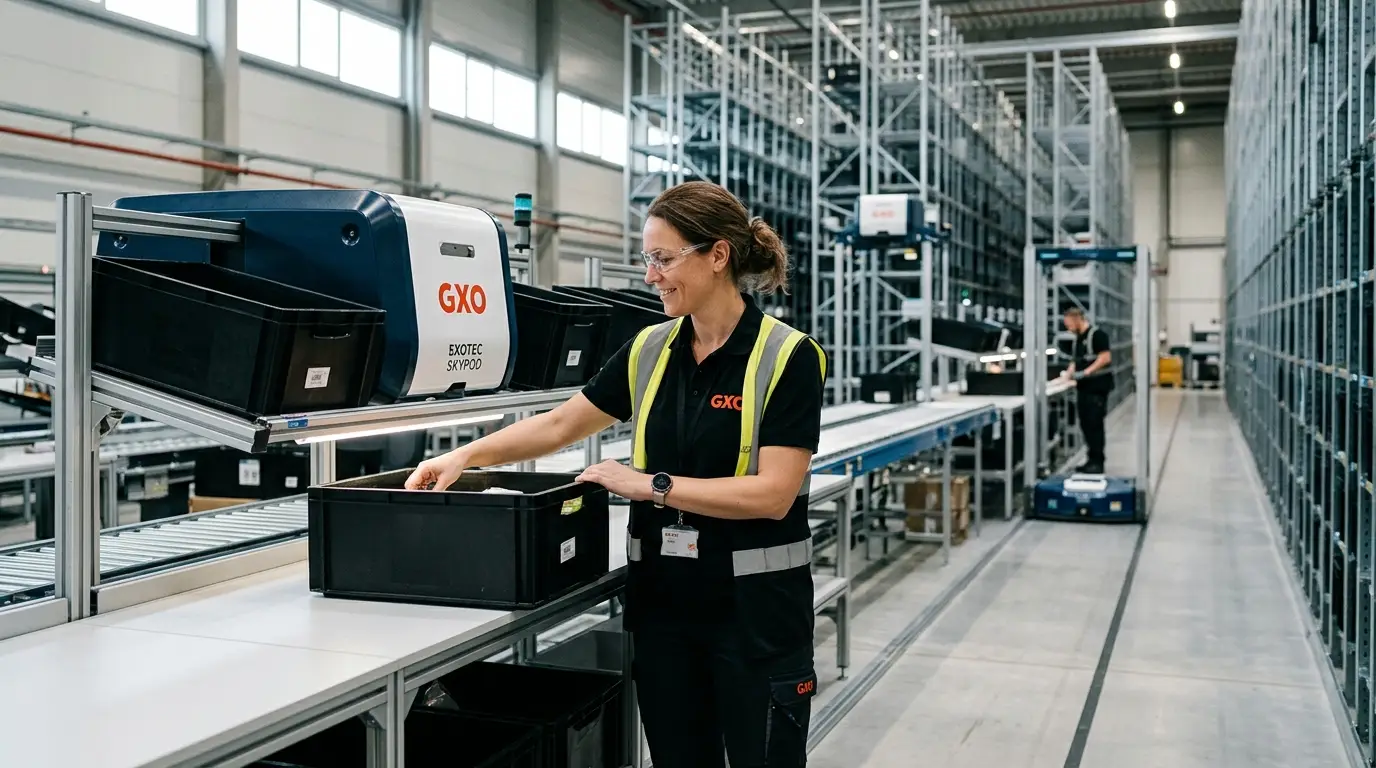
A picker takes the right quantity of one product and puts it in the order bin. In an assisted system, a machine may bring the inventory to a workbench while a person does the pick. The GXO and Guess site in Venlo uses this kind of handoff. In a robot-picking cell, the bin arrives at a station where an arm grabs and places each unit.
Dematic's case and piece picking guide describes both models. A robot cell needs to find an exposed item, choose a place to grip it, lift it out and set it down in the right container. Some cells check the pick through a scanner, camera or scale before the order moves on. A lift alone tells you little about whether the order is right.
Three packages, three different tests
Carton. A small box offers a broad face for a suction cup if the box lies flat. A dent or open flap can spoil the seal. In a test, ask how often the robot lifts a box at the first try with corners partly covered. Set aside boxes it rejects so a worker can check for damage.
Soft pouch. A pouch can fold near the edge the robot plans to grip. Flexible cups are one way to make closer contact, as Schmalz's packaging gripper documentation illustrates. Ask for first-try picks and wrong-quantity flags when two pouches lie against each other. Send any uncertain double pick for a count.
Clear bottle. The camera can see the background through a bottle. The ClearGrasp research team found that standard 3D sensors can yield poor depth readings for transparent objects. Ask the vendor to test actual bottles with the bin and lighting you use. Route failures to a manual pick so an empty slot does not slip through the order check.
These three examples show possible failure modes. They are examples for a buyer test, so the actual outcomes depend on your tool and stock. Amazon, for instance, describes using vision and suction in several systems and adding force sensing to Vulcan for different tasks. The tool at the end of the arm matters as much as the arm itself.
Count the picks that make it into the order
Ask for four counts per package type. Record first-try success, success after a retry, manual handoffs and unresolved or incorrect picks. Use items presented as the denominator for the first-try rate. Report which products the setup excluded before they reached the cell.
In a simple example, a cell gets 90 of 100 cartons right on the first try. Five work after a retry and five need a person. Its first-try rate is 90%. If the manual picks all succeed, the team finishes 100 items, with five needing human work. Report both numbers so the rework stays visible.
Ask to run a mixed tote again after the easy items are gone. The bits at the bottom may sit at odd angles or press against the sides. That run lets you see when the cell calls for help and what the next worker sees when the job reaches the exception station.
A piece-picking cell is one stage in the warehouse robot workflow. Trace stock movement separately when you compare a pick cell with a system that brings an entire tote to a worker.

Popular news

Nvidia closes up 31.5% as AI stocks lead a Wall Street rebound
Marlowe raises $277 million to run AI on more kinds of chips
Replit brings in Resonate to help AI agents resume interrupted work

Barbados AI summit calls for shared safeguards and a $3 billion fund
OpenAI adds spending limits to individual AI agent sessions