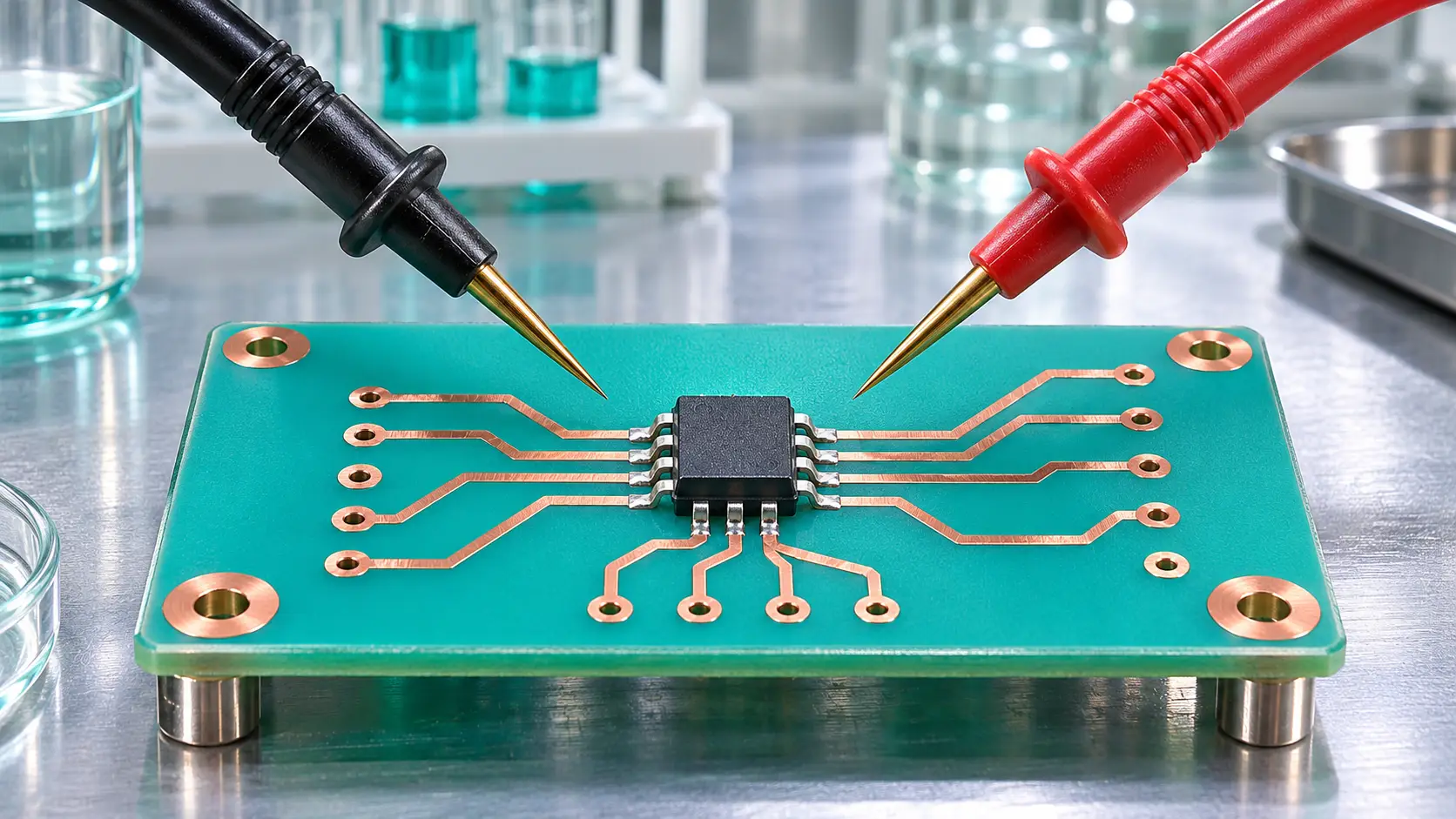
Editorial illustration of analog circuit testing.
MIT researchers trained a small AI model to tune analog circuits with help from a simulator. On one set of tests it beat GPT-6 Astra when both models had four turns. The larger model pulled ahead when each had eight turns and led overall on a separate set of unfamiliar circuits.
The method is called Small LM Iterating on Circuits, or SLIC. Researchers from MIT, IBM Research and Analog Devices worked on it. The team says the trained model is small enough to run on a laptop, which could help chip teams work with private design data on their own systems. MIT described the research on November 23 and said the team will present it at NeurIPS 2026.
How the simulator helps the model learn
Analog circuits work with signals that vary, such as the output of a sensor. A small change to one part of the circuit can affect its power use or how well it boosts a signal. Engineers often test several sets of component values in a simulator to find one that meets all the targets.
The team used examples from a larger model to give its small model a starting point. It then let the small model try its own changes and learn from measurements returned by the simulator. At each turn it could look at the results, choose a new set of values and try again.
The tests covered four targets including gain, power use, bandwidth and phase margin, a measure that helps describe stability. A design needed to meet all four within a set tolerance to pass. This gave the team a way to score each attempt against the same rules.
Where the small model scored well
On 840 tasks with familiar circuit structures, the four-billion-parameter model passed 74.9% of tasks at four turns. GPT-6 Astra passed 67.1%. With eight turns, the small model reached 87.1% and GPT-6 Astra reached 90.6%, according to the research team's paper.
On 240 tasks with circuit structures held out of training, the authors' strongest 4B variant reached 72.6% at eight turns. GPT-6 Astra reached 86.2%. The gap on those new structures matters for teams that want to apply the method to designs outside the examples a model learned from.
What a chip team could run locally
Running the model in-house could help a team keep sensitive circuit files within its own network. The model still needs a simulator and a way to check whether its designs meet the targets. The choice between local and cloud AI therefore includes the tools and data a team uses with the model.
The paper measures circuit tuning in simulations. Engineers would still need to verify the proposed values before using them in a chip. MIT says the team plans to test whether the method can handle a broader range of circuit structures and design targets.

Popular news

AWS gives HyperPod models one gateway across clusters

U.S. senators propose new disclosures for AI funding and risks

Cognition launches Devin Bots to manage multiple coding sessions

METR tests AI on tougher jobs and finds a gap in judgment

Nvidia posts two Sigma language models that write in blocks