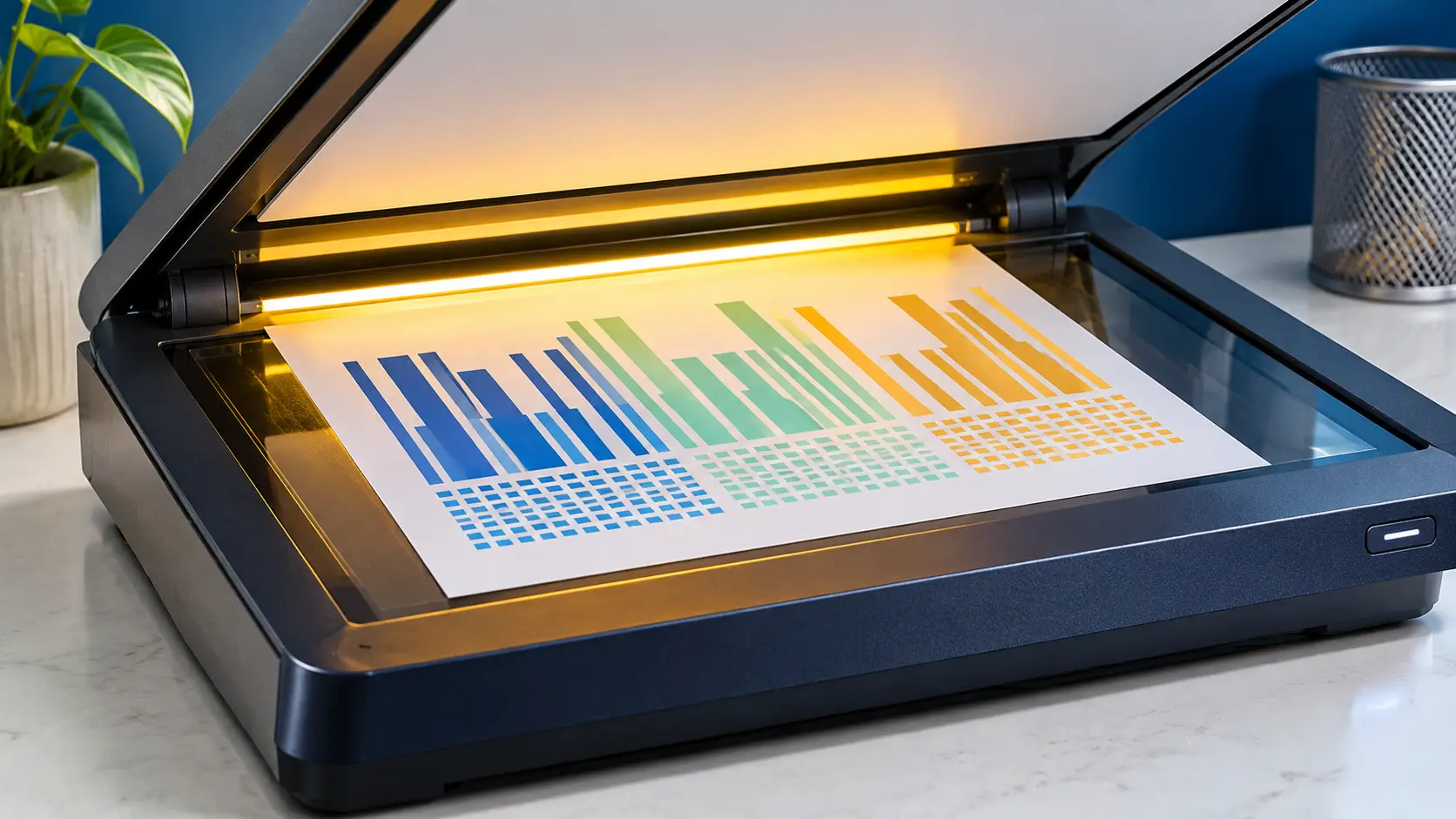
Editorial illustration of a document in a scanner.
Nvidia has released new training data and a tool to speed up Nemotron 3.5 Parse, its AI model for reading documents. The November 26 update also includes a recipe to help developers adapt the model to their own forms. A team could use it to turn a scan with tables and charts into records its software can search or check.
What the model pulls from a page
Parse puts text in reading order and marks where each heading, table and chart sits. It can turn a chart into a list of values and read a table into rows and columns. Nvidia’s training data includes generated charts, tables and text in several languages. With a chart it created itself, Nvidia already knows the right values and can check whether the model recovered them. See the Nvidia release notes.
Where the speed gain comes from
DFlash2 drafts pieces of the output so Parse can check several at once. In Nvidia’s tests on one H200, it raised single-pass throughput 7.62 times with one request in flight. At 512 requests in flight, the gain was 1.52 times. Both tests compared the same model with and without the drafting step. Our coverage of Nvidia’s Sigma models explains a related approach for writing text.
How to judge it on your own forms
A table can look tidy even when a value lands in the wrong row. The model card describes ways to spend an extra pass on hard parts of a page. Teams can compare one pass with a second look at dense tables or small charts. Keep some of the hardest pages out of training so they can serve as a fresh test.
If the results feed a search tool, keep the page reference with each record. Readers can then check a surprising number against the original document.

Popular news
Soitec jumps 6.9% as European chip stocks rebound and Eutelsat falls

Ant Group releases a design image model that tops the open-weight ranking

Kioxia jumps 12.6% as Asian AI stocks trade through Thanksgiving

Perplexity lets developers search the web as it looked on an earlier date

AI sends more shoppers to retail sites ahead of Black Friday