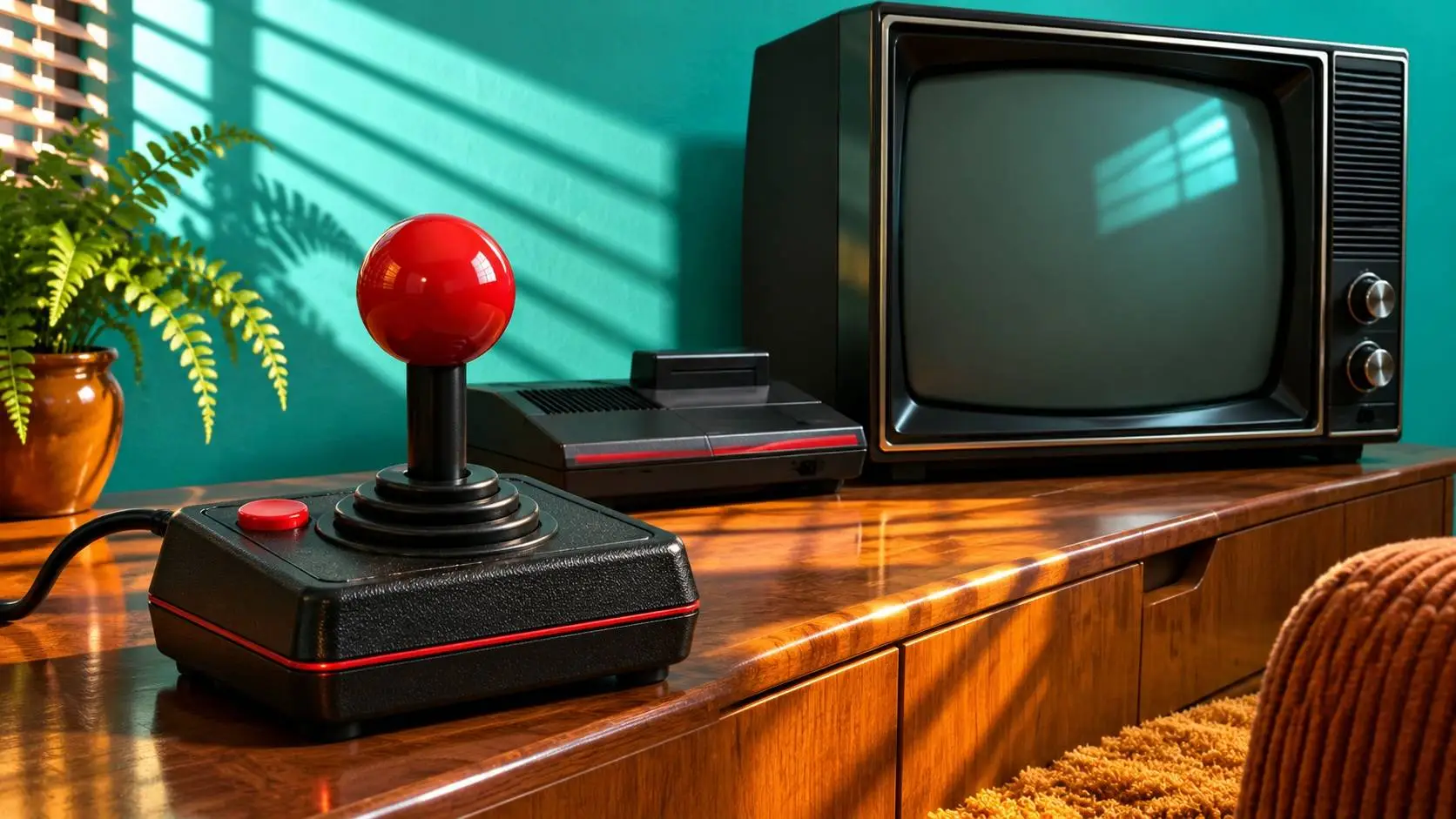
A black joystick with a red ball top sits beside an unlit curved CRT monitor. AI-generated editorial illustration by AI World Today.
In Breakout, DeepMind’s system learned to get the ball past a wall of bricks. It saw frames from the screen and got a reward when it scored. That one bit of play showed the team how a move could pay off much later in a game.
The group also tried the same design on dozens of other Atari games. The work went from a seven-game study in 2013 to a 49-game paper in 2015. The games gave the team a lab in which it could start over, run tests again, and see how much a new method helped.
Why Atari made a good lab
The Arcade Learning Environment gave teams a common way to run Atari 2600 games. Marc Bellemare and his coauthors used the platform to put many kinds of tasks in one place. Each game had its own rules. A screen, a set of controls, and a score helped give the tests a common shape.
Take a game in which you have to catch a ball. Then take one in which you need to dodge an object. The buttons may be much the same. The moves that help you win depend on what is on the screen and what happens next.
Games also make it cheap to fail. When an attempt goes wrong, the team can try again. The rules of the test still matter. Teams need to agree on where a game starts, how much time a player gets, and what the system sees.
Seven games in 2013
On December 19, 2013, Volodymyr Mnih and colleagues posted Playing Atari with Deep Reinforcement Learning. It tested seven titles. The team reported doing better than prior methods on six and scoring above its human expert comparison on three.
The paper used a neural network to learn from frames of play. It used a method called Q-learning to estimate what reward might follow each action. With each new try, the system could improve its guesses about which moves would pay off.
The name DQN stands for deep Q-network. The network uses the images it gets from the game to produce a value for each move it can take. A high value tells it the move looks good from that state. Later outcomes give the learning rule fresh evidence about how good those guesses were.
That study came out after the date in our snapshot of AI at the launch of GTA 5. The two events are a few months apart. The date helps us separate a view of AI as it stood in September from results published later that year.
How the system learned from play
A picture of a ball at one spot on the screen leaves out where it is going. A few frames in a row can show if it is going up or down. That is a clue the system can use to work out where it wants to send the paddle.
That mattered well beyond Breakout. A wall in one frame may look as though it stands still. The last few frames can show that the view is moving toward it. For a player who must act, what has just changed can be as useful as what is on screen now.
A reward can also come very late. In Breakout, a shot through the wall can put the ball behind the bricks. The ball can then hit more bricks on the way back. Part of the job is to give earlier moves some credit for the points they help earn later.
DeepMind’s account of the 2015 work describes how it used experience replay. The system held on to bits of earlier play and drew samples from them during training. That let it learn from a mix of past moves and outcomes beyond the ones from its latest run.
Imagine a coach who can bring back a few moments from each of several games. One clip shows what led to a point. Another shows a miss. The mix lets you look again at plays you might go a long time without seeing. The way the network updates its numbers is different from the work of a coach. The example shows why it helps to keep past tries on hand.
What the larger test measured
The February 2015 Nature paper covered 49 games. The researchers kept the method, the network design, and key settings the same across them. They trained a player for each game and used the scores to see where that shared method did well.
It was a test of how far one set of learning rules could take the team. To test if a single trained player could switch from Pong to Breakout on the spot would take another design and a new test. The table of scores in the paper shows how much results varied by game.
The clip of the ball going behind the bricks helps you see how one move can lead to a later reward. To tell how often it works, you need the results from more runs. To tell how well the method works on other games, you need to look at their scores as well.
A score of a thousand can mean very different things from one game to the next. In one game it may take a lot of skill to get that far. In another it may be easy. The numbers in the paper make sense with the name of the game, the rules of the run, and the result the team used for comparison.
Why teams went on to change the tests
Later work on Double Q-learning found that the method could judge some moves to be better than they were. The authors tested a way to cut that error. It made a difference on several games.
Researchers also looked again at how Atari tests were run. They proposed adding a chance that a game would repeat the last button press, a setup they called sticky actions. That made the game less easy to predict. It gave the test a way to see how the player dealt with small changes.
The arcade made the link between a sight, a move, and an outcome easy to watch. The scores matter because we can read the rules of each test. For work that builds on this idea of taking actions, see our guide to how AI agents use models and tools. More such tests are in our AI history collection.

Popular news
Soitec jumps 6.9% as European chip stocks rebound and Eutelsat falls

Ant Group releases a design image model that tops the open-weight ranking

Kioxia jumps 12.6% as Asian AI stocks trade through Thanksgiving

Perplexity lets developers search the web as it looked on an earlier date

AI sends more shoppers to retail sites ahead of Black Friday