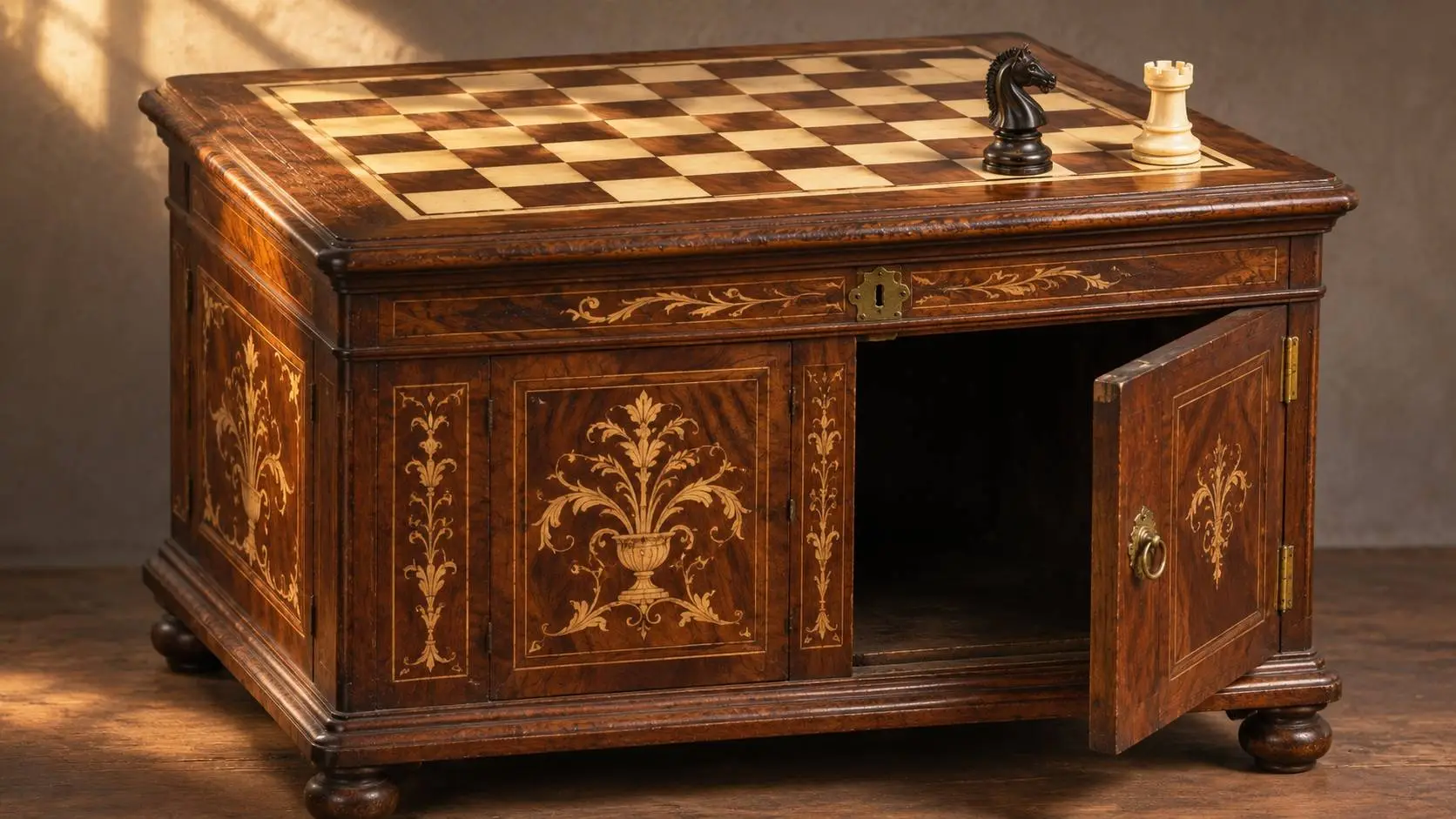
A knight and rook sit on a chess cabinet with a partly open wooden door beneath them. AI-generated editorial illustration by AI World Today.
The Mechanical Turk drew crowds by appearing to play chess on its own. The Computer History Museum dates its debut to 1770. A chess player hid in the cabinet and chose each move. The machine let that person follow the game and move the pieces from inside.
Some people who saw it guessed that there was a person behind the show. That still left a puzzle. How could a player stay out of sight, see enough of the board, and reach the pieces? The Turk took skill both to build and to perform.
Why a chessboard made for a good show
Wolfgang von Kempelen’s machine gave the audience a figure to watch and a board they could inspect. The figure made the show feel like a match with a person. The board made it clear when a move worked, even to someone who never got a full view of the machine.
Each visitor who sat down to play could make a new set of moves. The figure seemed to take those choices into account. That was a step beyond the kind of clockwork display that moves the same way each time. It also made the show fun to debate. Even if you guessed there was a trick, it took more work to explain how it was done.
There were centuries between the Turk and the first electronic chess programs. In our history of the roots of AI before 1950, you can see how the idea of a machine that could follow rules became a subject of study in its own right.
How the hidden player moved a piece
The Heinz Nixdorf MuseumsForum explains how the machine worked. Magnets helped someone inside the cabinet follow the pieces on the board. A set of moving parts let that person work the figure’s arm and fingers. The player could pick a move without opening the cabinet in front of the crowd.
This took more than a good place to hide. The person inside had to keep track of a game, choose a reply, and get the figure to place a piece at the right spot. The crowd saw the last of those steps. The other steps made it possible.
The museum also traces the machine’s later life under Johann Nepomuk Maelzel. The show went on for decades. The original machine was destroyed in a fire at a museum in Philadelphia in 1854.
That leaves a challenge for anyone who wants to know what happened inside. A new build can show that a method works. A report written at the time can tell us what people thought they saw. To work out how the original did its job, it helps to ask which parts each source can show and where the record runs out.
A letter about the player the show needed
One clue to the work comes from the American Antiquarian Society’s guide to the Maelzel papers. It describes a letter from November 1829 about how hard it was to find someone good enough at chess to run the show.
The note makes sense when you picture the task. A well-made figure could lift a piece, but the trick needed someone who could hold up against a real opponent. That person was part of the work of taking the show from city to city. The clever cabinet alone could only do so much.
The note gives us a way to learn from a performance long after the machine itself is gone. A show tells us what a crowd could see. A letter about the work tells us what someone had to arrange to make it happen.
Poe looked for clues in the show
Edgar Allan Poe laid out his case for a hidden player in an 1836 essay on Maelzel’s chess player. He watched for things like which people were in the room when the figure went to work. The essay shows how one person tried to test what the show seemed to claim.
Poe also argued that a machine that could play chess would always win. We now have games that show how a real chess computer can lose. A program works with a set of rules for judging moves, and it can run out of time to look ahead. A weak line of play or a bad score can lead it to a poor move.
That makes Poe’s essay worth reading for two reasons. It shows that people questioned the show at the time. It also gives a record of what one writer expected a chess machine would have to be like. Those are two different parts of the story.
What a move can tell you about a machine
Suppose you watch two displays. In both, a device moves a knight to a square that wins the game. In one, a person picks the move. In the other, a program reads the board and searches for a move under a time limit. You learn as much about the score from either display. You need another kind of evidence to learn who chose the move.
Try following the path from input to action. Who sees the position? Who judges the options? Who makes the choice? What puts the piece on the board? These questions also help when a tool is meant to work with a person. You can see where the help comes in and what the person still needs to do.
There is a simple way to try the idea with chess today. In a game with a friend, ask a third person to move the pieces while you both call out the squares. The extra person will move every piece. A game record may tell you where the pieces went, but you would still have to be in the room to see who called for each move.
The Turk took skill to build and skill to use. Its place in history comes from how well the display hid the second kind of skill. The next time a machine claims to play a game on its own, the record of how it picked its moves is worth as much as the score.
For another case of a new interface that was hard to read at first, see early reactions to ChatGPT. More stories about how people tested what machines could do are in our AI history collection.



Popular news

Marlowe raises $277 million to run AI on more kinds of chips
Replit brings in Resonate to help AI agents resume interrupted work

OpenAI adds spending limits to individual AI agent sessions

Amazon Connect AI now fills forms during live support calls

Barbados AI summit calls for shared safeguards and a $3 billion fund