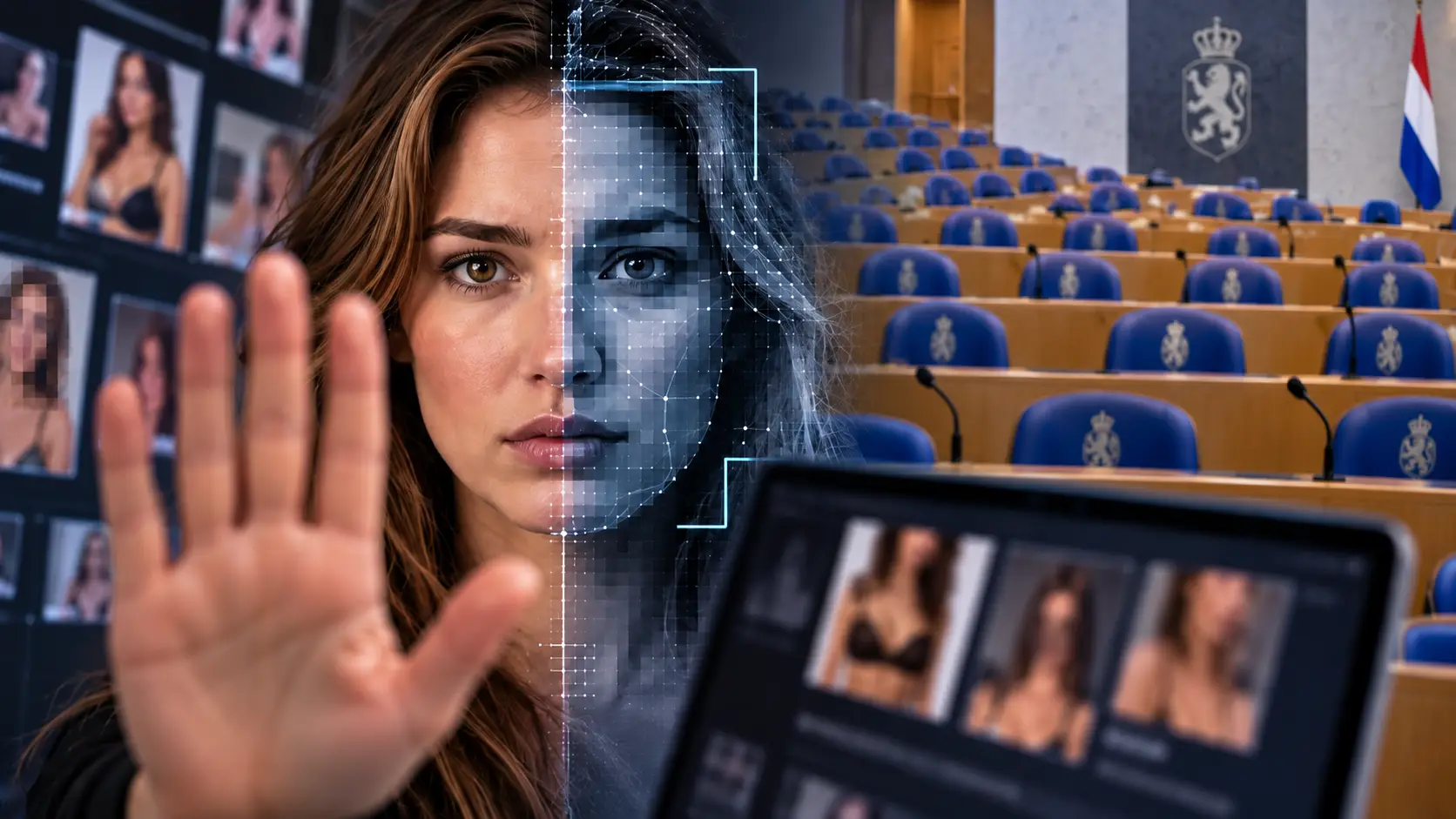
Fifteen female members of the Dutch House of Representatives from across the political spectrum are joining forces against sexual deepfakes. They want stronger support for victims, tough enforcement, and more public education. Their call isn’t just about politicians: women without public profiles must also be better protected against this online abuse.
The initiative is drawing national attention. Among the MPs involved are Suzanne Kröger (PRO), Sandra Beckerman (SP), Queeny Rajkowski (VVD) and Femke Wiersma (BBB). They discussed the impact of pornographic deepfakes and what needs to happen next on Pauw & De Wit.
According to ANP, the push is backed by D66, PRO, VVD, CDA, JA21, BBB, Party for the Animals, SP and Volt—signaling broad political support for stronger victim protection.
One help desk, real enforcement, and a national campaign
The MPs want action on three fronts.
A low-threshold help desk for victims. There should be a clear, trusted place for victims to get support—ranging from takedowns of images to assistance with filing reports and aftercare. Going straight to the police is too daunting for many, the initiators say.
One of the current help desks can be found here.
Strong enforcement of the “undressing ban.” The politicians want the upcoming ban on AI systems that depict people sexually without consent to be enforced in practice. Their message: crack down from day one, don’t leave it as a paper ban.
Swift removals and more awareness. Abusive content must be taken down fast. The MPs also call for a national campaign to show how harmful sexual deepfakes are. Education for young people should help prevent the creation and sharing of such content from becoming normalized.
EU research exposes stark gender gap
The call follows research by Agora Digitale Transformation into sexual deepfakes targeting national parliamentarians in the European Union. Researcher Benjamin Shultz analyzed the names of 5,872 MPs across 27 EU countries on 160 websites. He found 138 women and nine men in, or linked to, the material examined.
There’s an important caveat. The study didn’t only count confirmed sexual fakes. Mentions of names, search results, and pages that combine personal data with links to AI generation tools could also be included. So the numbers are not a tally of confirmed deepfake videos alone.
The often-cited factor of 33 also needs precision. It comes from a statistical model that accounts for factors like age and political visibility. It’s an odds ratio—not simply a 33 times higher chance or 33 times more videos. Still, the imbalance is clear: women are linked to this form of abuse far more often.
Why sexual deepfakes are so damaging
Sexual deepfakes use someone’s likeness to fabricate a nude image or sexual scene. A face can be inserted into existing footage, or regular photos can be edited to make someone appear naked. The person depicted doesn’t have to have taken or shared any intimate images.
The fact that the images are fake doesn’t make the impact imaginary. In a previous ruling, the Amsterdam court warned of severe, lasting psychological harm, including shame, powerlessness and a sense of insecurity. Another problem: once shared, material often never disappears completely from the internet. Victims can be confronted with it again and again.
For AI policy, that means detecting whether an image is real or fake isn’t enough. The violation also lies in depicting a recognizable person sexually without consent. Offlimits stresses that manipulated images can be harmful even when they only resemble the victim.
EU ban takes effect on December 2, 2026
The so-called “undressing ban” is part of the EU’s tightened AI rules. According to the European Commission’s official timeline, new bans on AI systems that generate sexual deepfakes without consent or child sexual abuse material will apply from December 2, 2026. This is not a blanket ban on AI image editing—only on specific harmful uses.
That start date doesn’t mean making and sharing sexual deepfakes is allowed in the Netherlands until then. On November 2, 2023, the Amsterdam court convicted a man for creating and publishing a pornographic deepfake without consent, imposing a suspended 180-hour community service order. Existing criminal options and the new EU ban should be viewed separately.
European politicians regularly put this on the agenda.
More than a personal issue
The initiators argue the abuse also undermines women’s participation in public debate. “Women are intimidated into silence,” Kröger told ANP. She stressed the plan goes beyond the personal experiences of MPs: support must also reach people with fewer means to speak up.
Victims can get help today
If you’re facing sexual deepfakes, you don’t have to wait for new measures. Offlimits, the expertise center for online abuse, offers practical support. You can reach out for free and anonymously via chat, email or phone. The organization helps with questions about unwanted images and how to get them removed.
Save whatever information you can about where the content was posted—like links and accompanying messages—and discuss with the help line or police how to preserve evidence. Do not share the images further. Support can target both the spread and the impact on the victim; full removal of all copies is unfortunately not always possible.
Latest comments
Loading