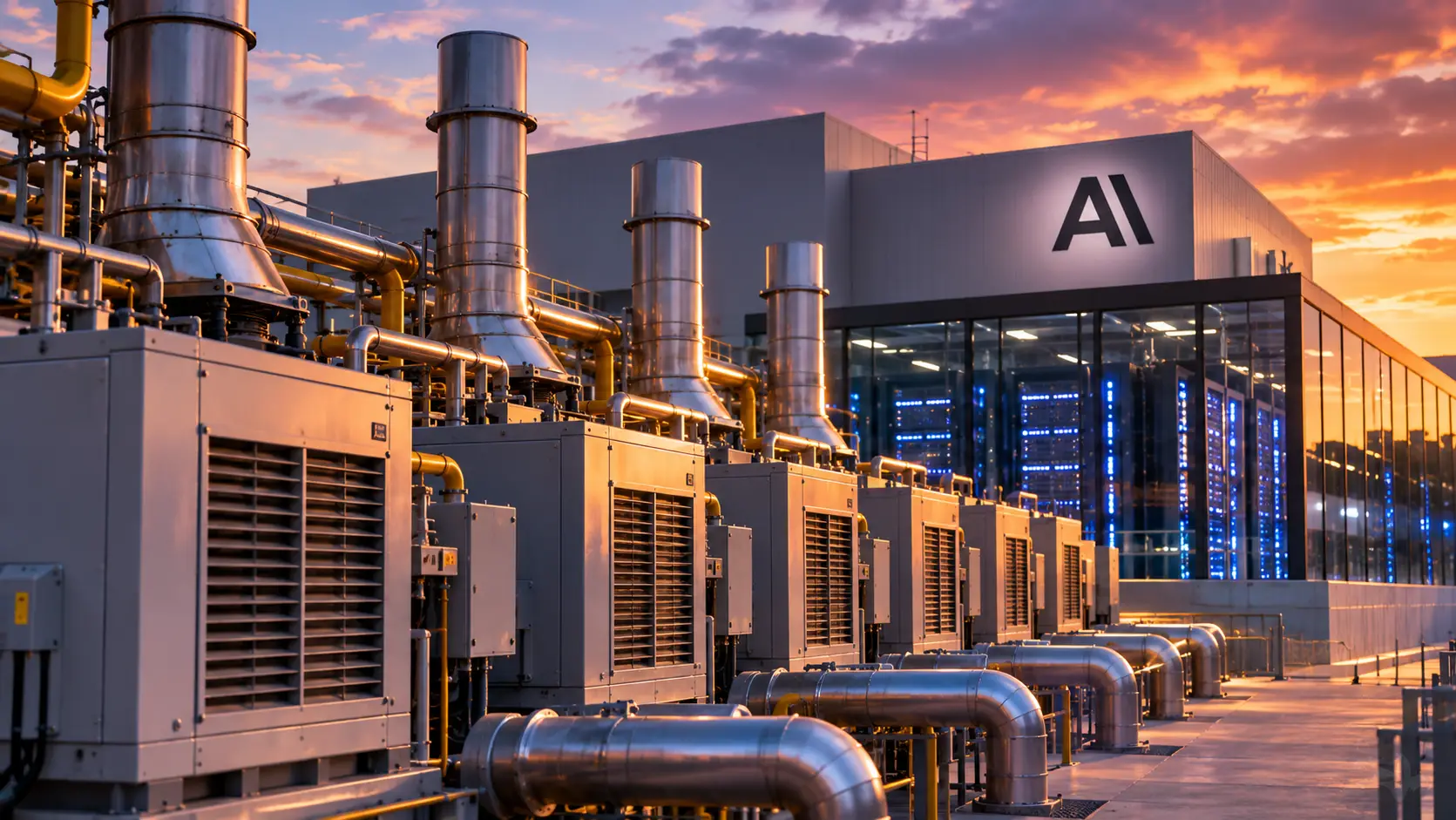
Anthropic has reportedly committed around $3.4 billion to gas generators for its data centers, according to the Financial Times. The maker of Claude is said to be taking over orders for 1.7 gigawatts of power-generation capacity. The reported deal has not been publicly confirmed.
The Financial Times reported the agreement on Sunday. It was reportedly reached with OnePWR Solutions in late September, without Anthropic acquiring the company or its staff.
Reuters could not independently verify the report. Anthropic and OnePWR did not respond to the news agency’s requests for comment.
What 1.7 gigawatts actually tells us
A capacity of 1.7 gigawatts equals 1,700 megawatts. That figure describes the combined electrical output the equipment could deliver. How much electricity it actually generates depends, among other things, on how many hours it runs.
The U.S. Energy Information Administration explains the difference between power and energy: watts measure power, while watt-hours also account for how long it is used. The two terms are often confused in discussions about data centers.
So a generator order alone does not reveal Claude’s annual electricity use. Nor can it tell us the future electricity bill or emissions without data on usage, efficiency, and fuel supply.
Anthropic is securing computing power from multiple partners
The reported purchase fits a broader push to expand Anthropic’s infrastructure on several fronts. The company previously struck a deal with Google and Broadcom for several gigawatts of capacity using new TPUs, Google’s specialized AI chips. That capacity is expected to come online from 2027.
Anthropic combines Google TPUs with AWS Trainium chips and Nvidia GPUs to train and run Claude. When the deal was announced, Amazon remained its primary cloud provider and training partner.
These agreements secure access to computing systems. A generator order would address a different part of the equation: supplying electricity where those systems operate. Chips, buildings, cooling, and power all have to work together before a data center can serve customers.
A previous pledge to protect household energy bills
In February, Anthropic pledged to cover household price increases caused by its data centers. The company says it will pay for all necessary grid upgrades for new connections and help bring additional power generation online.
Anthropic also says it is developing systems that would reduce data center power use during peak hours. Where new generation is not yet available, it plans to work with utilities and experts to calculate the price pressure created by its electricity demand.
The pledge directly covers projects developed by partners for Anthropic’s own operations. For capacity leased in existing data centers, the company was still exploring additional measures. That makes the plan more specific than a blanket promise that local residents will never face extra costs.
Construction and permits remain separate hurdles
In documents for its planned IPO, Anthropic describes how infrastructure projects can be delayed by permits, a shortage of skilled workers, and long delivery times. Cooling systems, power supplies, and networking equipment also require time and specialized expertise.
AI Wereld previously examined the financial commitments Anthropic is taking on. These contracts make future capacity more certain, but costs arise before all the expected revenue is secured.
For gas-fired power, the company also identifies natural gas prices and transportation costs as risks. Securing equipment and paying to operate it are therefore separate financial challenges. Anthropic also points to limited gas pipeline capacity: generators need a reliable fuel supply as well as an electrical connection.

Popular news

Nvidia CEO Jensen Huang Admits to an Affair as Company Probes Possible Chinese Espionage

Singapore General Hospital Wins Global Healthcare Award For Antibiotic AI Tool

Global Media Leaders Forge AI Action Plan at Beijing Summit

Nvidia Board Launches Probe Into Foreign Intelligence Reports Targeting CEO

Valve Updates Steam Release Rules to Manage AI Game Surge