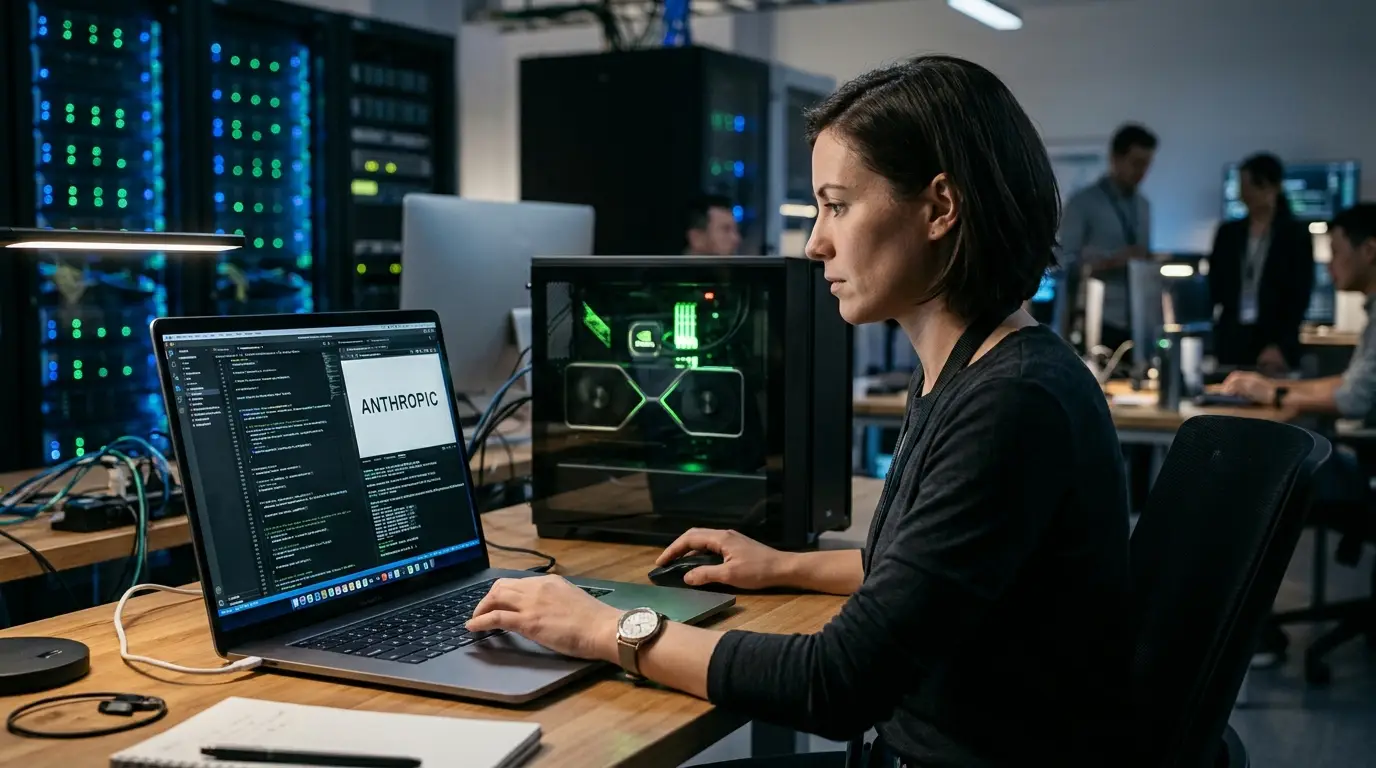
Investment banks underwriting Anthropic’s highly anticipated public debut are preparing to price shares above the initially proposed range. Following robust demand during the roadshow, underwriters now project the artificial intelligence company could achieve a fully diluted valuation exceeding $1.5 trillion.
According to initial market reports covered by MLQ.ai, the surge in institutional interest has forced syndicate desks to reconsider the original $70 to $78 per share corridor outlined earlier this week.
Strategic Private Placement Architecture
The structural foundation of this offering relies heavily on strategic anchor investors rather than traditional public float mechanics. As detailed in the company’s Amendment No. 2 to Form S-1 registration statement filed with the U.S. Securities and Exchange Commission, a concurrent private placement will absorb $26 billion in capital immediately upon market listing. The largest tranches of this placement are secured by major cloud providers and chipmakers, who are committing billions to acquire non-voting equity at the final public offering price.
| Capital Architecture Component | Allocation Percentage | Voting Rights | Strategic Objective |
| Primary Public Float | 68% of Total Equity Issuance | Full Voting Privileges | Establish Nasdaq Trading Baseline |
| Syndicate Over-Allotment | 15% of Public Tranche | Full Voting Privileges | Mitigate First-Week Volatility |
| Hyperscaler Anchor Block | 22% of Total Equity Issuance | Zero Voting Privileges | Secure Multi-Year Cloud Tenancy |
| Fabrication Partner Block | 8% of Total Equity Issuance | Zero Voting Privileges | Guarantee Advanced Node Access |
Retail Demand and Secondary Market Indicators
Beyond institutional allocations, the offering is structured to accommodate unprecedented retail participation. Brokerage platforms across international jurisdictions, including a dedicated retail tranche launched in Australia, are processing early indications of interest. Derivative markets are also front-running the syndicate desks; decentralized perpetual contracts tracking the company's pre-market equity currently reflect an implied enterprise value approaching $1.8 trillion.
This premium over the syndicate's baseline indicates that secondary market participants expect the final pricing to clear the top end of the initial prospectus range, potentially pushing the total capital raised well past the $100 billion threshold when combining public and private tranches.
Regulatory Filings and Timetable Execution
Despite the aggressive pricing discussions, the official regulatory framework remains bound by existing disclosures. The U.S. SEC EDGAR database currently lists the initial price corridor as the active legal parameter until a formal 424B4 pricing prospectus is published. Furthermore, supply chain partners are formalizing their equity stakes through standard corporate governance channels, such as the recent board resolutions filed by TSMC authorizing their specific capital deployment. Lead underwriters are managing a highly complex book-building process that must balance maximizing proceeds against the risk of a post-listing correction. Any upward revision to the share price requires an updated regulatory filing before the final Nasdaq bell.
Governance and Dual-Class Mechanics
The heavy reliance on non-voting stock for the private placement serves a distinct corporate governance function. By directing strategic partners toward non-voting equity, the founding executive team retains operational control while still absorbing the massive capital required to sustain compute infrastructure. This dual-class architecture ensures that hyperscalers and semiconductor manufacturers gain economic exposure to the artificial intelligence boom without diluting the voting power of the original leadership. This structural safeguard is increasingly common among frontier technology firms navigating aggressive expansion phases, ensuring that short-term market fluctuations do not disrupt long-term research and development timelines.

Popular news

EU Leaders Meet in Dublin to Decide Who Pays for Europe’s AI Computing Power

Google DeepMind’s AlphaGenome 2 predicts what DNA variants do in specific cells

Fans Mistake New GTA 6 Footage For AI Generation
US Data Brokers Supply Half Billion Dollars In AI Training Environments To Chinese Labs

Anthropic Forecasts Intelligence Explosion Arrival in 2027