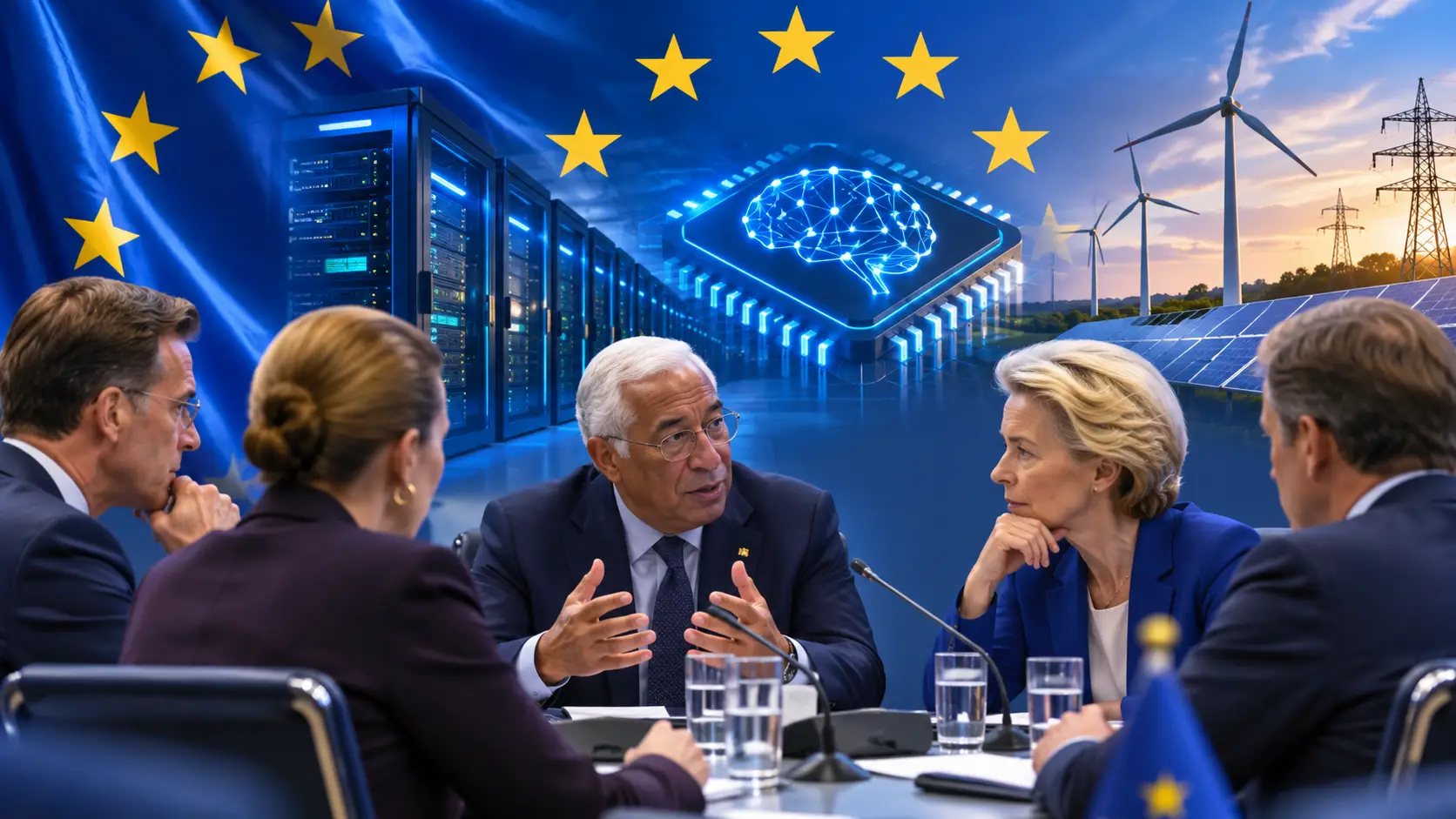
European leaders are meeting in Dublin to discuss how Europe can build more of its own AI computing capacity. They are considering public and private investment in infrastructure, affordable energy and ways to reduce reliance on foreign technology. The Dutch government points to the AI factory in Groningen and wants to accelerate the expansion of Europe’s data-centre capacity.
Computing power and electricity go hand in hand
The European Council is putting Europe’s competitiveness at the heart of its informal meeting on Friday, 13 November. Leaders will examine how European businesses and governments can make greater use of AI—and what infrastructure they will need to do so. Arthur Mensch, head of French AI company Mistral, has been invited to discuss Europe’s position.
The agenda puts affordable, clean energy alongside investment, bringing the debate into sharp focus for data-centre projects. A large computing cluster needs more than a grid connection: it requires a reliable power supply throughout its operating life. Funding is needed for the buildings and equipment, followed by enough electricity to keep that equipment running. The Council will discuss how public and private investors can pool enough capital to build this infrastructure.
Ahead of the meeting, Reuters reported that plans for seven European AI gigafactories are colliding with disagreements over the EU’s 2028–2034 budget. These larger facilities would bring together advanced chips, data centres and high-speed connections. Who pays is therefore a question for both budget negotiations and the companies able to build or use the facilities.
The Netherlands backs capacity in Groningen—and across Europe
In written correspondence with the House of Representatives, the Dutch government outlined three ways to make more computing power available. Its AI vision places these plans within the broader national strategy. The Netherlands is developing its own AI factory in Groningen, participating in the European EuroHPC supercomputer programme and backing a role for European AI gigafactories. The government is also calling for an ambitious European Cloud & AI Development Act to speed up the expansion of computing and data-centre capacity.
For a Dutch business, the bottom line is whether it can access the machines. AI Wereld previously reported how Drenthe-based company KOWW secured 5,000 hours on a European supercomputer. The company wants to train AI to identify aquatic plants in drone footage. After an initial rejection, it received help with its application and was able to run its computations in Bulgaria. That kind of access is a practical part of the AI strategy the government presented earlier.
Read also

Leaders will also tackle safety and children’s rights
Geoffrey Hinton, co-winner of the 2024 Nobel Prize in Physics, has been invited to discuss AI safety and its effects on society. The Council highlights fundamental rights, child protection and the integrity of democratic processes. Mensch will address Europe’s AI industry; Hinton, the technology’s risks and consequences.
In his invitation to EU leaders, President António Costa says he expects the issue to return to the agenda in 2027. For this meeting, the key question is which proposals member states are willing to develop together. At the time of writing, the European Council listed the meeting as ongoing and had not yet published any conclusions on AI.

Popular news

Google DeepMind’s AlphaGenome 2 predicts what DNA variants do in specific cells

Anthropic Bankers Push IPO Pricing Above Initial Range to Reach 1.5 Trillion Valuation

Fans Mistake New GTA 6 Footage For AI Generation
US Data Brokers Supply Half Billion Dollars In AI Training Environments To Chinese Labs
Anthropic Forecasts Intelligence Explosion Arrival in 2027