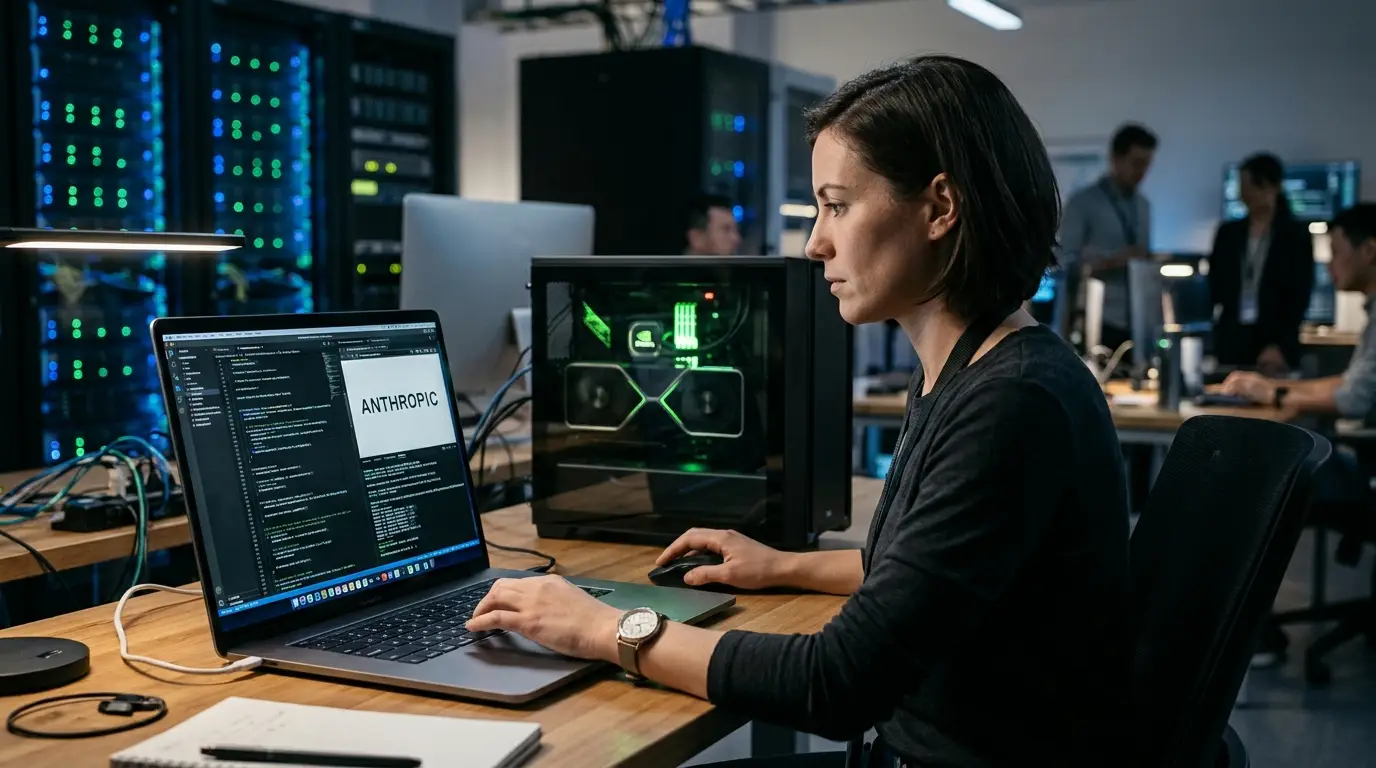
For years, the biggest hurdle for competitors trying to take on the artificial intelligence hardware market has been software, not silicon. However, according to a recent report by The Decoder, that protective barrier is crumbling much faster than Wall Street anticipated.
Boris Cherny, Chief Compute Officer at Anthropic, revealed that advanced language models can now translate highly optimized code from Nvidia's proprietary platform to AMD's open-source alternative in roughly three days. Historically, manually rewriting kernel code and debugging compatibility issues to migrate a complex machine learning workload took engineering teams several months of grueling, specialized labor.
Software Lock-In Is Rapidly Weakening
The proprietary nature of the Nvidia CUDA toolkit has long served as the company's most effective moat. Because researchers have spent nearly two decades writing algorithms specifically tuned for this architecture, moving to a different hardware vendor meant losing months of optimization and risking model performance.
Now, artificial intelligence is doing the heavy lifting. If large language models can instantly rewrite complex parallel computing instructions, enterprise hardware buyers can shop around for better pricing or availability without being held hostage by legacy software.
This reality opens the door significantly wider for the AMD ROCm software stack, which has historically struggled to gain organic developer adoption despite offering highly capable silicon. By using AI to bridge the translation gap, AMD becomes a much more viable, plug-and-play alternative for major data centers.
| Market Snapshot Metric | Nvidia (Q3 2025 / Early 2026) | AMD (Q3 2025 / Early 2026) |
| Estimated AI Accelerator Share | ~85% - 88% | ~4% - 6% |
| Quarterly Data Center Revenue | $39.2 Billion | $3.5 Billion |
| Flagship AI Compute Node | HGX B200 / Blackwell | Instinct MI325X / MI350 |
| Average Developer Migration Time | N/A (Native Platform) | Dropped from Months to 3 Days |
Table data reflects independent semiconductor market tracking and recent corporate earnings reports.
The Path to Hardware Commoditization
While Nvidia still holds an overwhelming majority of the global compute market, the financial cost of switching platforms is plummeting. Major cloud providers, enterprise data centers, and independent AI labs are actively hunting for alternatives to diversify their supply chains and avoid vendor monopolies.
If automated translation tools continue to improve at their current trajectory, the tech industry might soon see AI accelerators treated more like interchangeable commodities. This would force hardware giants to compete purely on raw compute price, manufacturing yield, and power efficiency rather than relying on deep ecosystem lock-in to retain their clients.

Popular news

EU Leaders Meet in Dublin to Decide Who Pays for Europe’s AI Computing Power

Google DeepMind’s AlphaGenome 2 predicts what DNA variants do in specific cells

Anthropic Bankers Push IPO Pricing Above Initial Range to Reach 1.5 Trillion Valuation

Fans Mistake New GTA 6 Footage For AI Generation
US Data Brokers Supply Half Billion Dollars In AI Training Environments To Chinese Labs