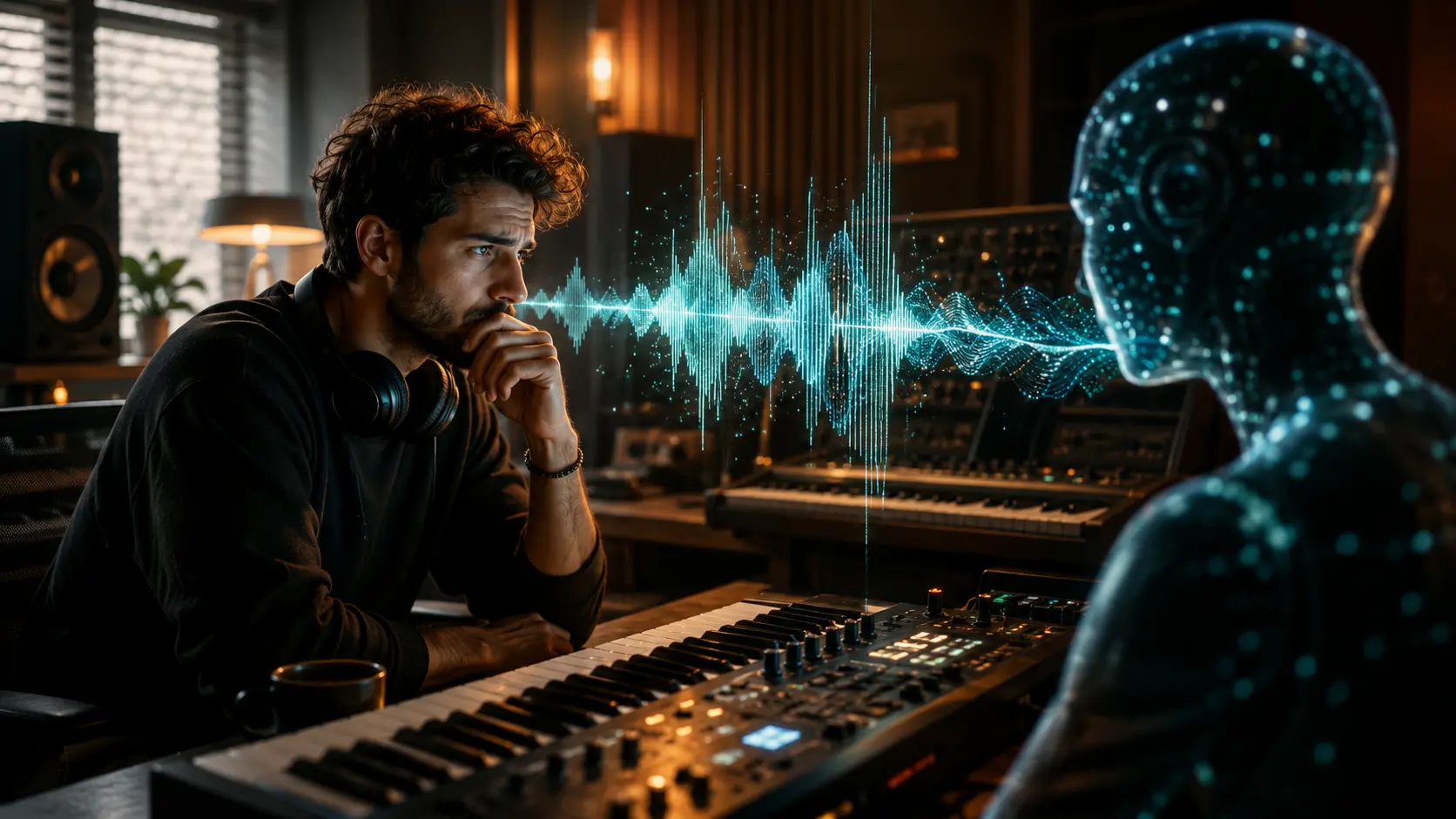
The most interesting part of the recent conversation between Adam Neely and Alex O'Connor was not the familiar argument about copyright, jobs, or whether AI-generated songs “count” as music. It was the deeper question sitting underneath the entire interview: what exactly are we losing if music becomes frictionless?
That framing matters because discussions around AI music are often trapped in a shallow loop. Either the technology is celebrated as democratization, or criticized as theft. But Neely’s argument goes somewhere more uncomfortable. His concern is not simply that AI might replace musicians. It is that generative systems like Suno automate the part of music that actually makes music culturally meaningful in the first place.
The interview becomes compelling precisely because Neely is not arguing like a reactionary purist. He repeatedly acknowledges that music history is full of disruptive technologies. Recorded music disrupted live performers. Drum machines replaced session drummers. MIDI, sampling, autotune, quantization, and digital audio workstations all transformed the economics and aesthetics of music production. He openly admits that people once called those tools “cheating” too.
But he insists AI is categorically different.
Not because it changes music production, but because it changes where musicality itself lives.
The Core Fear Is Not Automation. It Is Deskilling.
One of the strongest sections of the interview arrives early, when Neely compares AI music generation to industrial deskilling.
He references the assembly line as an analogy. Before industrial automation, building a car required a collection of highly skilled craftspeople. The assembly line fragmented and automated those tasks until much of the original craft disappeared. The product remained. The skill ecosystem did not.
Neely argues that AI music systems threaten something similar because they automate “idea generation” itself.
That distinction matters.
Most previous music technologies still required musicians to make musical decisions. Sampling required taste, rhythm, editing, and arrangement. MIDI required understanding timing, harmony, and sequencing. Even autotune and quantization usually sat downstream from human performance.
But systems like Suno bypass the slow, embodied process of developing musical instincts through repetition, failure, experimentation, and collaboration. Instead of extending musical craft, they compress it into prompting.
That is why Neely keeps returning to the word “craft” throughout the interview.
For him, music is not merely the final audio artifact. Music is the accumulation of bodily memory, social interaction, technical judgment, and disciplined repetition. Learning an instrument changes the person learning it. Sampling records changes the listener. Playing in bands changes how musicians hear each other. Improvisation changes reaction speed and emotional sensitivity.
AI systems shortcut all of that.
And this is where the interview becomes more philosophically interesting than most AI debates.
The real issue is not whether AI songs sound good enough. Eventually, many of them probably will.
The issue is whether removing the process also removes the meaning.
Neely’s Most Important Argument Is About Human Reciprocity
A recurring theme throughout the conversation is that music is fundamentally communal.
Neely repeatedly describes music less as an object and more as a social activity. He references musicologist Christopher Small’s concept of “musicking,” where music is understood not as a product but as a relationship between people participating in shared experience.
That idea reshapes the entire debate.
If music is primarily a file, then AI music is simply another production tool.
But if music is fundamentally relational, then replacing human interaction with generation systems changes the thing itself.
This becomes especially clear during the discussion about producers versus AI systems. O’Connor pushes back intelligently, arguing that many musicians already rely heavily on producers, engineers, session players, and technical specialists. A singer might describe a feeling or atmosphere while someone else handles the engineering execution. Why should prompting AI be fundamentally different?
Neely’s answer is subtle but important.
Human collaboration involves resistance.
A producer pushes back. A session musician interprets differently. A bandmate introduces surprise. A jazz player responds in real time. The social friction is part of the creative process itself.
An AI system does not collaborate. It fulfills requests.
That distinction echoes broader concerns appearing across generative AI fields right now. Many AI systems optimize for instant satisfaction. But human collaboration often creates value precisely because another person introduces unpredictability, disagreement, reinterpretation, or emotional complexity.
In other words, AI systems are excellent servants and poor collaborators.
And art may depend more heavily on collaboration than the tech industry currently assumes.
The Interview Quietly Becomes About Culture Fragmentation
The conversation’s strongest section comes later, when Neely introduces the idea of “narcissistic music.”
He references users in AI music communities describing themselves as their own favorite musicians because they can now generate perfectly personalized music streams tailored exactly to their tastes.
At first glance, that sounds harmless. Even empowering.
But Neely identifies something culturally corrosive underneath it.
Shared culture only exists because people consume the same artifacts together.
Songs become socially meaningful because they are collectively recognizable. A wedding song matters because everyone knows it. A concert matters because thousands of people react simultaneously. A jazz standard matters because musicians can improvise around a common framework.
Hyper-personalized AI music weakens those shared references.
Spotify already began this process algorithmically, pushing listeners toward mood streams and individualized discovery rather than artist-centered fandom. AI generation pushes the logic further. Why discover artists when you can generate endless content optimized specifically for your preferences?
Neely’s fear is not merely aesthetic decline.
It is cultural isolation.
That concern extends beyond music.
Large portions of digital life are already becoming hyper-personalized. News feeds, recommendation systems, algorithmic entertainment, and AI companions all increasingly optimize around individualized consumption patterns rather than shared social experience.
The danger is not simply low-quality content.
The danger is a world where culture stops functioning as common ground.
O’Connor Provides the Necessary Counterweight
What makes the interview work is that O’Connor does not simply agree with Neely.
He consistently pushes the strongest possible counterarguments.
He argues that AI tools could unlock creativity for people who lack technical training, time, physical ability, or production access. He describes friends using AI-generated demos to prototype songs they otherwise could never realize.
Importantly, this is not a trivial argument.
Historically, access to music production required expensive instruments, technical education, studio infrastructure, and often geographic proximity to creative communities. AI dramatically lowers those barriers.
O’Connor’s strongest thought experiment asks Neely to imagine losing the ability to physically play instruments or communicate traditionally, leaving AI systems as the only route for externalizing musical ideas. Would AI-assisted creation still count as meaningful then?
Neely partially concedes the point.
And that concession matters because it reveals the nuance in his position.
He is not arguing that AI-generated music has zero legitimate use cases.
He is arguing that convenience should not be confused with musical development.
That distinction becomes central to the interview’s philosophy.
The Real Divide Is Taste Versus Skill
One of Neely’s most revealing observations is his claim that generative AI shifts culture away from skill and toward taste.
That may sound abstract, but it captures a major tension emerging across AI industries.
Generative systems increasingly allow users to curate outcomes without developing the underlying capabilities traditionally associated with producing them.
You no longer need to illustrate to direct visual aesthetics. You no longer need to code to prototype software. Increasingly, you no longer need to understand harmony, arrangement, rhythm, or instrumentation to produce music-like outputs.
The remaining human role becomes preference selection.
Neely finds that future spiritually hollow because admiration traditionally grows around demonstrated mastery.
People are inspired by watching others become excellent at difficult things.
That observation explains why the interview repeatedly returns to jazz.
Jazz represents almost the opposite of generative AI culture. It emphasizes spontaneity, imperfection, embodied skill, communal responsiveness, and risk. Live improvisation creates meaning precisely because listeners witness humans navigating uncertainty together in real time.
AI systems remove uncertainty from creation.
But uncertainty is often where artistry lives.
The Most Important Observation Is Probably Sociological
Late in the interview, Neely describes attending an AI and music conference where faculty members were broadly optimistic about AI while younger students were overwhelmingly skeptical.
That inversion is notable.
Historically, disruptive media technologies usually spread through younger generations first. Electric guitars, synthesizers, hip-hop production, internet culture, and social media all diffused upward from youth adoption.
AI music appears different.
Neely suggests older generations may feel more culturally excluded and therefore more attracted to systems that offer immediate creative participation. Younger musicians, meanwhile, already possess familiarity with digital creative tools and often appear more protective of human artistic identity.
If true, that creates a potentially important market signal.
It suggests AI music may face a legitimacy problem inside the very demographic that typically defines future cultural norms.
That does not mean AI music disappears.
But it may shape where it settles socially.
Neely predicts a future where human-created live music becomes a prestige experience while AI-generated content fills lower-cost, high-volume entertainment layers.
That outcome already resembles trends emerging elsewhere in media. Human authenticity increasingly functions as a premium signal in environments flooded with scalable synthetic content.
The Interview’s Most Valuable Insight Is About Meaning, Not Technology
The easiest way to misunderstand this conversation is to reduce it to “AI good” versus “AI bad.”
That is not really what the interview is about.
The deeper question is whether art is fundamentally defined by outputs or by relationships.
AI systems can already produce increasingly convincing artifacts. That capability will improve dramatically. But humans rarely attach meaning to outputs alone.
People attach meaning to struggle, intention, memory, context, identity, and shared experience.
O’Connor makes this point beautifully near the end when discussing paintings and music recordings. Knowing the story behind a work changes how audiences experience it. The context becomes inseparable from the artifact itself.
That observation may ultimately become the strongest defense of human creativity.
Not because AI cannot imitate style.
But because culture is not merely style.
Culture is accumulated human context.
And context cannot be generated as easily as content.
Read also
The Broader AI Lesson Extends Beyond Music
The reason this interview matters extends well beyond the music industry.
The conversation accidentally exposes a larger tension at the center of generative AI adoption.
Modern AI systems are extraordinarily good at reducing friction.
But not all friction is waste.
Some forms of friction produce attachment, identity, community, and meaning.
Learning an instrument is inefficient. So is writing manually, collaborating with difficult colleagues, revising drafts repeatedly, practicing public speaking, or rehearsing performances.
But those inefficient processes often create the very human qualities people later value most.
That does not mean generative AI has no place in creative work. Clearly it will.
The more important question is whether societies can distinguish between tools that extend human capability and systems that gradually replace the developmental experiences that make culture socially meaningful in the first place.
That distinction may define not only the future of music, but the future of creative labor more broadly.

Popular news
Latest comments
Loading