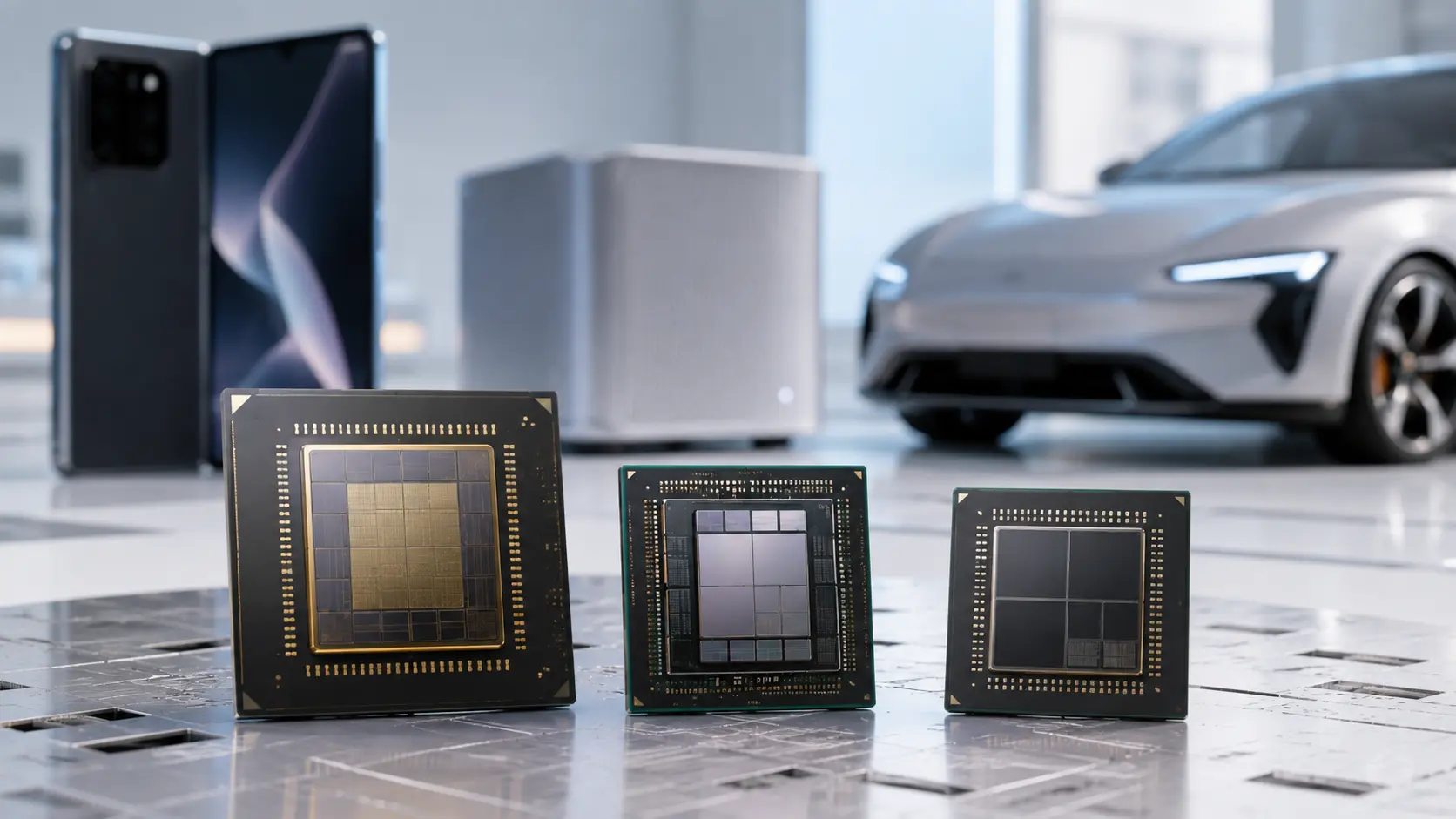
Xiaomi has unveiled three self-designed Xring chips in Beijing. The Xring O3 is a processor for smartphones and tablets, the O100 accelerates on-device AI models, and the D100 targets intelligent driving. With that, Xiaomi expands its chip strategy in one move from mobile devices to AI accelerators and cars.
According to Xiaomi, the O3 is already in mass production. The company says development of the O100 and D100 is complete and plans commercial rollout in 2027. Products using these two specialized AI chips have not yet been announced.
Three chips, three missions
The Xring O3 succeeds the O1 introduced in 2025. Xiaomi cites a 3nm design with 24 billion transistors, ten CPU cores, a sixteen-core GPU, and support for LPDDR6 memory. The updated NPU is said to deliver 200 TOPS of tensor compute and is optimized for Xiaomi’s own MiMo models. The chip is slated to debut in September inside the Xiaomi 18 Fold and a new tablet.
The O100 isn’t a full phone processor, but a 6nm on-device AI accelerator. Xiaomi stacks compute and memory in this design, claiming 1.22 terabytes per second of memory bandwidth and up to 330 tokens per second during local inference. Such figures are only meaningfully comparable once the model, precision, and power settings are known.
For cars, there’s the 3nm D100. Xiaomi mentions twenty CPU cores, sixteen NPU cores, and support for up to 160 GB of shared memory. In theory, that could run a model with more than 200 billion parameters locally. That maximum doesn’t reveal how quickly such a model would respond in a moving vehicle or which safety functions it could support.
Impressive benchmarks—still just vendor claims
During the presentation, Xiaomi positioned the O3 as an AI flagship. The company reports an AnTuTu score of 5,228,014. In Geekbench 6, multicore performance is said to be 60 percent higher than the O1; traditional graphics performance allegedly rose 85 percent. For MiMo inference, Xiaomi claims a 45 percent speed-up versus what it calls common flagship SoCs, aided by its own quantization and compression. These results come from Xiaomi’s own lab and have not been independently verified.
That distinction matters. A synthetic benchmark measures a specific configuration and doesn’t automatically predict battery life, heat, or real-world app speed. And 200 TOPS isn’t a universal yardstick: software, memory throughput, and numerical precision determine how much of that theoretical capacity is actually usable.
Reuters, citing anonymous sources, reports that TSMC manufactures the O3 on 3nm and that the upcoming foldable with the O3 has a shipment target of 200,000 to 300,000 units, according to one source. Xiaomi confirmed mass production but did not name a manufacturer or volumes. TSMC declined to comment. Treat that sourcing as background, not as a jointly announced production contract.
Xiaomi tightens the link between hardware and MiMo
The three designs fit Xiaomi’s push to control more of its ecosystem. A custom mobile processor can tightly align cameras, power management, HyperOS, and on-device models. The O100 tackles the memory bottleneck of local generative AI even more directly; the D100 brings the same logic to cars.
That move matches Xiaomi’s software progress. AIWereld previously reported how MiMo V2 ranked highly on AI leaderboards. But a strong model alone doesn’t make a great product. The edge only appears when compiler, memory, OS, and apps fully exploit the custom chip.
According to Reuters, Xiaomi has invested more than 20 billion yuan—about 3 billion dollars—in Xring. One source says the chip team now exceeds 3,000 employees. The previously announced goal to invest 50 billion yuan over at least ten years remains the backdrop; the new development today is that Xiaomi has shown three concrete chip designs and rollout windows.
Global availability is still a question mark
For European consumers, nothing changes today. Xiaomi has not announced Dutch pricing, an international sale date, or a list of supported AI features. It’s also unclear whether the Xiaomi 18 Fold with O3 will launch outside China. The O100 and D100 won’t arrive before 2027 and could still change before then.
Practical details for developers are also missing. The announcements include no public SDK, supported models, or developer documentation for the O100 and D100. Maximum model size says little without knowing the required quantization, context length, and software stack. A custom chip only becomes a platform when both external and internal developers can reliably program it.
Details about licenses and compatibility with existing Android apps are also absent.
The broader trend is clear, though. Arm recently released chip designs for on-device AI in mobile, while Qualcomm’s wearable chip for local AI agents underscores the same shift to edge AI. Xiaomi aims to stand out not just by adopting such an architecture, but by designing the processor across several of its own product lines.
Next up are the real tests: independent O3 reviews in September, actual power draw for the O100, and safe deployment of the D100 in vehicles. Until then, this is a major expansion of Xiaomi’s chip program—but only independent testing and shipping products will show how competitive these designs really are.

Latest comments
Loading