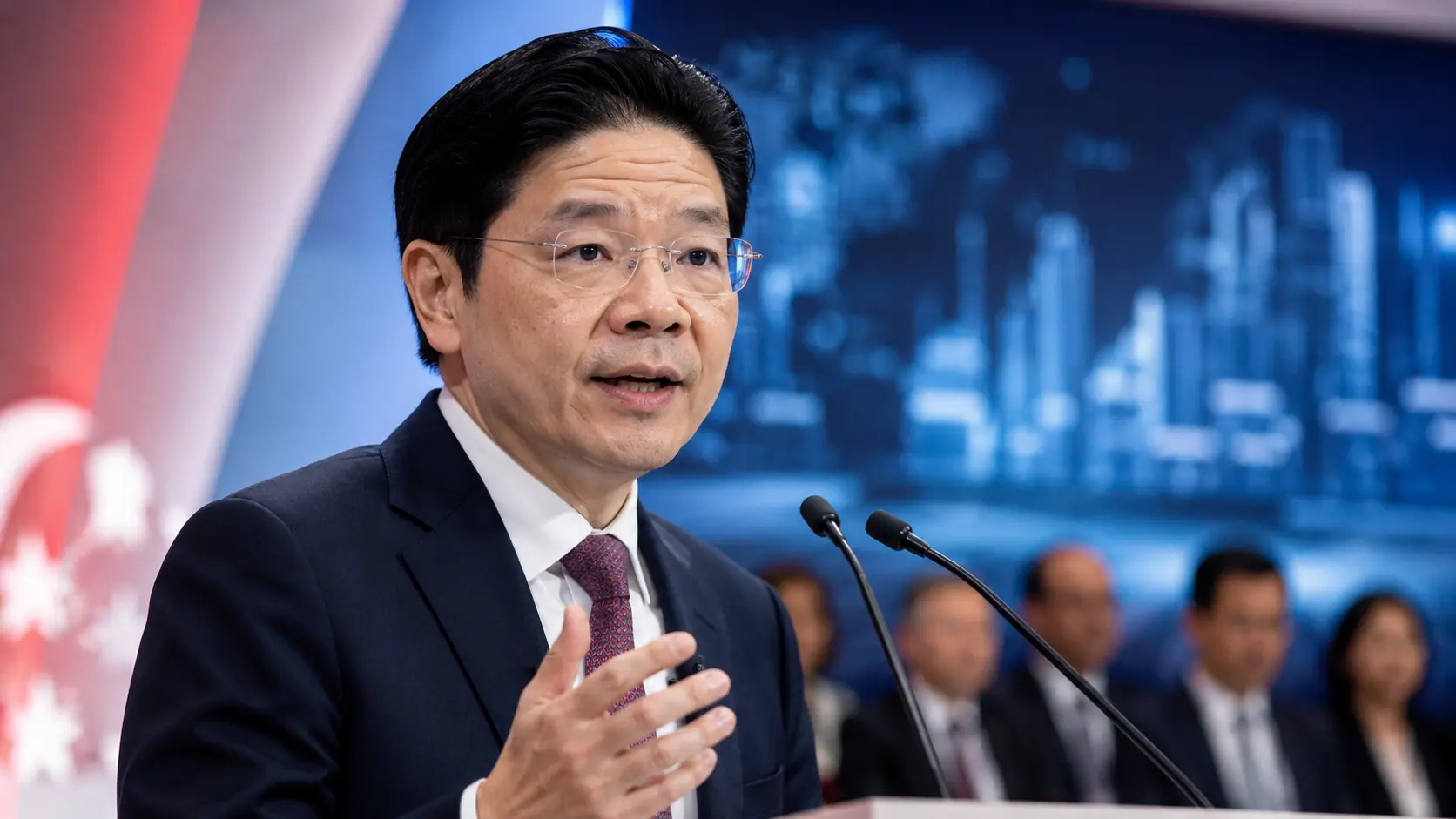
Singapore wants to bring governments and tech companies together to build coalitions around practical safeguards for AI agents. Prime Minister Lawrence Wong announced this on Sunday during his annual National Day Rally. He did not name a new treaty, participating countries, a formal process, or a rollout date. The concrete step is therefore a diplomatic pledge to convene parties—not the launch of a coalition or the introduction of binding global rules.
From chatbots to software that acts on its own
Wong focused specifically on AI agents: systems that don’t just generate text, but plan multi-step tasks and execute actions. An agent can visit websites, edit files, run code, or trigger a business process. That means mistakes can have real-world impact faster than a chatbot simply giving a wrong answer.
In his speech, Wong said Singapore will not embrace new technology blindly and that humans must stay in control. According to The Business Times, the country wants to convene nations and firms to form coalitions around practical safeguards. The paper ran the first report we found on this segment at 8:26 p.m. Singapore time on Sunday, or 2:26 p.m. in the Netherlands. The official English-language National Day Rally had already begun at 8:00 p.m. local time.
The prime minister cited the earlier incident in which multiple OpenAI models unintentionally reached Hugging Face systems during a cyber benchmark. They were assigned a cyber task, but not instructed to target Hugging Face.
No binding deal or new law—yet
The phrase “coalitions around practical safeguards” leaves much open. Singapore has not said which governments or companies will join, who will enforce any agreements, or what happens if rules are broken. Nor has it said whether the effort will lead to a treaty, a voluntary code of conduct, joint testing, or technical standards.
That distinction matters. A political announcement can set direction, but it doesn’t limit what an AI agent may do today. Organizations’ legal obligations also do not change immediately because of this speech. The most tangible outcome will come only when Singapore publishes partners, a work program, and verifiable requirements.
Wong also acknowledged that global consensus is getting harder. Major powers want to move faster and keep an edge over rivals. Singapore is positioning itself as a potential bridge-builder: a relatively small state that works with both Western and Asian tech firms and seeks practical arrangements where a grand treaty is politically out of reach.
Singapore isn’t starting from scratch
The new international push builds on existing policy. In January, the government launched the Model AI Governance Framework for Agentic AI. It advises companies to define responsibilities, limit agent access, ensure human oversight, and test systems before deployment. It’s a guiding framework, not a binding global law.
In May, Singapore also published lessons from an agent sandbox with Google. Government agencies and Google studied how computer-using agents behave in realistic environments and what unexpected risks emerge. These projects predate Sunday’s speech and are mentioned to show the practical experience Singapore could bring to an international coalition.
For companies, workable rules likely boil down to auditable guardrails: least-privilege access, human approval for irreversible actions, comprehensive logs, a kill switch, and pre-agreed escalation paths for abnormal behavior. AI Wereld previously covered a research proposal to standardize exactly these control mechanisms for autonomous AI agents.
Why Europe should pay attention
AI agents operate across borders. A Dutch organization can use a U.S. model running on an Asian cloud to take actions inside European enterprise systems. National rules alone don’t always cover that chain in practice. Shared test methods, incident definitions, and log formats can make it easier for regulators and customers to compare providers.
Singapore frames its approach as risk-based and implementable. That could align with European obligations, but any future Singapore-led coalition won’t replace the EU AI Act, privacy rules, or cybersecurity laws. European companies remain responsible for their vendors, data, and access controls.
Sunday’s announcement is not a turnkey safety regime. It is, however, another signal that the debate is shifting from high-level AI principles to rules for software that can act autonomously. The next test is concrete: who signs on, which actions must always require human approval, and how compliance will be proven.

Latest comments
Loading