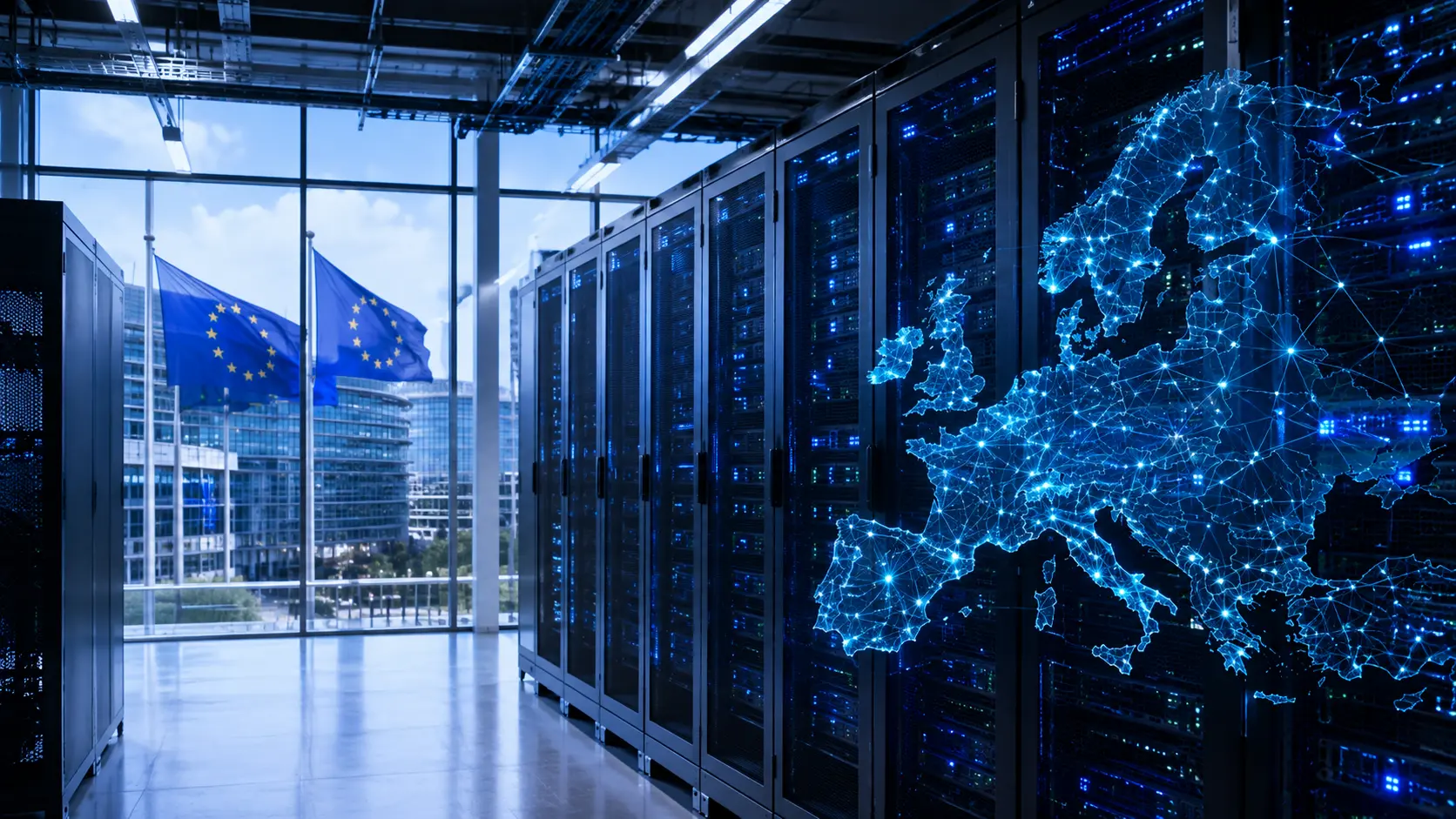
Europe has the researchers, capital, industry and increasingly the compute. The question is whether it can turn those ingredients into power.
You don't have to be an engineer to see that something strange is happening in Europe.
Europe has excellent universities, world-class researchers, industrial giants, the machines required to manufacture the world's most advanced chips, enormous amounts of capital, sophisticated energy companies and a single market of more than 450 million people. Yet somehow, at the end of the technology chain, we keep finding ourselves dependent on American platforms.
I've been thinking about this while looking into Mistral.
Personally, I don't particularly care whether Mistral succeeds. I don't own shares in the company, I don't have any special attachment to it because it happens to be French, and I don't think Europe needs Mistral specifically to win anything.
But I find it fascinating to watch.
Mistral gives us a live experiment for a much bigger question: can Europe create, foster and scale major companies in this new world of AI?
Because the simplistic story that Europe can't build AI clearly isn't true. In just a few years, Mistral has become Europe's most important frontier AI company. It raised €1.7 billion in 2025 at a valuation of €11.7 billion, is building European compute infrastructure of its own and wants to develop capacity toward 1 GW by 2030.
The most interesting detail in that funding round, at least to me, was ASML.
ASML invested €1.3 billion and became Mistral's largest shareholder, with a stake of roughly 11%. One of Europe's most important industrial companies, which builds machines without which the world's most advanced chips cannot be manufactured, now owns a significant part of one of Europe's most promising AI companies. The two are also working together on applying AI across ASML's products, research and operations.
This is exactly the kind of connection I want to see more often. An enormously successful European industrial company is putting some of its capital into a new European technology company, while that technology company can in turn make the industrial company better.
You can start to see the beginnings of a loop.
And there are more pieces moving. Europe now has 19 AI Factories, is planning much larger AI Gigafactories and this summer opened a process for up to seven such facilities. Meanwhile, the European Investment Bank and all 27 EU governments are backing a new investment alliance intended to mobilize as much as €80 billion for European technology scale-ups.
The more I look at it, the less convinced I am that Europe lacks the ingredients.
The bigger problem may be what happens between them.
Europe doesn't have much of a startup problem
Look at what happens when something like OpenAI, Nvidia, Palantir or SpaceX emerges in the United States. Around it sits a huge system of capital markets, institutional investors, cloud providers, universities, government agencies, military contracts, venture capital and a massive domestic market. There is also, I think, a greater willingness to place enormous bets on companies that might fail spectacularly.
When one of those companies succeeds, it can tap into many of those things at roughly the same time. Capital pays for infrastructure, government contracts create customers, universities provide talent, existing technology companies provide distribution, and deep public markets eventually give early investors and employees somewhere to sell.
Success creates the conditions for more success.
Europe has many of the same pieces, but they connect much less reliably.
The European Investment Bank describes the consequences surprisingly clearly. By their tenth year, European scale-ups have raised roughly 50% less capital than comparable companies in San Francisco. More than four out of five European scale-up deals involve a foreign lead or sole investor. EU venture funds raise only a fraction of the venture capital raised in the United States.
The pattern that follows is familiar. Europe educates people and produces interesting companies, but once one of those companies needs hundreds of millions or billions to compete globally, foreign capital becomes increasingly important. Foreign infrastructure becomes attractive or necessary. An American acquisition or stock exchange starts to make sense. Some of the economic value, expertise and wealth generated by the company then compounds somewhere else.
That is why the term scale-up gap is so useful.
Europe is pretty good at producing smart people, conducting research and starting companies. It is exceptionally good at creating highly specialized technologies that the rest of the world sometimes discovers it cannot live without.
The problems become much more obvious once something works.
Why doesn't the European flywheel turn?
I don't think "Europeans are too risk-averse" explains enough.
There are structural reasons.
Europe has enormous pools of savings, insurance capital and pension money, yet remarkably little of that money reaches venture capital. The EIB recently estimated that around 0.024% of European pension fund assets are invested in venture capital.
That number is almost absurd when you put it next to the constant European discussion about our supposed lack of capital.
The capital exists. Getting it from European savers into European high-growth companies is much harder.
Institutional mandates, prudential regulation, fragmented markets, different national systems and the risk profile of venture investing all contribute to this. The European Commission itself describes the European venture and growth capital ecosystem as fragmented and underdeveloped, with regulatory, tax and market barriers making it harder for funds to scale across the continent.
Then there is the other end of the process.
Taking enormous risks on young companies becomes easier when there is a deep market waiting for the ones that succeed. American technology companies can eventually access enormous pools of public capital through markets such as Nasdaq.
Europe still has nothing comparable at the same scale. Its capital markets remain divided between countries, legal systems and investor pools, while European scale-ups are more likely to seek foreign buyers or list on foreign exchanges.
The consequences go further than where a company's ticker ends up.
Founders, employees and early investors who become extremely wealthy from a technology success often become investors in the next generation. They bring money, experience, networks and a much higher tolerance for ideas that sound ridiculous to everyone else. When Europe's biggest successes repeatedly end up inside foreign capital markets or foreign companies, part of that compounding process moves abroad as well.
Government procurement creates another problem.
The United States has spent decades building institutions that connect technological development to the state. The Pentagon, intelligence agencies and programmes such as DARPA, In-Q-Tel and SBIR can give young technology companies something extraordinarily valuable: serious customers with difficult problems and serious budgets.
Europe spends enormous amounts through public procurement too, but young companies often struggle to access those markets. Risk aversion, slow procedures, national fragmentation and systems designed around established suppliers make governments much less effective as early customers.
Once you look at those connections, the European problem becomes less mysterious.
We have the savings, governments spending enormous amounts of money, universities producing talent, large industrial companies and a sophisticated financial sector. We struggle to connect them in ways that allow one success to produce the next.
That is the flywheel.
Power requires power
AI adds another problem because so much of it is physical.
Frontier models run inside real buildings, on physical chips, consuming enormous amounts of electricity. Data centers need grid connections. Those grids need generation, transmission capacity and transformers. All of that needs permits, investment and time.
Mistral's ambition to build toward 1 GW of European capacity by 2030 therefore interests me more than another benchmark result.
Europe already struggles with grid congestion, slow permitting and the difficulty of building large infrastructure quickly. We can announce an AI strategy in Brussels, but eventually that strategy has to become a data center somewhere, connected to a grid capable of supplying it.
If we cannot solve that, our technological ambitions eventually run into transformers, transmission lines, permits and waiting lists.
There is something almost amusingly literal about it.
Europe needs power to have power.
What strategic autonomy should actually mean
This is also where I think the discussion about European technological sovereignty sometimes goes wrong.
Complete technological independence isn't realistic. America uses ASML machines. Europe uses Nvidia GPUs. Taiwan fabricates advanced chips. Japan produces critical materials and equipment. Modern technology depends on supply chains crossing continents.
Trying to recreate every component inside European borders would cost an extraordinary amount of money and, in many cases, leave us rebuilding things our allies already produce better.
So I think the useful question is much simpler:
Do we have enough capacity of our own that nobody can effectively switch us off?
That is the definition of strategic autonomy that makes sense to me.
Europe needs enough alternatives, infrastructure, expertise, energy, industrial capacity and bargaining power that another country or company cannot make fundamental European choices for us.
We don't have to control everything.
We need enough control to retain agency.
Europe has known power before
There is a strange historical contradiction here.
I don't think there is anyone in the world who doubts that Europeans have had the power to literally change and rule enormous parts of the world. At a global scale, we are still wrestling with that historical fact today.
European empires shaped borders, institutions, languages, trade routes, legal systems and economies across much of the planet. You can judge that history however you want, but you cannot seriously argue that Europeans historically lacked the ability to organize and project power.
So I don't think Europe simply forgot how power works.
The more interesting explanation is that post-war Europe was deliberately designed to constrain it.
After two catastrophic world wars, that made sense. The European Coal and Steel Community started by placing the industries required to wage war inside a shared institutional structure. European integration was partly an attempt to make the old European balance-of-power politics harder to practise.
It worked extraordinarily well.
Western Europe became peaceful, prosperous and increasingly integrated. National power was constrained through rules, institutions, courts and economic interdependence.
The world outside Europe didn't undergo the same transformation.
The United States still uses industrial policy, procurement, export controls and military power to pursue strategic interests. China openly pursues technological independence and industrial scale. Russia has reminded Europe, brutally, that military power never disappeared.
The institutions Europe built to constrain power internally now have to operate in a world where power remains very real externally.
That, to me, is much more interesting than saying Europeans have somehow become culturally incapable of thinking big.
The answer obviously isn't to romanticize empire or rediscover nineteenth-century nationalism. There is an enormous space between imperialism and helplessness.
Europe has to figure out how to act collectively without becoming what European integration was originally designed to prevent.
A democratic Europe can believe in international cooperation, human rights, regulation and the rule of law while possessing the technological, industrial, economic, energy and military capacity to defend its own interests.
In the world we're moving into, I suspect it will have to.
Does Europe still have agency?
This is why I've been thinking about a recent column by Dutch geopolitical analyst Rob de Wijk.
His argument was much broader than AI. He wrote about climate, migration, Ukraine and geopolitics, and about a Europe that increasingly risks becoming a spectator rather than a player.
I think the question underneath all of those subjects is whether Europe still has agency.
Can Europe shape events, or can it increasingly only respond to events created somewhere else?
AI may be the cleanest technological version of that question.
If AI becomes general-purpose infrastructure comparable to electricity, the internet or cloud computing, European control over it will matter far beyond whether we have a good chatbot. Models, compute, data centers, electricity, cloud infrastructure, industrial applications and defense systems will become layers of the same technological stack. The countries and companies controlling enough of those layers will have enormous economic and political leverage.
This is also why I prefer talking about control rather than trying to put a European flag on every piece of technology.
Europe doesn't need every model to be European. It doesn't need every GPU to be European. It doesn't need every cloud provider to be European.
It needs choices.
If one supplier disappears, can we continue? If an ally becomes less friendly, do we have alternatives? If a European company develops strategically important technology, can we finance its next stage ourselves? If European governments decide that a capability matters, can they actually procure and deploy it?
That is what agency looks like in practice.
Can Europe build the machine?
I'm not ready to conclude that Europe has become a spectator.
Europe has almost all the resources required to remain a serious technological power. What it hasn't proved is that it can connect and mobilize them quickly enough.
At least the problem now seems to be getting more attention. AI Factories and Gigafactories address compute. European initiatives are trying to bring more institutional capital into technology scale-ups. The Commission is examining barriers preventing venture funds from becoming larger and genuinely pan-European. There are also attempts to make governments better customers of innovative companies.
Whether any of this moves quickly enough is another question.
But I think we're finally asking a better one.
We already know Europe can innovate. ASML alone should have ended that discussion years ago.
Can Europe organize, finance and scale what it creates?
And this brings me back to Mistral.
Personally, I don't need Mistral to succeed.
Maybe it becomes one of the world's great AI companies. Maybe it gets overtaken by someone else. Maybe another European company we haven't heard of yet becomes far more important.
Individual companies come and go.
What interests me is whether Europe can keep producing them.
Can there be another Mistral after Mistral, and another after that? Can successful European AI companies produce engineers who start five more? Can their founders eventually become investors? Can European industrial companies become their customers and shareholders? Can European pension and insurance capital participate when those companies need billions rather than millions? Can governments help create markets for technologies they consider strategically important?
If Mistral succeeds, I want to know whether its success makes the next European company easier to build.
If Mistral fails, I want to know whether the ecosystem around it has become strong enough to produce another one.
That is the test.
Because ultimately I don't care very much about Europe having its own version of OpenAI.
I care whether Europe can create, foster and scale major players in this new world of AI.
We have the researchers. We have the universities. We have the money. We have more than 450 million people. We have companies such as ASML, Siemens, SAP, Airbus and Schneider Electric. We have governments capable of spending extraordinary amounts of money. We have some of the physical infrastructure on which the rest of the technological world depends.
The pieces are there.
Can Europe build the machine?

Latest comments
Loading