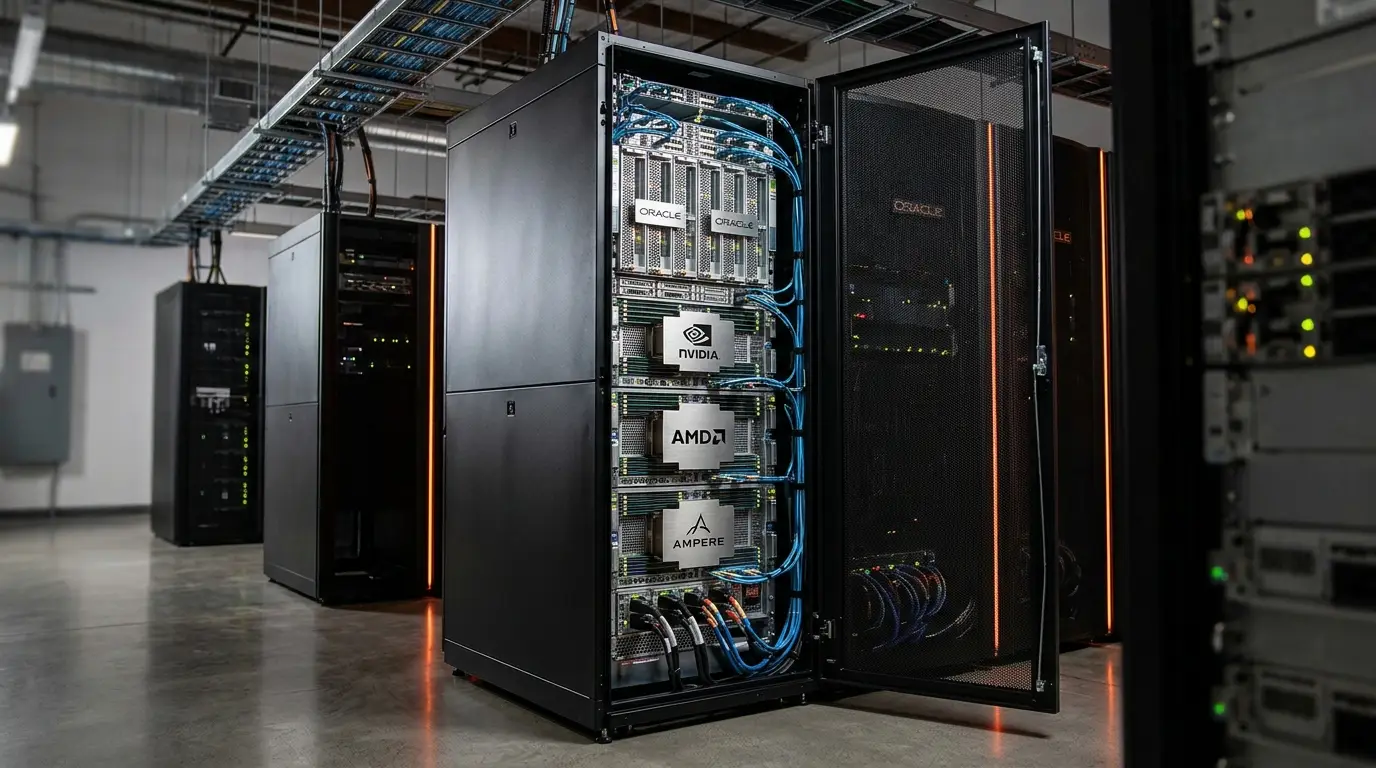
Oracle Cloud Infrastructure recently announced major compute agreements at AI World 2026 to integrate five distinct silicon architectures into its platform. This strategic move positions the company as the first hyperscale cloud provider outside of Google to offer Tensor Processing Units. The initiative fundamentally shifts how artificial intelligence workloads are processed by distributing tasks across specialized hardware rather than relying on a single vendor ecosystem.
The foundation of this massive expansion relies on the general availability of NVIDIA Vera Rubin systems. These advanced racks and Vera CPUs are now live on the platform with concrete plans to scale the infrastructure to multi gigawatt capacity. Customers can explore the technical specifications and performance benchmarks of these systems on the official NVIDIA Vera Rubin product page. Alongside this deployment, Google will introduce its eighth generation TPUs for both training and inference tasks in calendar year 2027. This partnership allows developers to access specialized machine learning hardware through the Google Cloud TPU official documentation.
Specialized Hardware for Agentic Workloads
Oracle is also incorporating specialized inference processors to handle the growing demand for agentic workloads. Cerebras will deploy its wafer scale inference technology to keep compute and memory on a single die, drastically reducing latency. Details about this unique architecture are available on the Cerebras official website. SambaNova is contributing its fifth generation Reconfigurable Dataflow Units specifically optimized for the decode stage of inference. You can learn more about their hardware capabilities and enterprise solutions at the SambaNova official site.
A multiyear collaboration with Intel will bring Diamond Rapids processors into planned X14 system shapes to support x86 compatible AI serving and application services. The Intel Xeon processor family page provides comprehensive details on these upcoming enterprise chips designed for heavy computational loads.
Hardware Integration Overview
| Hardware Architecture | Primary Workload Focus | Expected Availability |
| NVIDIA Vera Rubin | Training and general AI compute | Currently available |
| Google TPU 8t and 8i | Machine learning training and inference | Calendar year 2027 |
| Cerebras Wafer Scale | High speed decode stage inference | Calendar year 2027 |
| SambaNova SN50 | Reconfigurable dataflow for agent response | Calendar year 2027 |
| Intel Diamond Rapids | x86 compatible AI serving and tool execution | Future X14 shapes |
Navigating Operational Complexity
This multi silicon approach requires a robust networking foundation to connect disparate hardware efficiently. Oracle Acceleron networking will serve as the common fabric linking TPU clusters and NVIDIA systems within the data center environment. This custom SmartNIC technology ensures that different silicon architectures can communicate seamlessly while maintaining high performance standards across the entire infrastructure.
Integrating multiple silicon platforms introduces operational complexity regarding software stacks and demand forecasting. Developers will need to navigate different programming environments like CUDA and specialized software development kits. Oracle must ensure its scheduling layers make this hardware heterogeneity completely invisible to the end user. The success of this strategy depends on capturing sufficient value through network ownership while meeting the massive capital requirements of multi gigawatt data center expansions. Investors and enterprise clients will closely monitor upcoming financial disclosures to see if revenue commitments match the reported capacity investments.

Popular news

Podcast: Google's Genie 4 gives AI worlds a soundtrack

Warhorse Studios Confirms Cyberattack After Hackers Access Company Data

Google’s Genie 4 Creates Interactive Worlds with Sound

Apple Creator Studio Update Adds MotionVFX and Artificial Intelligence Features

MIT Researchers Observe AI Agents Playing Without Assigned Tasks
Nvidia and Oracle Expand Cloud Infrastructure to Fix Idle GPU Problems
Latest comments
Loading