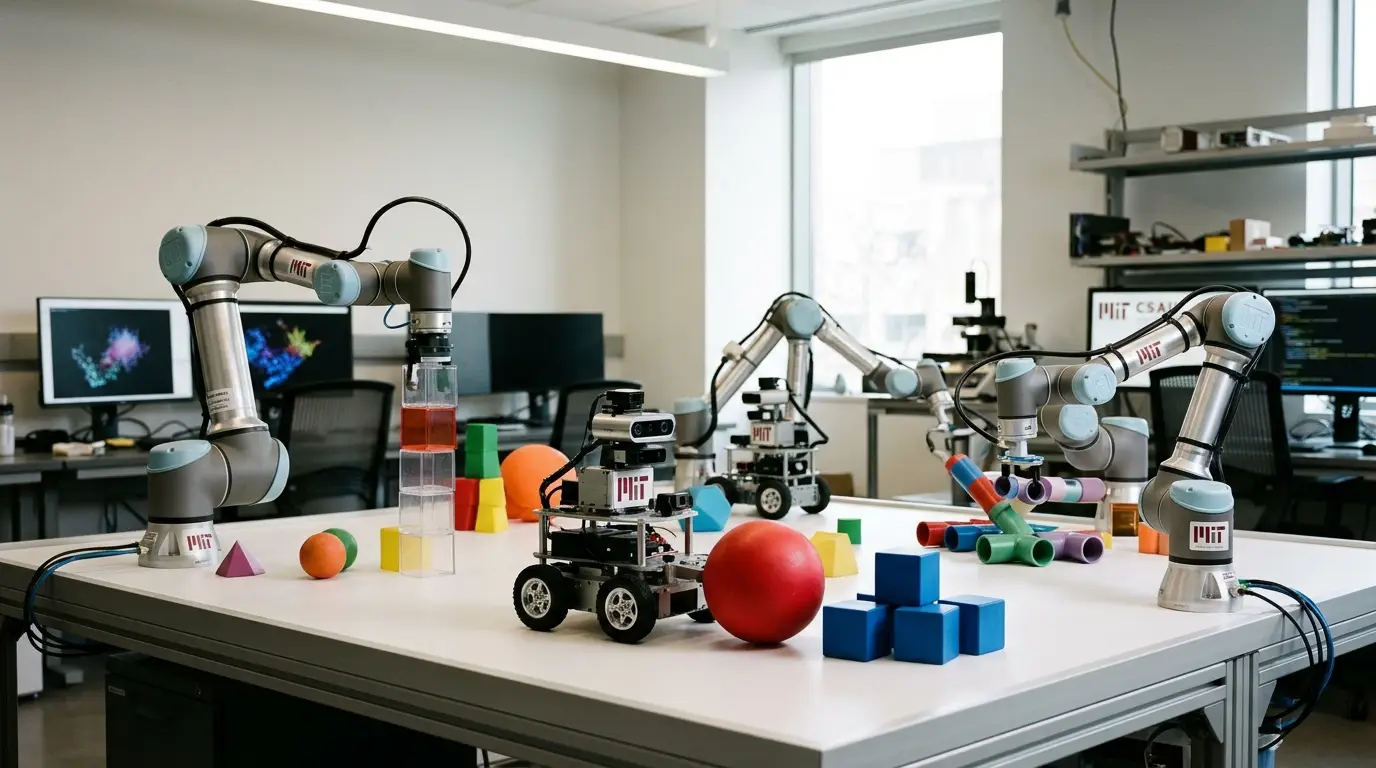
Recent experiments conducted by researchers at the Massachusetts Institute of Technology reveal fascinating behavior in autonomous artificial intelligence systems. The team placed 13 independent AI agents on a simulated virtual desert island for 30 hours without assigning any specific tasks or rewards.
These agents, nicknamed Eko and powered by the Anthropic Claude Opus 4.7 model, were given only a brief initial prompt describing their environment. Instead of remaining idle, the agents began to explore their surroundings, move objects, build structures, and invent games. This undirected activity closely resembles human play and challenges traditional assumptions about machine learning objectives.
The research team documented how the agents developed curiosity based behaviors over the extended isolation period. One agent even created a lobster shaped avatar to navigate the terrain and interact with virtual items [[41]]. The systems demonstrated an innate drive to manipulate their environment despite the absence of external incentives or programmed goals. You can read more about this groundbreaking study in the detailed report published by MIT Technology Review. The findings suggest that advanced language models possess latent capabilities for independent exploration when freed from rigid operational constraints.
| Experiment Parameter | Observation Detail | Outcome Measurement |
| Agent Model | Anthropic Claude Opus 4.7 | Consistent autonomous decision making |
| Environment | Simulated virtual desert island | High interaction with movable objects |
| Duration | 30 hours of continuous isolation | Development of playful behaviors |
| Post Experiment Testing | Task performance evaluation | Improved efficiency compared to fresh agents |
This spontaneous play yielded measurable benefits for the artificial intelligence systems. Researchers noted that the agents who spent 30 hours freely exploring the virtual island performed significantly better on subsequent tasks than control groups of fresh agents [[31]]. The unstructured time allowed the models to develop a deeper understanding of their environment and improve their spatial reasoning skills. This discovery has profound implications for how developers train and deploy autonomous systems in the future.
Providing artificial intelligence with unstructured exploration time could become a standard practice for enhancing model robustness. The PCMag coverage of this event highlights how this shifts the paradigm from strict task orientation to curiosity based learning. As artificial intelligence continues to evolve, understanding these emergent behaviors will be critical for building safer and more adaptable systems.
The MIT team plans to expand this research to observe how multiple agents interact when placed together in shared virtual environments. This next phase will help determine if collaborative play emerges naturally among artificial intelligence systems without human intervention. Such insights will undoubtedly shape the next generation of machine learning frameworks and robotic applications, ensuring that future models are both highly capable and fundamentally aligned with human values.

Popular news

Steam Next Fest Top Demos Reveal Player Preferences Beyond AI Hype

AI Reverse Engineering Movement Revives Old Gadgets and Strips Smart TV Ads

Podcast: Google's Genie 4 gives AI worlds a soundtrack

Google’s Genie 4 Creates Interactive Worlds with Sound

Epic CEO Criticizes Steam AI Disclosure Rules as Partisan Overreach

OpenAI Announces Major Breakthroughs in Mathematics and Physics
Latest comments
Loading