Meta Title: Meta Description: Main Keywords: Nvidia AI financing, Jensen Huang resignation, $500 billion AI infrastructure, Wall Street AI investment, Colette Kress interim CEO Slug URL: Tags: Nvidia, AI Infrastructure, Wall Street, BlackRock, Apollo, Corporate Finance, Tech News
Wall Street Faces Uncertainty Over Massive AI Financing Pact Following Nvidia Leadership Shake-Up
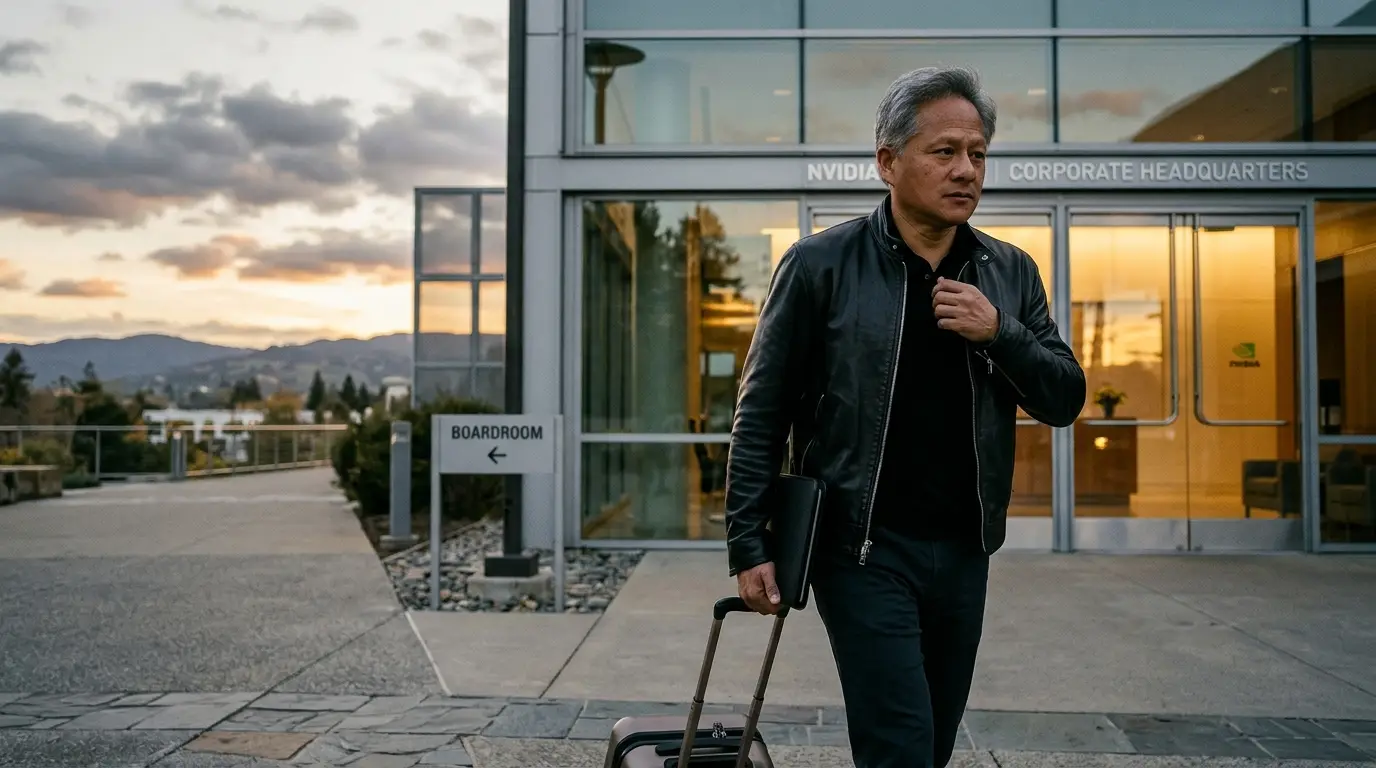
Jensen Huang's abrupt departure from the helm of Nvidia has sent shockwaves not just through the semiconductor industry, but across the broader financial sector. The chipmaker’s sudden leadership crisis now threatens to complicate an ambitious $500 billion Wall Street financing initiative designed to turn artificial intelligence hardware into bankable infrastructure assets.
The $500 Billion Vision
Before the scandal and subsequent resignation, Nvidia was widely considered the undisputed central bank of the AI build-out. In a landmark move announced this past August, the company signed memorandums of understanding with six of the world’s largest asset managers—Apollo Global Management, BlackRock, Blackstone, Brookfield, Goldman Sachs, and KKR. The goal was to mobilize over half a trillion dollars in third-party capital to fund next-generation data centers and chip factories. Rather than treating graphics processing units (GPUs) as rapidly depreciating tech equipment, Huang's strategy sought to securitize them into stable, long-term collateral, comparable to the financing models used for real estate or toll roads.
Market Reaction and Investor Jitters
The financial markets reacted violently to the CEO transition, with Nvidia shares initially plunging more than 13% before recovering slightly in after-hours trading. Wall Street is now grappling with succession risk. While Chief Financial Officer Colette Kress has stepped in as interim chief executive, institutional investors are pausing to re-evaluate the terms of the massive compute financing platforms.
According to Sunaina Sinha Haldea, global head of private capital advisory at Raymond James, a sudden leadership change gives every lending firm a natural moment to scrutinize the underlying agreements. While she noted that the capital itself is unlikely to walk away—since lenders are fundamentally underwriting Nvidia's silicon and the robust customer contracts attached to it—the uncertainty could lead to tighter financing terms. Investors may now demand a higher risk premium to compensate for the sudden executive void.
| Wall Street AI Financing Consortium | Role in AI Infrastructure Push | Estimated Market Cap or AUM |
| BlackRock | Global Infrastructure Investment Partnerships | ~$11.6 Trillion AUM |
| Apollo Global Management | Private Credit & Digital Infrastructure | ~$670 Billion AUM |
| Goldman Sachs | Asset Securitization & Tech Underwriting | ~$263 Billion Market Cap |
| KKR | Private Equity for Compute Platforms | ~$686 Billion AUM |
Repricing the AI Ecosystem
The broader risk is a potential ripple effect across the entire AI financing ecosystem. Charu Chanana, chief investment strategist at Saxo, warned that the leadership shake-up could make Wall Street significantly more cautious. This hesitation might slow down final commitments or introduce more discipline into a market that was already facing scrutiny over rising debt levels and circular financing models.
While a full financing crisis is not currently on the table, Huang's departure acts as a catalyst for a broader repricing of risk across the AI sector. As the board initiates its search for a permanent successor, Kress will face the immediate challenge of reassuring these financial titans that the core business vision and technology roadmap remain entirely intact. If the new leadership cannot quickly stabilize confidence, the $500 billion pipeline could see severe delays or structural renegotiations.

Popular news

EU Leaders Meet in Dublin to Decide Who Pays for Europe’s AI Computing Power

Google DeepMind’s AlphaGenome 2 predicts what DNA variants do in specific cells
Anthropic Says Automated Coding Tools Are Dismantling Nvidia Software Moat
US Data Brokers Supply Half Billion Dollars In AI Training Environments To Chinese Labs

Google DeepMind Ships Next Generation Robotics and Genomic AI Models