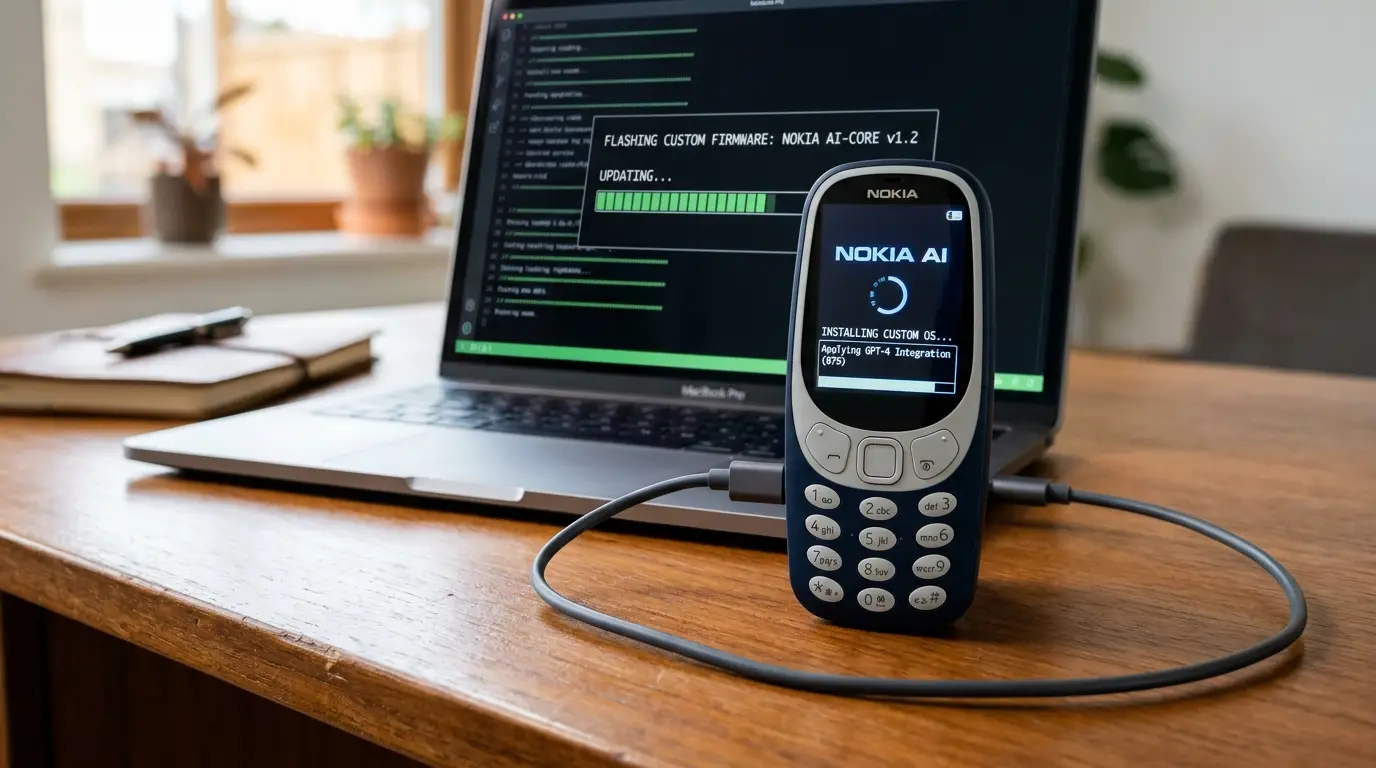
Turkish developer Emir Karsiyakali recently demonstrated a clever method to bring modern artificial intelligence capabilities to the classic Nokia 6300. This iconic device originally launched in 2007 and remains a favorite among enthusiasts of legacy mobile technology. The original hardware relies on a 2G network connection and an outdated web browser limited to TLS 1.0 security protocols. These limitations make accessing the modern internet nearly impossible today, as major technology companies deprecated this standard years ago. You can read the full details of this project in the recent Engadget coverage.
To solve this problem, Karsiyakali created a custom application named Aikon. This name is simply Nokia spelled backward. The software acts as a bridge between the vintage mobile device and contemporary large language models. The system requires a separate Go server to manage API keys from major providers like Anthropic, Google, OpenAI, or xAI. This server communicates with the chosen artificial intelligence platform and truncates the generated responses into 8 kilobyte blocks. The older phone hardware can easily process these smaller data packets without crashing.
The application supports multiple major chatbot platforms. Users can connect their device to Claude, ChatGPT, Gemini, or Grok. The developer designed the software with several practical features to improve usability on a small 240 by 320 pixel display. A dedicated reading mode helps users navigate long text responses using the physical keypad. Users can also save conversation histories to a memory card for offline review. The system even supports voice message analysis. Users can record audio clips up to 30 seconds in length, and an external model handles the speech to text conversion before sending the data to the main chatbot.
The developer has made the entire project open source. This decision allows the global programming community to review the code and suggest improvements. You can find the complete installation instructions and source code on the official Aikon GitHub repository.
| System Component | Operational Mechanism | Practical Advantage |
| Network Bridge | External server manages API requests and payload reduction | Bypasses legacy browser security limitations |
| User Interface | Keypad optimized reading mode and offline storage | Enhances usability on low resolution screens |
| Media Processing | External speech to text and image analysis pipelines | Enables multimodal input on basic hardware |
| Localization | Built in support for multiple international languages | Broadens global user adoption potential |
Setting up the system requires some technical knowledge. Users must configure their own server environment and manage token billing for the chosen artificial intelligence provider. The developer provides clear documentation to guide users through the installation process. This hands on approach ensures that users maintain full control over their data and API usage. The project serves as an excellent educational resource for developers interested in building custom integrations for legacy hardware.
Potential users should note significant geographic limitations. The application requires an active 2G cellular network to function. Major carriers in North America have completely shut down their legacy 2G infrastructure. T Mobile in the United States officially retired its GSM network recently. Therefore, this project is currently only viable for users living in regions where 2G networks remain operational, such as parts of Europe, Asia, and Africa.
This project highlights the creativity of the developer community when facing hardware limitations. By utilizing a middleman server, enthusiasts can breathe new life into vintage electronics. The Aikon application proves that classic mobile devices can still participate in modern technological conversations with the right software adjustments. It transforms a piece of nostalgic hardware into a functional, albeit limited, artificial intelligence terminal. This innovative approach demonstrates how legacy technology can be repurposed rather than discarded, offering a unique blend of retro aesthetics and cutting edge computational power.

Popular news

Podcast: Google's Genie 4 gives AI worlds a soundtrack

Warhorse Studios Confirms Cyberattack After Hackers Access Company Data

Google’s Genie 4 Creates Interactive Worlds with Sound
Apple Creator Studio Update Adds MotionVFX and Artificial Intelligence Features

MIT Researchers Observe AI Agents Playing Without Assigned Tasks

Nvidia and Oracle Expand Cloud Infrastructure to Fix Idle GPU Problems
Latest comments
Loading