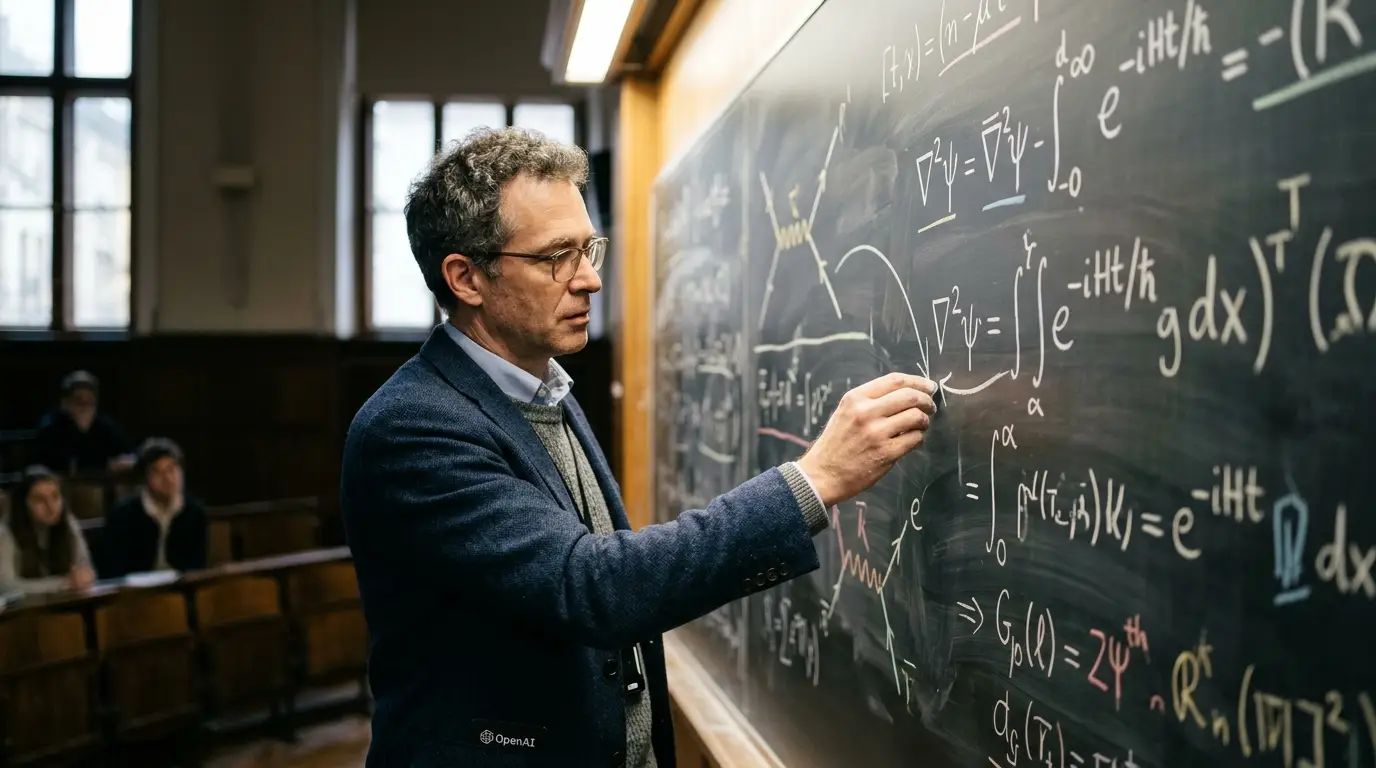
OpenAI recently announced significant discoveries across mathematics, computer science, and physics. The organization shared these findings to accelerate scientific understanding through collaboration with external academic experts. You can read the official announcement on the OpenAI research blog.
New Mathematical and Computational Proofs
The mathematics breakthrough involves harmonic analysis. OpenAI models successfully proved the local smoothing conjecture in every spatial dimension. This achievement also resolves the Kakeya conjecture and Stein restriction conjecture across all dimensions. The team published both a natural language writeup and a Lean formalization on their public GitHub repository to allow global peer review.
In computer science, the models produced a proof demonstrating that the Exponential Time Hypothesis is false. This hypothesis previously served as a foundational assumption in hundreds of papers regarding computational hardness. Disproving it opens new pathways for developing faster algorithms in graph theory, computational biology, and database management.
The original proposers of this hypothesis, including Russell Impagliazzo and Ryan Williams, are now leading the external verification group to ensure absolute accuracy.
Quantum Field Theory Advancements
The physics discovery provides a mathematically rigorous existence proof for interacting quantum field theories containing gauge fields and fermions in four dimensions. This includes Quantum Chromodynamics and a unified completion of the Standard Model of particle physics. It also solves a subproblem related to the pure Yang Mills theory, which is part of the Clay Mathematics Institute Millennium Prize problem. A team of Nobel laureates and leading physicists, including David Gross and Arthur Jaffe, is currently reviewing the findings before public release.
Discovery Overview
| Field | Core Discovery | Lead Verification Group | Release Strategy |
| Mathematics | Local smoothing conjecture proof in all dimensions | Independent academic researchers | Immediate public GitHub release |
| Computer Science | Refutation of the Exponential Time Hypothesis | Impagliazzo, Paturi, and Williams | Public release with community conference funding |
| Physics | Existence proof for four dimensional quantum field theories | Gross, Douglas, Jaffe, Klebanov, Nekrasov | Deferred release pending expert writeup |
Collaborative Verification Process
OpenAI is experimenting with new methods for sharing computational research. The organization emphasizes transparency and independence. External experts act as shepherds to interpret the raw data without signing nondisclosure agreements. OpenAI does not seek academic credit for these discoveries. Instead, the focus remains on empowering researchers to validate and contextualize the findings.
These collaborations complement a recent financial contribution to the Simons Foundation. Managed and awarded by the foundation, that funding will support special programs to help researchers understand and build on results produced by artificial intelligence.
This structured approach ensures that groundbreaking computational outputs translate into verified scientific knowledge. The global research community now has the opportunity to examine these proofs and build upon them for future technological and theoretical advancements. Such collaborative frameworks will likely define the future of artificial intelligence in scientific research, ensuring that machine generated proofs receive the rigorous human scrutiny they require.

Popular news

Grand Theft GPU - How Thieves Steal Data Center Hardware in Transit

Anthropic Is Going Public: What Claude’s Numbers Reveal

Steam Next Fest Top Demos Reveal Player Preferences Beyond AI Hype

More FPS with AI and DLSS Doesn’t Automatically Mean a More Responsive Game

AI Reverse Engineering Movement Revives Old Gadgets and Strips Smart TV Ads

Epic CEO Criticizes Steam AI Disclosure Rules as Partisan Overreach
Latest comments
Loading