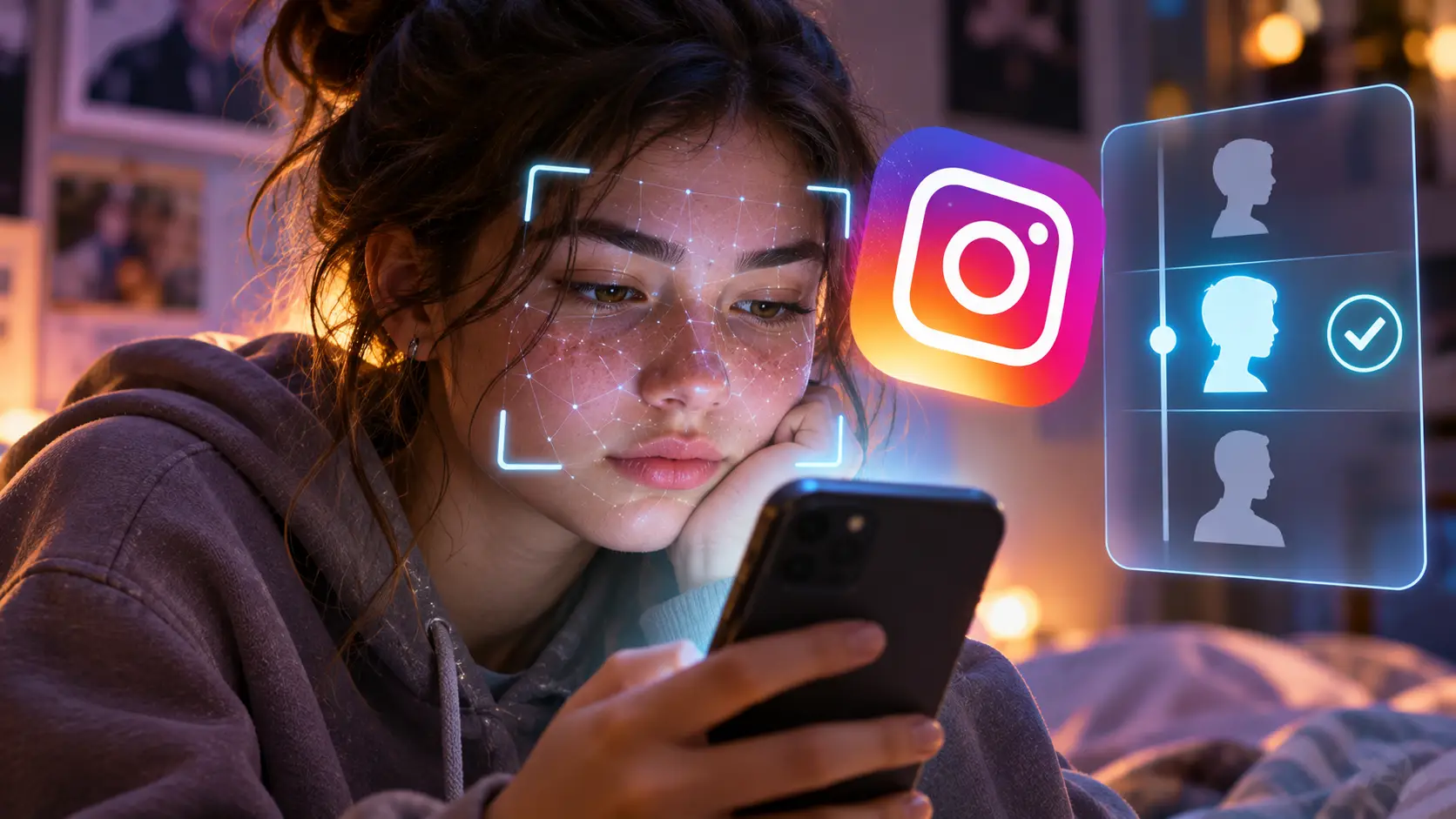
Instagram is using AI worldwide to identify teens who enter an adult date of birth. Accounts it estimates belong to teenagers will automatically be placed under stricter settings for contact, content and app use. Meta says the move is also designed to reach young people who evade existing protections by entering a false age.
The global expansion follows earlier rollouts in several countries. Dutch users are not getting entirely new technology: Meta announced in May that it would extend the system to the European Union. The broader rollout is expected to bring millions more teens under its protections.
Stricter settings—even if teens don’t correct their age
Instagram’s existing Teen Accounts restrict who can message young users. Teens generally receive messages only from people they follow or are already connected to. They also see fewer sensitive recommendations in sections such as Reels and Explore.
After 60 minutes, teens are also reminded to leave the app. Sleep mode silences notifications between 10 p.m. and 7 a.m. This is not the same as blocking access to Instagram altogether.
Users under 16 need a parent’s permission to make built-in protections less restrictive. Meta introduced Teen Accounts in 2024 and expanded them to every country where Instagram is available in June 2025. The latest expansion is aimed primarily at finding accounts that fall outside those settings.
Through parental supervision, parents can also see who their child exchanged messages with over the past seven days. They cannot see the content of those conversations.
AI looks for clues across an account
In an earlier explanation of its age checks, Meta described how AI combines clues from profiles. These can include birthday posts, school years and information in comments, bios and captions. The system can then flag a mismatch between a user’s stated date of birth and the age it estimates they are likely to be.
Meta also uses image analysis to detect users under the minimum age of 13. The company says it looks for general visual clues and does not identify specific people. Meta previously said this image analysis was available only in certain countries.
That limitation still matters: the global expansion of age estimation does not, by itself, prove that every analysis technique is now active everywhere. Accounts believed to belong to children below the minimum age may be deactivated until the user can verify their age.
The system can still get it wrong
When it first introduced the system, Meta acknowledged that the technology could make mistakes. The company said it would give users options to change their settings if they were assigned to the wrong age group.
The latest announcement includes no independently measured error rate. That leaves it unclear how often adults are wrongly placed under teen settings—or teens slip past the added protections.
The same trade-off applies to chatbots. AI Wereld previously reported that ChatGPT introduced a separate experience for teens. There, too, an account’s estimated age helps determine which features and safety limits a user encounters.
Apple sends an additional age signal in Australia
In Australia, Meta also now uses an age range provided by Apple. When setting up a device, parents can confirm an age range, which app developers can then receive as a signal.
Meta is calling for app stores to take on a broader role in age checks. That policy push is separate from Instagram’s global expansion. The company is continuing its existing rollout on Facebook, while similar technology for Threads is expected to launch worldwide later this year.

Popular news

Nvidia CEO Jensen Huang Admits to an Affair as Company Probes Possible Chinese Espionage

Singapore General Hospital Wins Global Healthcare Award For Antibiotic AI Tool

Global Media Leaders Forge AI Action Plan at Beijing Summit

Nvidia Board Launches Probe Into Foreign Intelligence Reports Targeting CEO

Valve Updates Steam Release Rules to Manage AI Game Surge