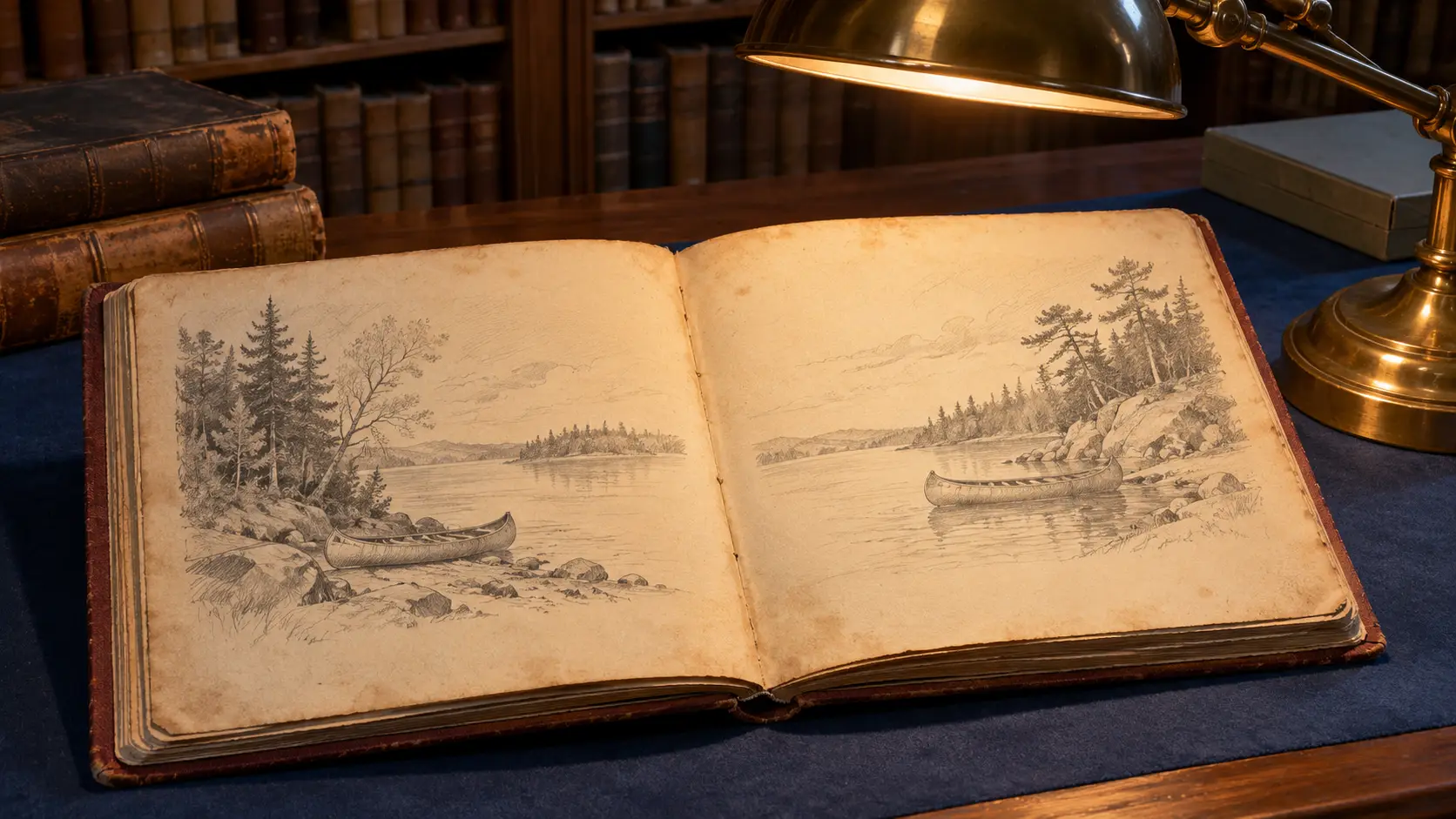
An editorial illustration of a period sketchbook. Yale’s original pages are not shown.
For years, historian Mark Humphries could not put a name to the artist behind an 1808 sketchbook at Yale. OpenAI’s GPT-6.2 Astra gave him a name in 22 minutes. The model also pointed him to a diary that he could use to check its answer.
The drawings follow a trip from Montreal to Lake Superior and back. Only a few have dates and labels. Humphries gave the model access to the images and his own leads. In his account of the test, he says the two candidates he had in mind turned out to be in the wrong places when some of the scenes were drawn.
A name in a Montreal diary
The model found one clue in a diary kept by retired fur trader Joseph Frobisher. An entry placed a French aristocrat, the vicomte de Chabot, in a party that left Lachine on June 6, 1808. Five days later, one of the sketchbook’s dated views put its artist on the Ottawa River. Another source placed Chabot farther west later that month.
That route made Chabot a candidate. It still left open who held the pencil. The model found a reference to Chabot’s own journal and suggested looking at a copy. Humphries then got copies of archival records, including a microfilm journal from Cleveland State University.
The diary gave the historian a way to check
Humphries compared the trip and its dates with the sketches. He says the records support the link to Chabot. The 22 minutes cover the time it took the model to name the artist and find the lead. They leave out the time it took to obtain and read the records.
Humphries later gave the same prompt to Claude Fable 5.2. He says it named Chabot in about 35 minutes and did not find the journal. That is one comparison on one task. Our report on the release of GPT-6.2 Astra covers the model and the tests OpenAI used. In the sketchbook case, the useful part was a lead that a historian could follow to the archive.

Popular news
Soitec jumps 6.9% as European chip stocks rebound and Eutelsat falls
Ant Group releases a design image model that tops the open-weight ranking
Kioxia jumps 12.6% as Asian AI stocks trade through Thanksgiving

Perplexity lets developers search the web as it looked on an earlier date
AI sends more shoppers to retail sites ahead of Black Friday