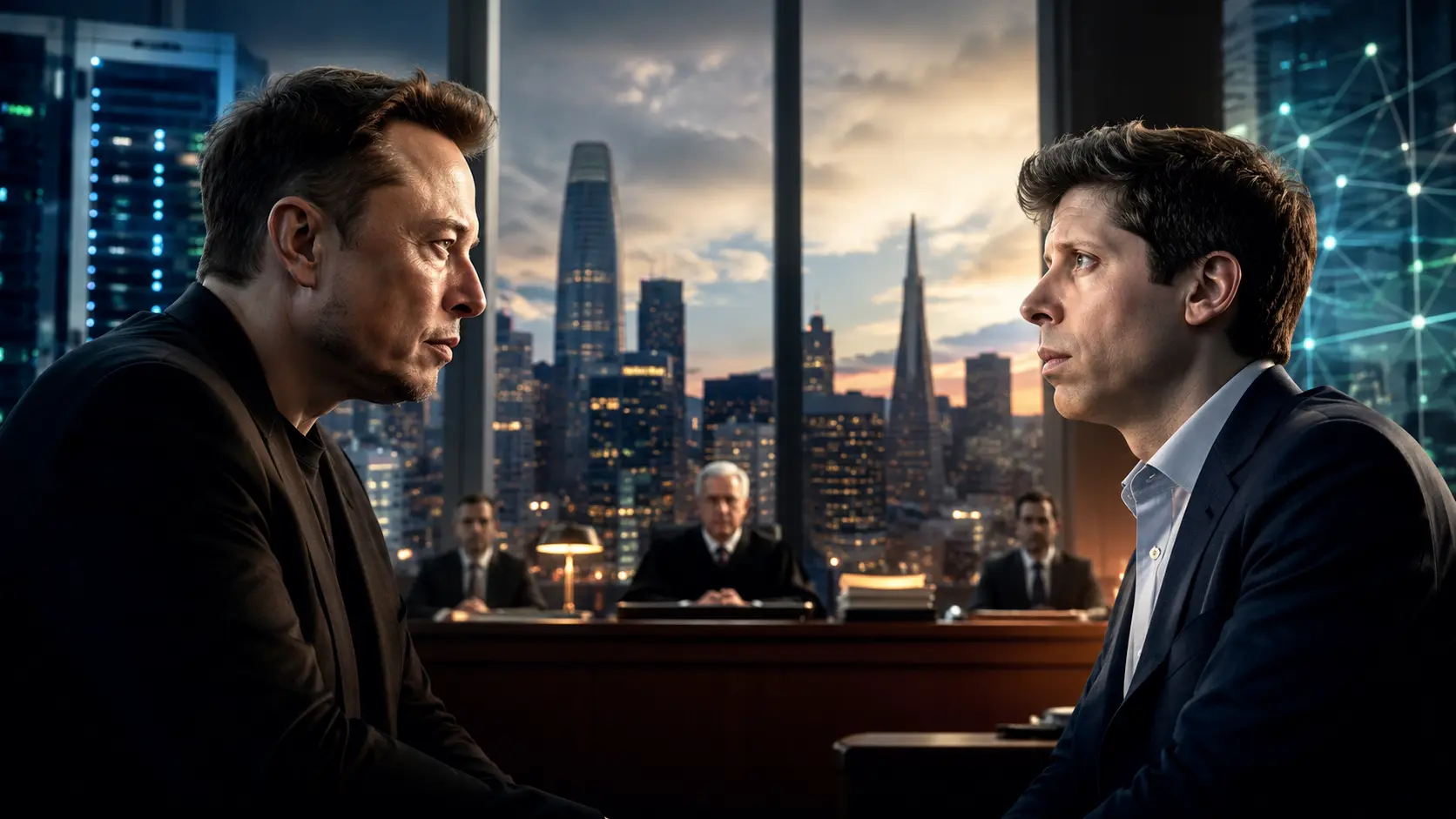
The power struggle between Elon Musk and Sam Altman hit a new peak this week in a lawsuit that could shape the future of OpenAI—and possibly the entire AI industry. In a U.S. courtroom, it’s not just about billions in investments and governance models, but about a core question behind OpenAI’s original mission: should artificial intelligence serve humanity, or commercial growth?
According to live reporting from tech outlet The Verge, Musk accuses OpenAI of betraying its nonprofit roots by morphing into a profit-driven operation closely tied to Microsoft. OpenAI counters that the case is Musk’s attempt to kneecap a rival in favor of his own AI company, xAI.
The lawsuit has become far more than a personal feud between two Silicon Valley heavyweights. It exposes the widening rift between idealism, power, and profit across the global AI sector.
What’s the case really about?
At its core, the dispute centers on whether OpenAI broke its original commitments. Musk co-founded OpenAI in 2015 and invested tens of millions of dollars, he says under the promise that it would remain an open research organization developing AI for the public good.
That structure later shifted dramatically. OpenAI introduced a so-called “capped-profit” model and struck multi-billion-dollar partnerships with Microsoft. Those deals fueled the massive investments needed to build advanced AI models like ChatGPT.
Musk now claims he was deliberately misled. Court filings indicate he wants OpenAI to stop operating as a public benefit corporation and seeks up to $150 billion in damages for the nonprofit behind OpenAI.
OpenAI flatly rejects the allegations. The company argues Musk sought more control over OpenAI, then left when he couldn’t secure a majority.
Sam Altman mounts a forceful defense
On the stand, Sam Altman tried to persuade the jury that OpenAI still acts on its founding mission. Reporters inside the courtroom noted Altman stayed strikingly calm amid repeated attempts by Musk’s attorneys to label him a “liar” and a “manipulator.”
Altman testified that without a commercial structure, OpenAI could never have competed in the global AI race. Building large-scale AI requires staggering compute, specialized chips, and billions in infrastructure.
“I probably could have made a lot more money at Microsoft with a simpler life,” Altman said, according to The Verge. He said he chose to continue with OpenAI because of its mission and its people.
Altman also stressed that OpenAI now oversees one of the largest nonprofit structures in the world—pushing back on the idea that the company has morphed into a conventional tech giant.
Microsoft keeps its distance—carefully
Microsoft plays a conspicuous role in the case. It has invested billions in OpenAI and provides the cloud backbone for many of its systems.
Yet Microsoft appears determined to avoid becoming the focal point of the legal fight. The Verge reports that the company’s opening statement signaled it would rather be anywhere else.
Strategically, that tracks. Microsoft has massive commercial stakes in OpenAI, but it doesn’t want to be cast as the force that fully commercialized an idealistic AI project.
CEO Satya Nadella took the stand this week—an unmistakable sign of how consequential the case has become for the broader tech industry.
OpenAI’s internal rifts spill into public view
The proceedings are also surfacing new details about OpenAI’s internal tensions. Multiple former and current employees testified, including cofounder Ilya Sutskever and former CTO Mira Murati.
The 2023 episode in which Altman was briefly ousted remains a recurring flashpoint in court. Inside OpenAI, that period is now referred to as “the blip.”
Altman said he was blindsided by the board’s decision to fire him, triggering immediate chaos and mass employee threats to quit.
The episode underscores how fragile AI organizations can be when commercial pressures, safety concerns, and governance collide.
AI safety takes center stage
Beyond the money, AI safety looms large in the case. OpenAI board member Jeremy “Zico” Kolter testified that the company runs multiple specialized safety teams focused on model security, evaluations, and alignment research.
According to Kolter, OpenAI’s safety committee has formally asked multiple times to delay AI model releases over safety concerns.
That detail matters because critics often accuse OpenAI of rushing products to market in a race against Google, Anthropic, and xAI.
The lawsuit taps into a bigger, global question: who gets to decide how powerful AI systems are built and governed?
Elon Musk casts himself as AI watchdog
In court, Musk positions himself as a defender of safe, open AI. He argues OpenAI has strayed from its original mission and is now driven mainly by commercial interests.
Critics point out the paradox: last year Musk launched xAI to compete head-on with OpenAI and released the Grok chatbot on X.
OpenAI is using that against him, arguing the lawsuit is really an attempt to slow down a rival.
That clash makes the case thornier. Both sides claim to champion safe AI—while battling for market share, talent, and influence.
Why this case matters for the entire AI industry
The ruling could reshape how AI companies are structured and funded worldwide.
Modern AI demands massive capital, creating friction between idealistic research goals and commercial reality. OpenAI is not the exception—it’s the most visible example.
If Musk prevails, hybrid setups that pair nonprofits with for-profit arms could face legal challenges—potentially rewriting AI investment models.
If OpenAI wins decisively, it bolsters the current playbook: Big Tech pours billions into AI startups in exchange for strategic access to tech and infrastructure.
The case also touches geopolitics. The U.S. now treats AI as a strategic technology in its rivalry with China—fueling pressure to move faster, even when safety questions remain open.
Read also
A personal feud turned power struggle
What began as a dispute between former partners has become a proxy war over the future of artificial intelligence.
The lawsuit underscores how fast AI has shifted from idealistic research to a sector where hundreds of billions of dollars, geopolitical clout, and technological dominance converge.
Investors, policymakers, and rivals are watching closely. Whatever the verdict, one thing is clear: the fight to control AI has only just begun.

Popular news

Latest comments
Loading