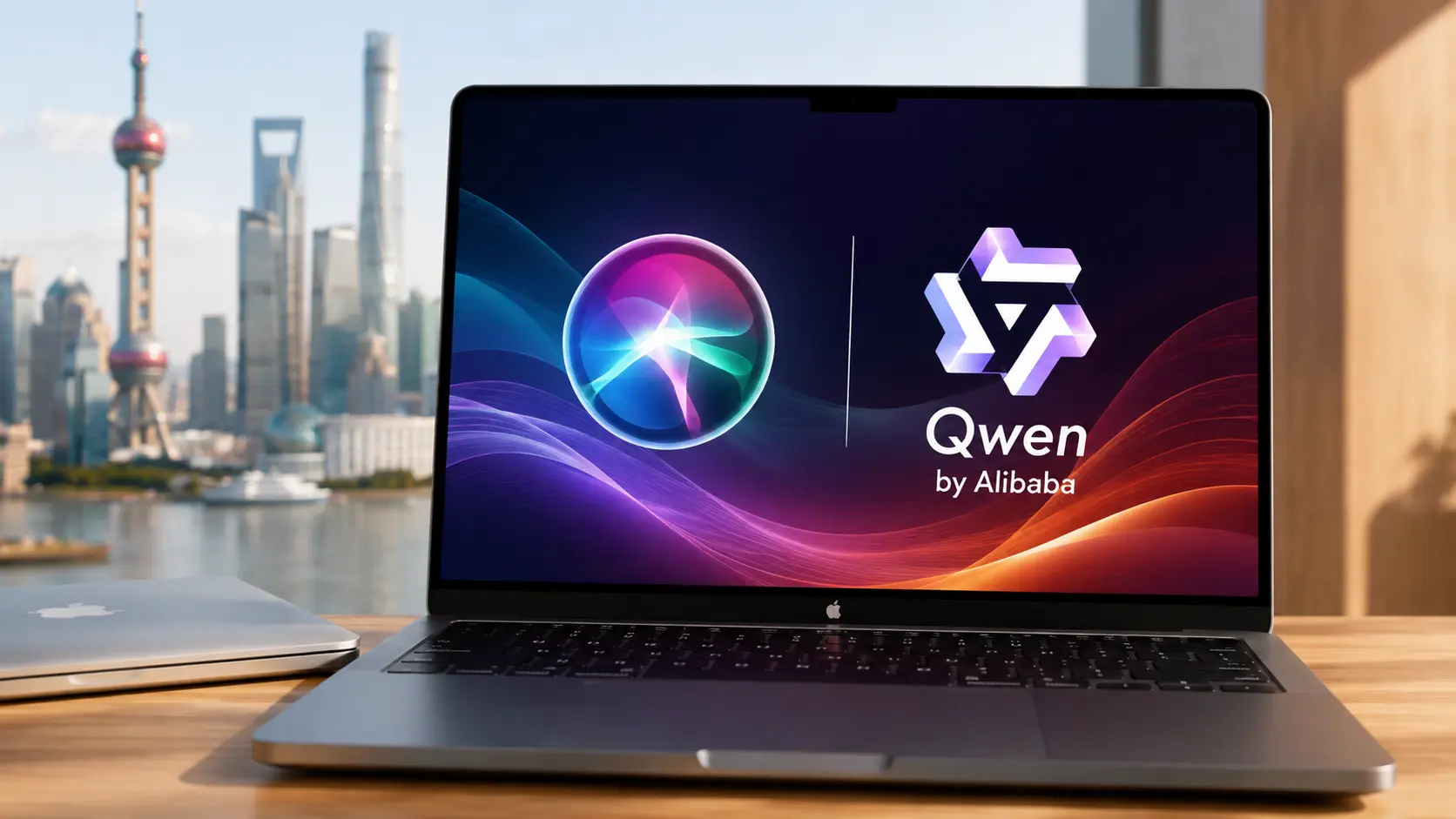
Apple has published a guide that lets eligible Mac users on the Chinese mainland connect Alibaba’s Qwen AI service to Siri and Writing Tools. It gives Apple a local option for more advanced generative AI on Chinese Macs.
Users can bring in Qwen when Siri needs extra help answering a question. The model can also generate or rewrite text, and analyze documents, images, and other files.
For now, the integration is described for Macs running macOS 26.6 or later. Users must enable Qwen themselves and sign in with a Qwen account.
The move shows Apple tailoring its AI strategy by region. In many Western markets, Apple taps ChatGPT for external generative AI. In China, it’s opting for a compliant local provider.
Qwen shows up inside Siri
Qwen is Alibaba’s family of generative AI models. The Chinese tech giant uses them for text generation, image analysis, coding, search, and task automation across its services.
On the Mac, Qwen won’t replace Siri. Siri stays in Apple’s environment. When extra generative AI is needed, Siri can, with user permission, route the request to Qwen.
Apple uses a similar setup outside China to connect Apple Intelligence with ChatGPT. Apple controls the interface and decides when an external service is invoked, while the external model produces the more complex response.
Writing Tools also gets access to Qwen. It can summarize, rewrite, correct, or restyle text. Users can also generate new text and images.
According to Apple’s documentation, Alibaba may not use material processed through the integration to train or improve its models. That includes documents and images a user asks Qwen to analyze.
That privacy condition matters, since an assistant can access personal or business information. It’s still wise for users and companies to review what data is sent to any external provider.
Why Apple needs a Chinese AI partner
Apple can’t simply roll out its international AI services in China. Generative AI providers must comply with local rules and register their services with Chinese authorities.
As a result, foreign AI models aren’t always available or suitable for products sold in China. Partnering with Alibaba gives Apple access to a model already active in the local market.
In July, Apple Intelligence was registered with China’s internet regulator. Alibaba previously confirmed that Qwen would be integrated into Apple devices, while Apple is also working with Baidu on certain features for Chinese iPhone users.
That suggests Apple may use multiple local partners. The provider could vary by device, feature, and technical or regulatory requirements.
The Mac guide is one of the first concrete signals of how Chinese consumers can actually turn the integration on.
AI as Apple’s edge in China’s PC market
This isn’t just about regulation. Apple faces growing pressure in China from local PC and smartphone makers.
Companies like Lenovo and Huawei are packing more on-device AI into their hardware. Their systems can summarize documents, process meetings, generate text, and search data across the computer.
Citing data from market researcher Omdia, Reuters reported Apple’s Mac shipments in China fell 9 percent year over year in Q1. Apple held about 9 percent of the PC market, versus 31 percent for Lenovo and 16 percent for Huawei.
A computer without strong AI features risks becoming a harder sell. The Qwen tie-in helps Apple close the gap with Chinese rivals.
Alibaba also benefits from a presence on Apple devices. Qwen gains access to users who might otherwise pick a competing AI service.
Will Qwen come to the Chinese iPhone?
Alibaba has said Qwen will power Apple Intelligence features in China across iPhone, iPad, Mac, and Vision Pro. However, the newly published instructions focus specifically on the Mac.
Apple hasn’t said when the same link-up will roll out broadly to other devices. The company also hasn’t specified which Qwen model is used.
That matters because Qwen includes multiple models. Some variants target fast, simpler tasks, while larger versions promise stronger performance for analysis, coding, and complex queries.
Apple may also use a specially tuned version. A model embedded in an operating system must deliver good answers while meeting strict requirements for speed, safety, privacy, and moderation.
What this means for users in the Netherlands
For Mac and iPhone users in the Netherlands, nothing changes for now. The Qwen integration targets the Chinese mainland, where Apple faces different technical and legal conditions.
Even so, the partnership is noteworthy beyond China. Apple Intelligence increasingly looks like a platform that can plug into different external AI models.
Rather than choose one global AI partner, Apple can pick the best model per country or feature. ChatGPT may be available in some markets, while Qwen or another local provider fills the same role elsewhere.
That approach reduces Apple’s reliance on a single AI firm and gives it flexibility as rules, prices, or model performance shift.
The Siri–Qwen link is more than a regional update. It signals how Apple plans to deploy generative AI worldwide: one trusted interface, with different models under the hood.

Latest comments
Loading