Nvidia plans up to $3 billion investment in the company behind the Stargate data center
NewsMonday, 10 August 2026 at 07:30
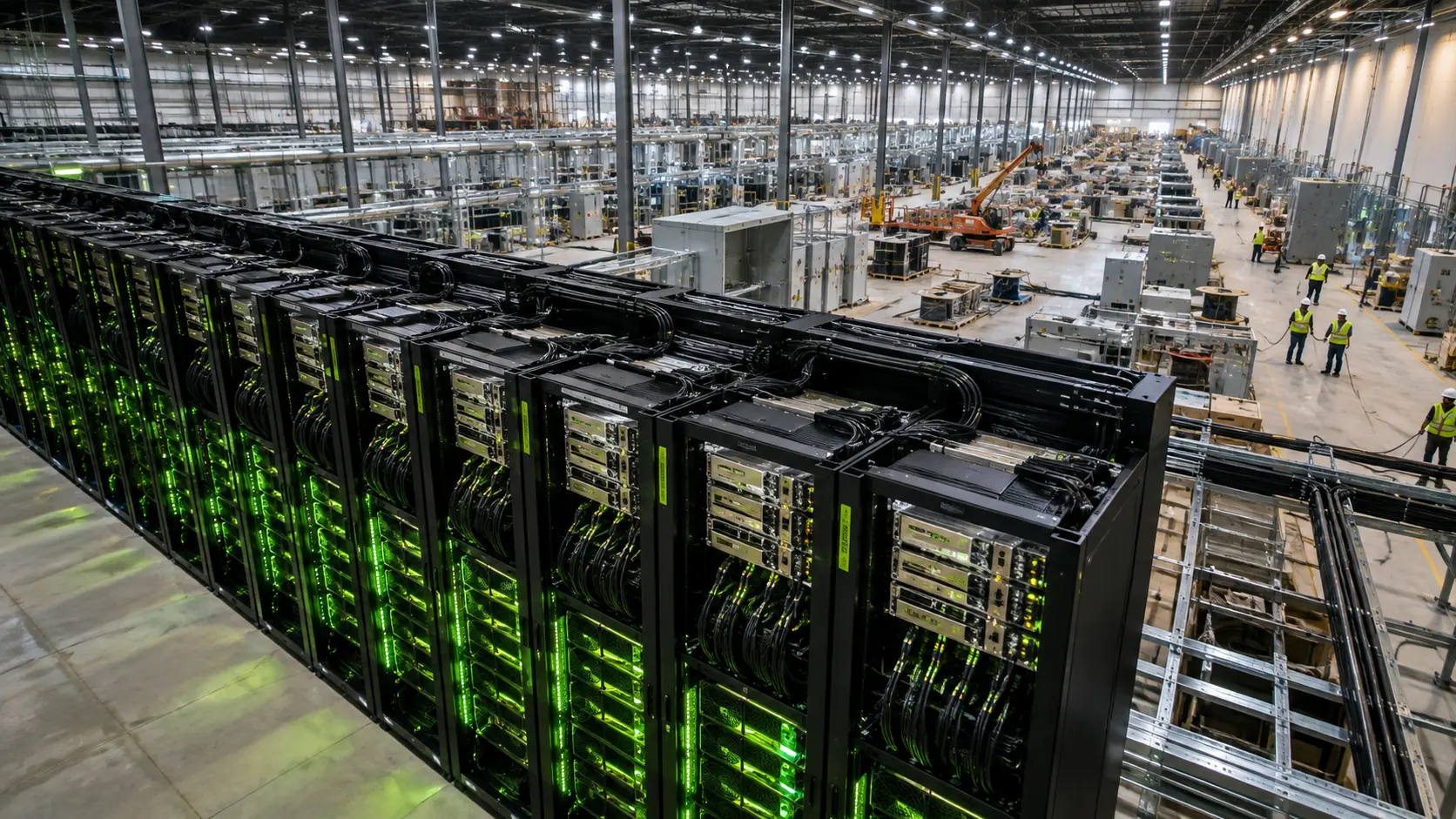
Nvidia is weighing an investment of up to $3 billion in Lancium, a developer of energy and data center infrastructure tied to the U.S. Stargate project. Reuters reports the news, citing The Information.
The potential deal has not been jointly confirmed by Nvidia and Lancium. For now, treat the figure as a reported plan, not a finalized transaction.
If it goes through, the move signals a major shift in the AI industry. The race is no longer just about building the fastest chips. Access to power, land, cooling, and data centers is becoming equally decisive.
What Lancium actually does
Lancium builds large-scale infrastructure in Texas for data centers and other energy-intensive operations, targeting locations where massive amounts of electricity can be brought online.
That makes Lancium a natural fit for AI. Training and running advanced models demands clusters with tens of thousands—or even hundreds of thousands—of processors. Those chips consume enormous power and generate heat that must be removed.
Lancium is involved in a Stargate data center campus in Abilene, Texas. Stargate is linked to OpenAI, Oracle, and various tech and investment partners. The program aims to deliver new U.S. infrastructure for artificial intelligence.
Nvidia supplies the processors and networking gear that power much of this stack. By backing an energy-infrastructure developer, it could help speed the rollout of new AI capacity.
AI’s growth meets hard physical limits
We often describe AI progress in terms of models, software, and algorithms. But every model runs on physical infrastructure.
New data centers need suitable land, permits, water or other cooling, and a high-capacity grid connection. Transformers, generators, fiber links, and specialized building materials can all be scarce.
Chips are of little use if you don’t have the power to run them.
Most electric grids weren’t built for data centers demanding hundreds of megawatts—eventually multiple gigawatts. Getting connected can take years. Local governments and residents are also increasingly scrutinizing energy prices, water use, noise, and environmental impacts.
Lancium’s approach is to co-plan energy and data center capacity at the same sites. In a market where available power is the new bottleneck, that could be a crucial edge.
Nvidia’s business goes far beyond GPUs
Nvidia is best known for designing graphics processors, but it now touches nearly every major component of an AI cluster.
Beyond GPUs, Nvidia sells networking hardware to link vast numbers of processors. It also builds complete server systems and software like CUDA, enabling developers to optimize for Nvidia hardware.
The company is also investing in cloud providers, model developers, robotics firms, and infrastructure projects—making Nvidia a supplier, investor, and strategic partner to many of its own customers.
A stake in Lancium fits that broader playbook. Nvidia wouldn’t just supply compute—it would help shape the environments where that compute can live.
That, in turn, can indirectly boost demand for Nvidia systems. More data center capacity means more room to deploy AI chips.
One tightly knit AI ecosystem
This setup also raises questions about the AI sector’s financial interdependencies.
Chipmakers invest in cloud providers that buy their chips. Cloud providers fund model developers, who then purchase massive compute from those same clouds. Infrastructure developers receive money to build data centers that once again house hardware from the investing chipmakers.
These investments can accelerate critical projects. But they also blur how much truly independent end demand exists.
If AI demand grows slower than expected, multiple companies in the same chain could feel it at once—especially relevant as hundreds of billions of dollars pour into new infrastructure.
For Nvidia, backing energy projects may be strategically smart, but it also increases exposure to the capital-heavy data center sector.
Why Texas keeps winning
Texas has become a major U.S. data center hub. The state offers abundant land, a large energy sector, and comparatively wide latitude to develop new projects.
At the same time, Texas runs on a unique power grid. Much of the state is served by ERCOT, which operates largely separate from the other major U.S. networks.
That setup can benefit new energy projects, but the grid has also faced intense strain. Extreme weather can disrupt supply, while a surge of new data centers keeps pushing demand higher.
As a result, major AI players are increasingly striking their own power deals, adding storage, or securing backup generation. Guaranteed, round-the-clock uptime is becoming a strategic asset in its own right.
Where chips, data centers, and power collide
Nvidia’s potential investment underscores how the lines between tech firms, energy developers, and data center builders are blurring.
The next wave of AI won’t be decided only by who trains the smartest model. The organizations that can lock in enough electricity and physical capacity will also gain a decisive edge.
AI is quickly turning into an infrastructure challenge. Software companies now face decisions once reserved for utilities, construction giants, and heavy industry.
That’s why Lancium isn’t a random bet for Nvidia. The company may be trying to remove one of the bottlenecks that could slow the sale and deployment of its own chips.
Whether the full $3 billion investment goes ahead hasn’t been confirmed. But the reported plan makes one thing clear: the next phase of the AI race won’t just be fought in labs and fabs—it will play out on power grids and sprawling construction sites.

Latest comments
Loading