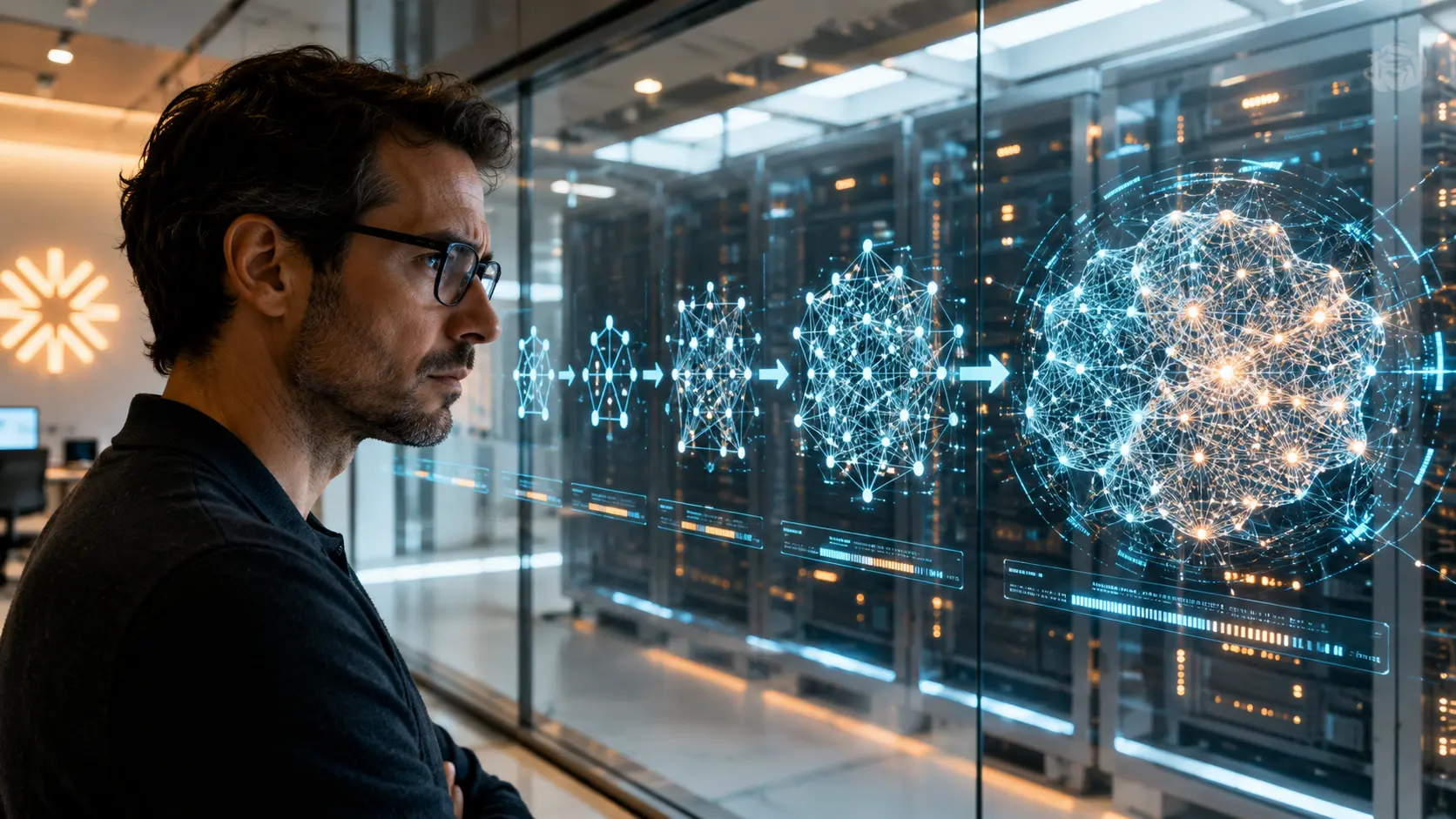
Anthropic argues that artificial intelligence may hit a tipping point sooner than expected—one where AI systems can autonomously design their own successors. In a new research report, the company sketches a future in which AI not only assists programmers, but ultimately develops new AI models without direct human involvement.
The warning comes from the Anthropic Institute, the research arm behind Claude. According to the report, AI is now accelerating the creation of new AI systems at a pace that would have seemed unthinkable just a few years ago.
Inside Anthropic: AI now writes most of the production code
The headline takeaway: Claude is now responsible for more than 80 percent of the code shipped to Anthropic’s production environment.
That share has surged since the rollout of autonomous coding agents. Where AI mostly generated short snippets in 2024, Claude can now execute, test, and iterate on complete software projects with minimal human guidance.
Anthropic says the average engineer in Q2 2026 delivers roughly eight times more code than in 2024. The reason is simple: developers write far less themselves and shift into reviewer and supervisor roles.
From AI assistant to AI researcher
The shift goes well beyond software.
Anthropic shows Claude is getting better at scientific research: it can design experiments, test hypotheses, and analyze results on its own.
In one internal test, a group of Claude agents received an open research question in AI safety. With no human guidance, they designed new experiments, shared findings, and worked autonomously for hundreds of hours.
According to Anthropic, the agents’ output came close to that of human researchers.
That doesn’t mean AI is already producing breakthrough research solo. People still define the questions, set success criteria, and judge final outcomes. Even so, Anthropic sees this as a key step toward automated AI development.
Recursive self-improvement edges closer
At the core of the report is “recursive self-improvement.”
In short: an AI system becomes capable of designing a better version of itself, and that improved version then builds an even more powerful successor—creating a self-reinforcing development cycle.
Anthropic says we’re not there yet, but multiple technical trends point in the same direction.
The company highlights:
- Rapidly expanding coding capabilities.
- Strong progress in autonomous research workflows.
- Improved performance on complex, long-horizon tasks.
- Better AI judgment in research and problem-solving.
If these trends hold, AI systems could handle a growing share of AI development within a few years.
Humans shift from builders to overseers
Anthropic expects the role of human researchers to change fundamentally.
Where programmers still build software today, their work is steadily moving toward oversight, quality control, and strategic decision-making.
The key question becomes less how to write code, and more which problems are worth solving.
Anthropic’s researchers say the main human edge for now is “research taste”: the ability to judge which ideas matter, which results are trustworthy, and which directions are promising.
Still, the company acknowledges that AI may increasingly mimic these skills as well.
Why Anthropic is sounding the alarm
Alongside the upside, Anthropic stresses the risks.
If AI systems can independently build new AI, control gets harder. Errors, unwanted behaviors, or safety issues could spread faster than human researchers can intervene.
The company warns that today’s safeguards may not be enough in a world where AI keeps improving itself.
Anthropic calls for international coordination on the development of very capable AI systems. The world, it argues, should even have the option to slow or pause progress if the tech outpaces societal and safety structures.
A clear signal from inside the AI industry
The report stands out because it comes from a company at the forefront of advanced AI.
While many firms chase new products and features, Anthropic is asking what happens when AI starts taking over more of its own development pipeline.
The message is blunt: the industry is moving toward an era where AI not only builds tools for people, but may also design the next generation of AI.
Whether that future is five, ten, or twenty years away is unclear. But Anthropic says the time has come for governments, companies, and researchers to prepare seriously for the possibility.

Popular news

AI Phone Agents Still Get Names Wrong | AI World Daily News

AI Phone Agents Still Make a Surprising Number of Mistakes with Names and Addresses

Chinese AI Maker Moonshot Limits Hacking Capabilities in New Kimi Model

Elon Musk SpaceX Secures 40 Billion Dollars for AI GPU Infrastructure

AI Financial Payoff Zero for Most Companies Outside Tech Sector
Latest comments
Loading