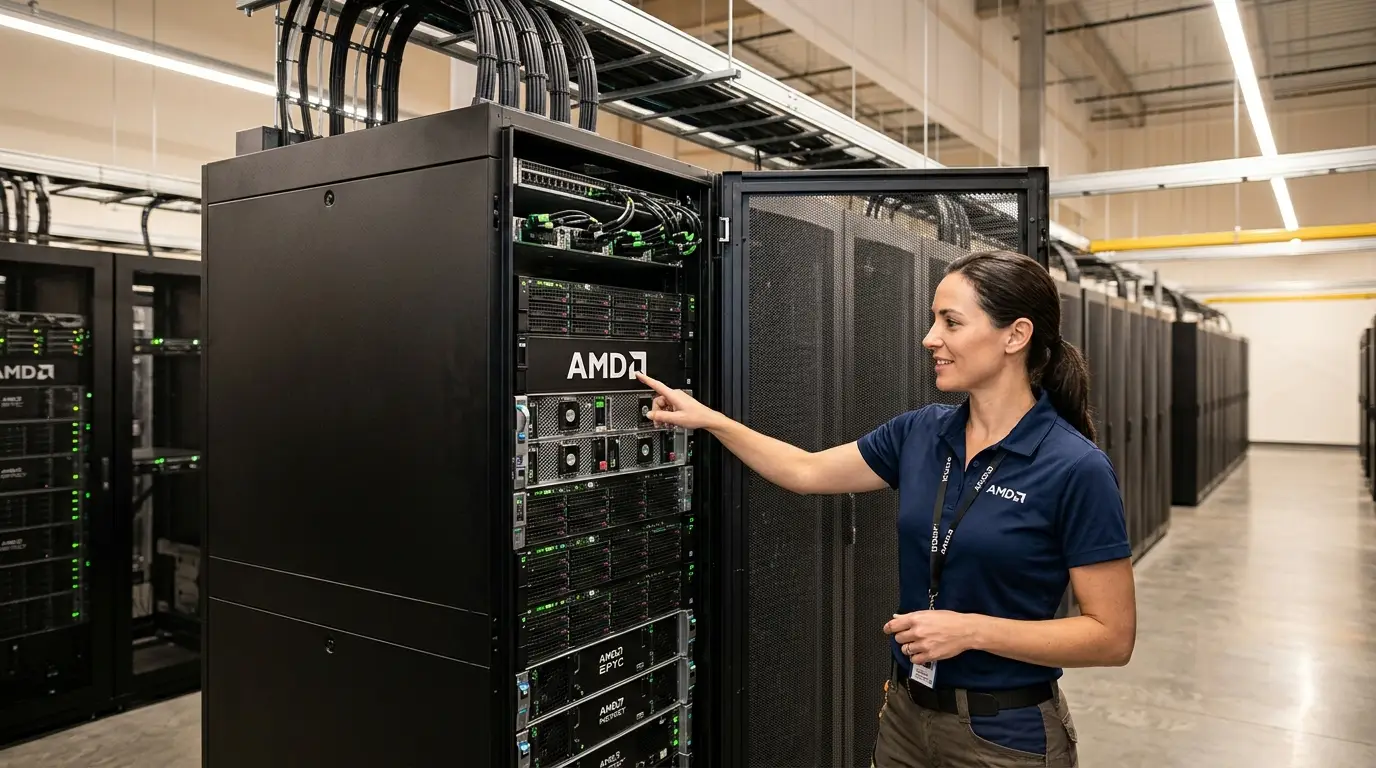
The power consumption of modern AI clusters has become a massive headache for data center operators. Training a single large language model can suck down as much electricity as a small town, pushing physical grid limits to the breaking point. Recognizing this bottleneck, AMD just dropped some major news regarding its hardware roadmap. The chipmaker announced that its upcoming 2026 rack-scale AI solutions are already tracking to be four times more energy-efficient than the company's 2024 AI platforms.
Beating the Industry Trendline
This fourfold leap in performance-per-watt puts the Silicon Valley giant significantly ahead of schedule. When AMD initially outlined its sustainability roadmap, it projected a 3x efficiency gain by this point in the development cycle. Instead, internal benchmarks show they are currently pacing at more than double the historical industry trendline for this specific milestone.
This aggressive push is part of the company's broader 20x30 energy efficiency initiative, which aims to deliver a 20-fold increase in rack-scale performance-per-watt for AI training and inference by the end of the decade.
The Shift From Node to Rack
Historically, chipmakers measured efficiency strictly at the silicon node level. AMD actually crushed its previous 30x25 node-level goal by achieving a 38x improvement. But as AI models balloon in size, looking at a single GPU is no longer enough. The new rack-scale approach evaluates the entire ecosystem, including EPYC CPUs, Instinct accelerators, high-speed networking, memory bandwidth, and advanced liquid cooling systems working in tandem.
Here is a look at the projected environmental and physical footprint reductions AMD expects to achieve by the time its 2030 architecture fully matures:
| 2024 Baseline Metric | 2030 Rack-Scale Projection | Operational Impact |
| Physical Footprint | >275 Server Racks | <1 Consolidated Rack |
| Electricity Consumption | 100% Baseline Usage | 95% Reduction in Power Draw |
| Carbon Emissions (Training) | ~3,000 Metric Tons CO2 | ~100 Metric Tons CO2 |
| Hardware Architecture | Discrete Node Scaling | End-to-End Helios Rack System |
Consolidating the Data Center
What does this actually mean for hyperscalers and enterprise IT teams? It means radical consolidation. According to projections validated by energy-efficiency expert Dr. Jonathan Koomey, an AI model that requires a sprawling 570-rack footprint today could theoretically be trained on just two highly optimized racks by the end of the decade. Alternatively, if operators keep the physical footprint the same, they could squeeze 20 times more raw compute out of the exact same power envelope.
As reported by Tom's Hardware, achieving these numbers relies heavily on hardware-software co-design and next-generation interconnects that drastically reduce the energy wasted moving data between chips.
When you factor in inevitable software and algorithmic optimizations—like lower-precision math and smarter routing—AMD estimates the total end-to-end energy efficiency for training a standard AI model could improve by up to 100x before the 2030 deadline hits. For an industry constantly under fire for its carbon footprint, that kind of headroom isn't just a nice-to-have feature. It is the only way AI survives its own power bill.

Popular news

Anthropic Unveils Claude Fable 5.2 and Mythos 5.2 With Record Benchmarks and Cheaper API Access

AI Stocks Rebound After Sharp Sell-Off as Nvidia, ASML and Chipmakers Recover
Australian STEM Game Competition Ends Over Generative AI Use
OpenAI Projects Massive 278 Billion Dollar Cash Burn Through 2030

Google Gemini 4 Carbon Dethrones Anthropic In Hallucination Benchmarks