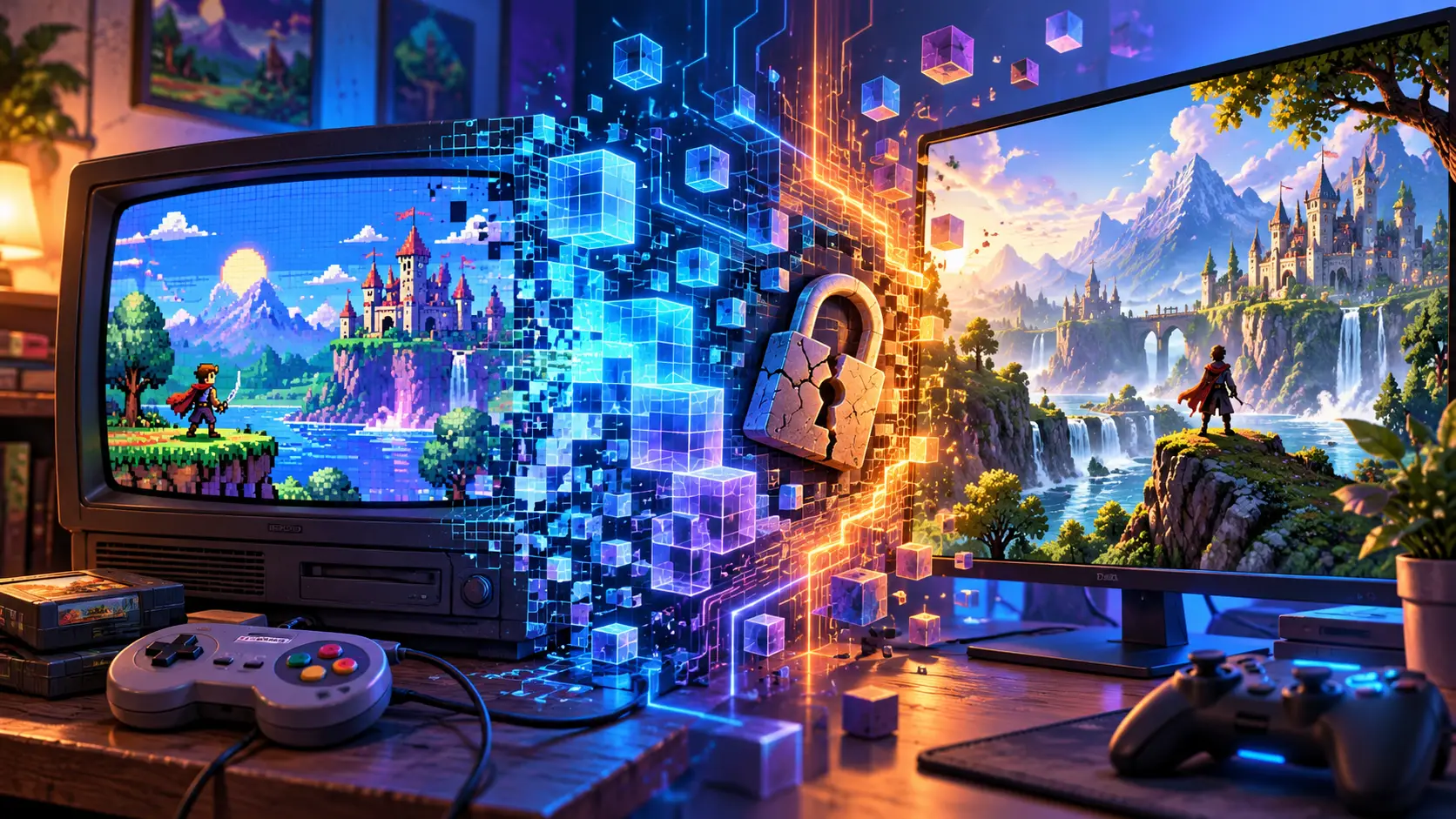
Artificial intelligence is helping developers rebuild old video games and make them playable on modern computers. The technology is advancing so quickly that on October 13, 2026, Microsoft announced a new initiative to explore its potential. But the same AI tools raise an unsettling question: what happens when almost anyone can reconstruct someone else’s software?
Indie game developer Popcar describes the trend in an in-depth blog post. He is usually critical of AI, but also sees enormous benefits for players who can no longer run their favorite games on modern devices.
AI is pulling old games apart—and putting them back together
The technique is called decompilation. Developers use it to reconstruct a program’s original logic from the finished software. Normally, programmers turn source code into an executable program. Decompilation attempts to reverse that process.
It’s an exceptionally difficult task. Compilation strips away many details from the original source code, so developers have to work out how the software operates, how its functions interact, and why it makes certain decisions.
For years, this meant enormous amounts of manual work. Volunteers sometimes spent years reconstructing classic video games. AI can now automate parts of the research, coding, and testing.
One example is IsaacRecomp, a project bringing the original 2011 version of The Binding of Isaac to modern devices. The game originally ran on Adobe Flash and came with technical limitations, including a fixed frame rate of 30 frames per second.
The new version uses reconstructed C++ code and supports higher resolutions, modern controllers, and smoother animation. The developer explicitly notes that AI helped with the reconstruction. Players still need to own their own copy of the original game.
Colin McRae Rally 2.0 is also getting a new lease on life on modern operating systems through a similar project. Meanwhile, FFTARecomp lets players run Final Fantasy Tactics Advance as a standalone program on a PC or Steam Deck, with widescreen support and modern settings.
These projects don’t all use the same techniques—or rely on AI to the same extent. Some reconstruct source code, while others translate existing machine code to a new platform. The results may look similar to players, but the methods behind them are different.
Developer burns through hundreds of billions of AI tokens
A experiment by software developer Maurice Heumann shows just how far AI has come.
On October 9, he described how he and a group of developers spent about three months reconstructing a commercial shooter. The team used multiple AI agents, including tools accessed through Claude Code and Codex.
The agents analyzed program files, reconstructed functions, and checked one another’s work. More than 15 agents were eventually involved.
Heumann says the reconstructed code ultimately reproduced 99 percent of the original game’s functions. For 83 percent of them, the compiler even generated machine code that exactly matched the original.
He estimates the project used 600 billion to 700 billion tokens—the units AI models use to process text and code. He could no longer determine the exact total.
The experiment also exposed the technology’s limitations. During the first month, the team appeared to make rapid progress: the game launched and loaded menus and environments.
But much of the generated code turned out to be wrong. AI agents sometimes invented how the program behaved or changed parts of it for no technical reason.
The team responded by building a verification system to compare the generated machine code with the original. That automated check was what substantially improved the results’ reliability.
Heumann has not published the reconstructed game code because of legal and other concerns. That means outsiders cannot independently verify his results.
Microsoft launches Xbox Labs as the opportunity grows
Major technology companies are taking notice of the trend.
On October 13, Microsoft announced Xbox Labs. The new team of developers, engineers, and researchers will experiment with technologies that make games less dependent on specific hardware.
Xbox chief Asha Sharma specifically pointed to recent projects that reconstruct existing games. Some can now run on hardware they were never originally designed for.
Other projects are bringing games directly to the browser using WebAssembly and WebGPU. These technologies let modern browsers run complex software and graphics.
Microsoft also sees potential for players to modify, combine or expand existing games. Xbox Labs plans to run experiments and develop new tools to support them.
That doesn’t mean Microsoft is giving the green light to unauthorized game copying. The company stresses that it intends to handle intellectual property responsibly.
The potential benefits for game preservation, however, are significant.
In 2023, the Video Game History Foundation examined how accessible classic video games still were. It found that 87 percent of the older US games surveyed were no longer commercially available at the time.
Reconstructed code could make some titles playable again without relying on outdated consoles or operating systems.
That matters most when the original developer no longer exists or has no plans to rerelease the game.
Who owns a game rebuilt by AI?
The same technology also brings legal and economic risks.
An AI system capable of reconstructing how an old video game works could, in principle, also help analyze modern commercial software—from paid apps and professional development tools to systems with complex security protections.
Popcar warns that these techniques could make it easier for companies to copy their competitors. Businesses that invest years in proprietary software could find rivals analyzing their products and building similar features.
Still, decompilation does not automatically recover the original source code. Nor does a technically functional reconstruction give anyone the right to distribute it.
The European Directive on the legal protection of computer programs allows decompilation under certain conditions, including when it is necessary to make independent software interoperable with other programs. It is not a blanket license to copy or republish commercial software.
Copyrights on graphics, music and other elements of video games also remain in force.
That raises a bigger question: what does it really mean to own a digital game?
The European Citizens’ Initiative Stop Destroying Videogames gathered more than 1.29 million valid signatures. Its organizers want to stop publishers from making purchased games permanently unplayable—for example, by shutting down their servers.
The European Commission responded in June 2026. For now, it proposed no new legal requirement to keep games playable after commercial support ends. Brussels does, however, plan to discuss possible agreements with the industry and consumer representatives by the end of 2026.
AI could solve part of the technical problem, but not all of it. Games that depend entirely on external servers, for instance, are difficult to preserve if the required server code and data are unavailable.
The development also comes as AI is already reshaping the game industry. Google, for example, is experimenting with creating games from text prompts, while the maker of Fortnite is stepping up its use of AI to develop new games.
Now there’s another possibility: not just making games faster, but also reverse-engineering and modifying existing ones.
That could be a major win for players and digital archives. At the same time, software companies face a difficult new reality: their programs are becoming easier to examine, even as the legal limits on reusing their code remain firmly in place.
The question, then, is not just how many old games AI can save—but who gets to decide what happens to them once they’re rescued.

Popular news

Google Launches Universal Cart: A New AI Shopping Cart for Multiple Online Stores

Google Opens Its AI Detector to Everyone: What the Results Do—and Don’t—Tell You

British Baroness Uses AI to Speak in Parliament in Her Own Voice Again

OpenAI Claims Cybersecurity Breakthrough: Malware Analysis Cut from Weeks to Eight Hours
Latest comments
Loading