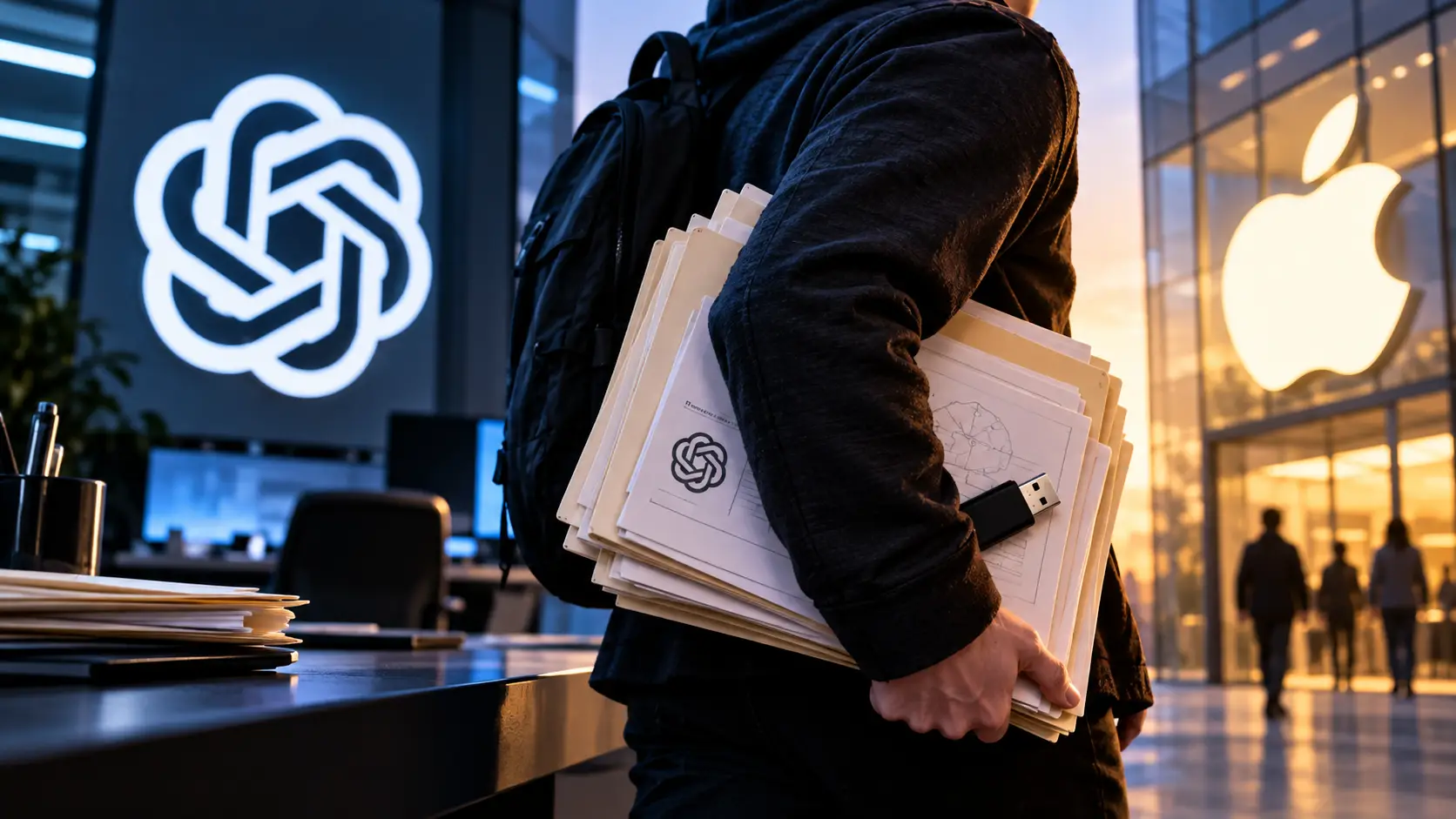
OpenAI has accused a former employee of taking more than 100 confidential files about an unreleased AI device. According to new court documents, the employee sent sensitive information to personal accounts and later presented product plans to Apple executives. Apple says it has found no evidence that OpenAI’s information was misused.
OpenAI says former employee took confidential files
The accusation appears in a supplemental court filing from OpenAI, submitted on October 14 to a federal court in San Jose, California.
An internal forensic investigation reportedly found that the former employee had sent more than 100 confidential files to personal accounts.
OpenAI says the files contain sensitive information about at least one AI device still in development. They reportedly include technical designs, images of the device, manufacturing data and supplier information.
The files also allegedly include hardware finish specifications, including reports on coatings and component sealing. Such information could give competitors insight into technical decisions, manufacturing methods and partnerships with suppliers.
The employee previously worked at Apple, then spent around six months at OpenAI before returning to Apple.
According to the court filing, some files were sent from Singapore shortly after midnight on June 2, 2026—the employee’s final day at OpenAI.
Product plans allegedly presented to Apple executives
OpenAI claims the former employee did more than send files to personal accounts: the employee also gave a presentation to senior Apple executives.
The audience reportedly included the vice president overseeing Apple’s operations in Asia. According to OpenAI, the presentation covered plans for future hardware products.
OpenAI fears that confidential knowledge may have made its way into Apple and could be used to develop competing devices.
The employee is not named in the filing. Nor has it been independently established what information, if any, was actually shared with Apple.
Apple disputes the allegations. The company told Reuters that it has internal procedures to prevent new hires from using trade secrets belonging to former employers.
Apple says its own investigation found no evidence to support OpenAI’s claims.
Apple’s HomeView puts the claims in the spotlight
The timing of the accusation is striking. On October 13, 2026, Apple unveiled HomeView, a smart home display powered by artificial intelligence.
Apple’s official announcement says the device features a 7-inch Liquid Retina display and the revamped Siri AI assistant.
Users can control smart devices with voice commands, look up information and access personalized features. The system uses facial recognition to tailor the interface to different household members.
HomeView will start at $299 in the United States and go on sale there on November 13. Apple is not currently selling the device in the European Union, where Siri AI is not yet available on iOS.
OpenAI explicitly refers to Apple’s new products in its court filing, suggesting the information allegedly shared could be relevant to Apple’s recent push into AI hardware.
But that link has not been proven. As The Verge also notes, tech companies typically develop hardware over long periods. Apple’s plans for a smart home display had also been reported for years.
HomeView’s unveiling, then, is not in itself evidence that Apple used OpenAI designs or trade secrets.
Legal battle began with Apple’s allegations
The latest claims are part of a wider legal battle between Apple and OpenAI over alleged trade secret theft.
Apple filed suit in July 2026, accusing former employees of taking confidential documents, technical information and knowledge of unannounced products to OpenAI’s hardware division.
Those involved include Chang Liu, a former Apple electrical engineer, and Tang Yew Tan, previously a vice president of product design for the iPhone and Apple Watch.
OpenAI denies Apple’s allegations.
This week, U.S. Judge Edward Davila ruled that Apple can fast-track access to certain documents related to the hiring of former Apple employees.
The records include job application materials, presentations and communications that could shed light on the exchange of technical knowledge, according to TechCrunch.
The judge also approved expedited depositions, while rejecting several of Apple’s broader requests for access to information about OpenAI’s hardware development—for now.
OpenAI now wants to investigate the alleged transfer of confidential files to Apple itself. The company has also left open the possibility of filing counterclaims.
Why AI hardware is becoming a bigger battleground
The legal dispute highlights how competition between Apple and OpenAI is no longer confined to software and AI models.
OpenAI is developing consumer devices built around artificial intelligence. Its aim is to give people new ways to interact with AI, without relying solely on existing smartphones and computers.
Apple, meanwhile, has a global hardware ecosystem and deep experience in product development, supply chains and mass production.
That combination makes technical trade secrets especially valuable. The race is about more than the quality of a language model: it also hinges on building compact devices, managing power consumption, choosing materials and integrating AI into physical products.
A detailed manufacturing document could reveal decisions that a competitor has spent considerable time and money researching.
The case also highlights a risk facing the tech industry: the transfer of knowledge when specialist engineers move between rival companies.
The next legal steps should clarify what information, if any, was transferred—and whether that violated either company’s rights.
For now, the key point is that both companies have made serious allegations, but the judge has yet to rule on whether trade secrets were misused.
The outcome could shape how AI companies recruit talent, safeguard confidential development data and work with hardware suppliers.

Popular news

Latest comments
Loading