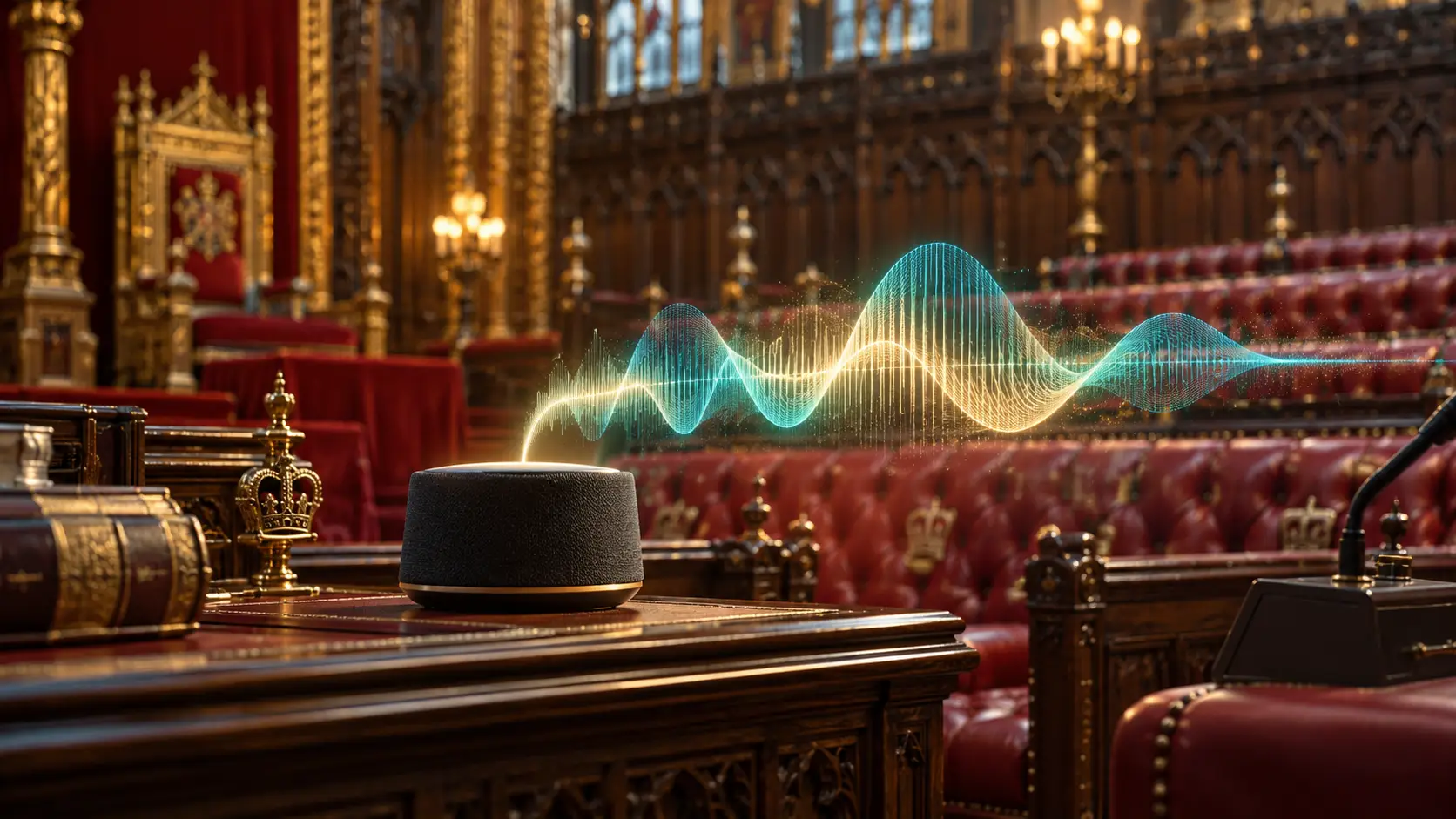
For the first time, a member of the British Parliament has delivered a speech using an AI-reconstructed version of her own voice. On Tuesday, October 13, Baroness Jane Campbell of Surbiton used ElevenLabs technology to speak in the House of Lords. A muscle condition is making it increasingly difficult for her to speak. Now, artificial intelligence is helping her sound like herself again.
You can watch the historic speech in the British Parliament’s official video recording. Campbell begins at 4:10 p.m. UK time. ITV News also published a video of the remarkable moment.
AI gives her a familiar voice back
Jane Campbell has spinal muscular atrophy (SMA), an inherited muscle condition that affects, among other things, her ability to speak. The British politician and disability rights campaigner still speaks for herself whenever she can. But her condition leaves her voice tiring more quickly.
Since 2012, a personal assistant has been allowed to read her speeches in the House of Lords when she is no longer able to deliver them herself. Parliament had to make an exception to a centuries-old rule dating back to 1707, which normally bars non-members from speaking in the chamber.
Fourteen years later, new technology offers another solution.
Campbell used ElevenLabs’ AI voice technology to reconstruct her former voice. She provided old recordings from a time when she could speak more clearly. The software analyzed her voice’s distinctive pitch, tone and rhythm.
ElevenLabs then converted her written speech into audio. A support device played the generated voice in the House of Lords.
The result wasn’t a generic computer voice, but a digital recreation of Campbell’s own, instantly recognizable voice.
“May I introduce Baroness Campbell 2.0?”
Campbell began her contribution in her natural voice, thanking the parliamentary committee and staff who made it possible to use the AI technology.
Then, with a touch of humor, she introduced her digital voice:
“With that, may I introduce noble Lords to Baroness Campbell mark 2?”
From that point on, the AI reconstruction took over.
It was a parliamentary first. No member of either the House of Commons or the House of Lords had ever used an AI voice to deliver an official speech in this way.
Campbell had stressed beforehand that the technology would not change the substance of her contribution. She wrote the speech herself, chose the arguments and set out her own political views. Only the way her words were heard changed.
The technology doesn’t take over her voice. It gives her more control over how her message sounds.
Her speech was about independence
The use of AI made history, but Campbell’s main aim was to draw attention to the UK’s health service.
During debate on the Health Bill, a proposed package of healthcare reforms, she called for stronger protections for personal care budgets.
These budgets allow people with complex care needs to decide what support they receive, who provides it and when they need it.
In the official record of her speech, she welcomed plans for better, more personalized care—an improvement she said was long overdue.
At the same time, Campbell warned that reform must not lead to one-size-fits-all care that strips people of choice. She wants to prevent care authorities from deciding where someone can live, travel or receive support.
The use of AI gave that message added force. Campbell showed not only how technology can increase her independence, but also used it to argue for the independence of others.
A positive use of AI we shouldn’t overlook
In recent years, much of the debate around AI voices has focused on their dangers. Criminals can clone voices to scam people, companies use synthetic voices without clear consent, and increasingly convincing deepfakes make it harder to tell genuine recordings from fakes.
Those concerns are valid. AI Wereld has previously explored the technology, opportunities and risks of AI voice cloning.
But the same technology also offers benefits whose social value is hard to dispute.
Consider people who lose their voices because of ALS, muscle conditions or other illnesses. Using old recordings, they can create a digital version of their own voice and continue communicating in a way that feels familiar to them and the people around them.
ElevenLabs says it has already helped more than 11,000 people restore their voices with AI. Through its Impact Program, the company aims to support one million people who have lost their voices.
Campbell’s experience shows why this matters. A voice conveys more than information: it carries personality, identity, emotion and the way a person expresses themselves.
This is also an important step toward making democratic institutions more accessible. By allowing assistive technology, they can help people remain part of political debate even as their physical abilities change.
That doesn’t erase the risks of voice cloning. Consent, control over how a voice is used and transparency remain essential. But Campbell shows just how valuable this technology can be when people decide for themselves how to use it.
Amid all the AI slop, privacy concerns and debate over the power of tech companies, this application deserves attention too.
AI-driven progress isn’t always about more automation, higher productivity or replacing human workers.
Sometimes, it simply gives someone her own voice back.

Popular news

EU Leaders Meet in Dublin to Decide Who Pays for Europe’s AI Computing Power

Google DeepMind’s AlphaGenome 2 predicts what DNA variants do in specific cells
Anthropic Bankers Push IPO Pricing Above Initial Range to Reach 1.5 Trillion Valuation
Anthropic Says Automated Coding Tools Are Dismantling Nvidia Software Moat

US Data Brokers Supply Half Billion Dollars In AI Training Environments To Chinese Labs