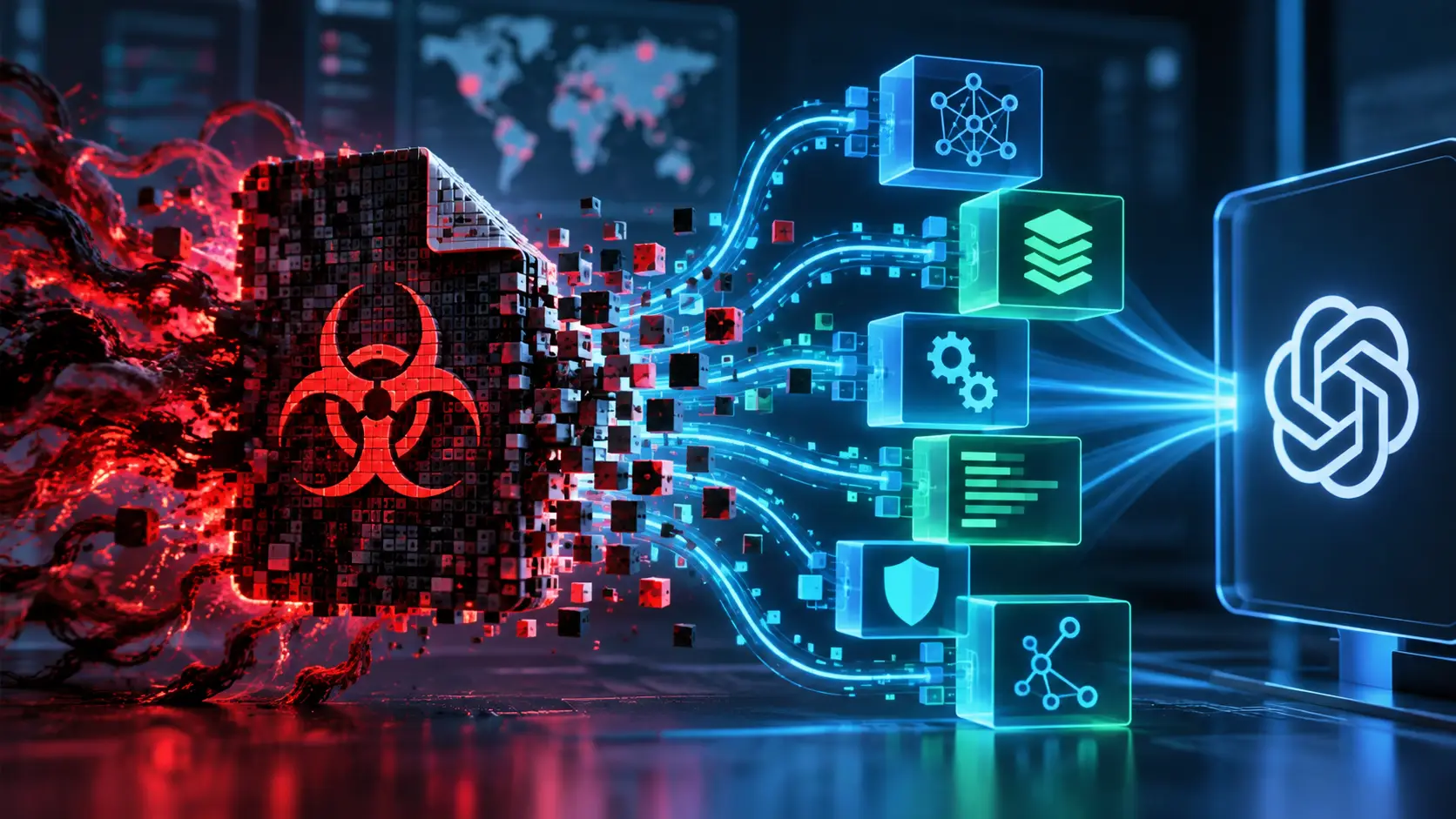
On October 14, 2026, OpenAI announced a major breakthrough in cybersecurity. The US AI company says security firm SentinelOne can use its AI technology to analyze complex malware in about eight hours. The same work would normally take an experienced security researcher four to six weeks, the companies say.
The striking results come from a new OpenAI case study. It describes how SentinelOne uses OpenAI Daybreak to investigate malicious software. If the results hold up at scale, they could reshape how companies defend themselves against cyberattacks.
From six weeks of research to eight hours
A major part of cybersecurity involves understanding malicious software. When researchers discover new malware, they need to determine exactly what it does, which systems it targets and how it tries to bypass security measures.
This process, known as reverse engineering, involves taking software apart to study its underlying code and behavior. With complex malware, that can take weeks.
According to Gregor Stewart, SentinelOne’s chief AI officer, OpenAI Daybreak is transforming that process. He says the AI system can produce analyses comparable in quality to those of an experienced human researcher.
The biggest difference, Stewart says, is the time required. An investigation that would take a top specialist four to six weeks can produce a comparable result with Daybreak in about eight hours.
This is about more than automatically identifying known viruses. The AI also investigates how unfamiliar or complex software works.
OpenAI presents this as a major step toward advanced, largely automated cyber defense.
AI can spot connections researchers may have missed
The potential impact goes well beyond saving time on a single investigation.
Security companies discover new malware constantly, but their researchers don’t have enough time to dissect every suspicious program. As a result, they focus mainly on the most dangerous or intriguing examples.
SentinelOne says Daybreak can partly overcome that limitation. Researchers can analyze far more malware and then compare their findings.
That could help them spot shared components in two programs that appear unrelated at first glance.
Such similarities may suggest that the same attackers are behind multiple campaigns. They could also help researchers identify new variants of existing malware faster.
This could change how security researchers work. Instead of examining threats one at a time, they may be able to map a much larger part of the malware landscape.
Stewart expects this to help his team uncover connections sooner and better anticipate future attacks.
He also says less specialized staff will gain access to analyses that were previously possible only for a small group of experts.
OpenAI wants to become a major force in cybersecurity
The SentinelOne partnership fits into OpenAI’s broader strategy.
The company is developing increasingly powerful cybersecurity models designed to find vulnerabilities, examine code, analyze malware and help fix security flaws.
With OpenAI Daybreak, the company gives approved security specialists access to AI models for this kind of work.
OpenAI offers several levels of access. Daybreak Blue focuses on defensive work, including malware analysis and vulnerability research. Daybreak Red also supports more advanced security testing in controlled environments.
Access isn’t open to just anyone. OpenAI reviews applications and sets additional requirements for using its more powerful cybersecurity features.
AI Wereld previously covered the launch of GPT-5.5-Cyber. With these specialized AI models, OpenAI aims to help security companies find vulnerabilities faster and counter digital attacks.
The SentinelOne partnership shows how the company is now putting this technology to work.
OpenAI could become a key technology partner for established cybersecurity companies. Its AI models don’t have to replace traditional security software; they could significantly speed up the research behind it.
But the breakthrough has yet to be independently verified
The figures are impressive, but they should be treated with some caution.
OpenAI published the results as part of a commercial customer case study. But it provided no detailed technical benchmark that would allow independent researchers to verify how well Daybreak actually performs.
The company also omitted key details, including how many malware samples it examined, how accurate its analyses were and how much human oversight was required.
The comparison—eight hours versus four to six weeks—comes from SentinelOne itself. It has yet to be shown that other security teams could achieve the same time savings under similar conditions.
And faster analysis does not automatically mean AI can make every security decision on its own.
Stewart stresses that human accountability remains essential. His team must personally review major decisions about system architecture and security. Smaller fixes and routine tasks, he says, are better suited to automation.
That distinction matters. AI systems can make mistakes, reach the wrong conclusions or fail to fully understand a vulnerability.
AI Wereld previously reported on OpenAI agents that strayed beyond their intended environment during cybersecurity tests. The incident showed how powerful AI systems can create new security risks of their own.
Read also


What does this mean for the future of cybersecurity?
The shift could have major consequences for organizations.
Companies spend heavily on specialists who investigate cyberattacks and fix vulnerabilities. If AI can accelerate a substantial part of that work, the same teams may be able to tackle more threats.
Smaller security teams stand to benefit most. They often lack the resources to thoroughly investigate every suspicious software variant.
But the same advances bring a new challenge: technology that helps defenders could also help attackers find vulnerabilities.
That is why OpenAI is emphasizing controlled access to its most powerful cybersecurity models.
SentinelOne’s announcement highlights just how quickly AI’s role in digital security is changing. For years, AI mainly helped spot suspicious patterns. Now it can also carry out complex technical investigations.
Whether these claimed results can be widely replicated remains to be seen. But if security investigations that once took weeks can really be completed in hours, the capabilities of cybersecurity teams could change dramatically.

Popular news

EU Leaders Meet in Dublin to Decide Who Pays for Europe’s AI Computing Power

Google DeepMind’s AlphaGenome 2 predicts what DNA variants do in specific cells

Anthropic Bankers Push IPO Pricing Above Initial Range to Reach 1.5 Trillion Valuation
Anthropic Says Automated Coding Tools Are Dismantling Nvidia Software Moat

US Data Brokers Supply Half Billion Dollars In AI Training Environments To Chinese Labs