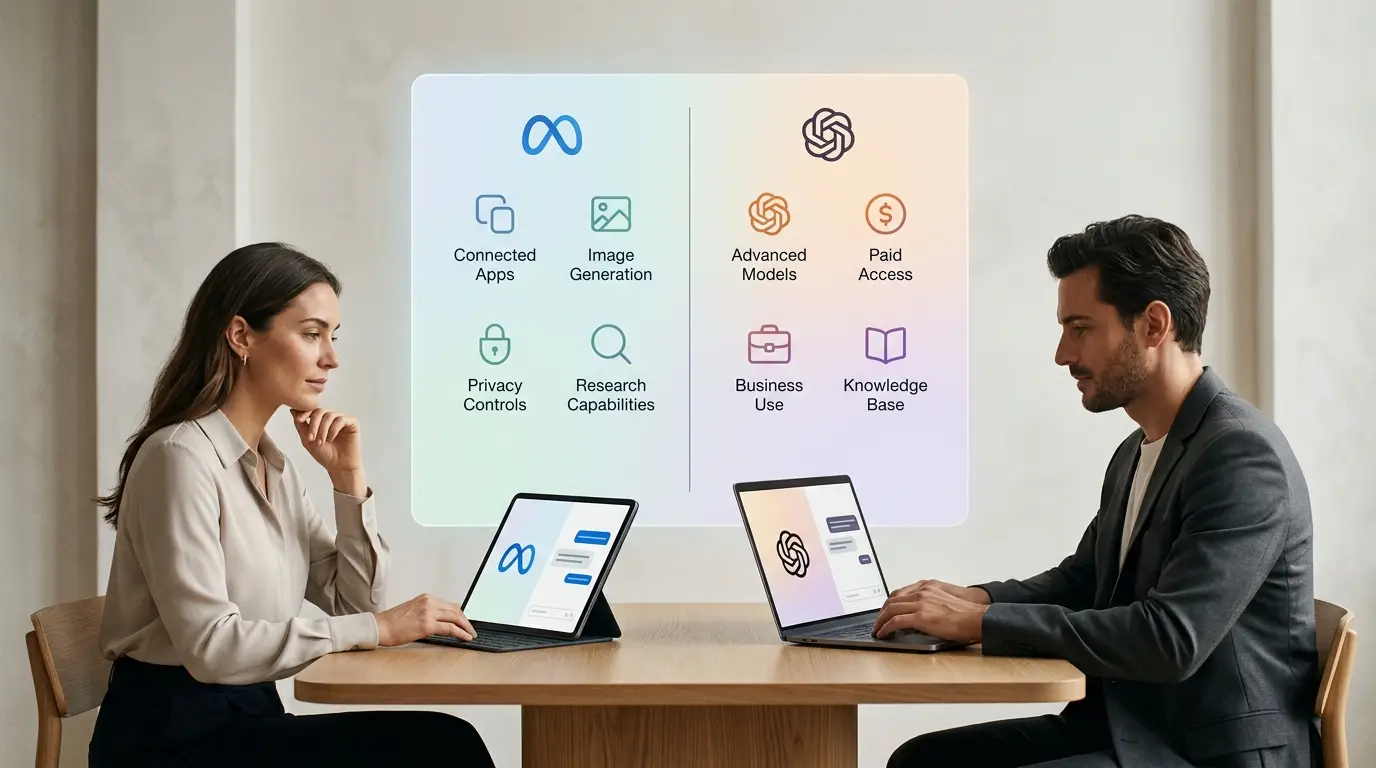
Meta AI is generally the better assistant for people who want free core AI inside WhatsApp, Instagram, Facebook or Meta's glasses, while ChatGPT is usually the stronger standalone environment for files, projects, coding and managed workplace use. Neither is universally better.
This comparison is between the finished products, not only their underlying models.
At the August 7, 2026 cut-off:
- Meta AI is powered by Meta's Muse model family, with Muse Spark 1.1 driving newer action-oriented features in supported markets;
- OpenAI's current flagship family is GPT-5.6, although the exact model and tools available inside ChatGPT depend on the selected experience and plan;
- Meta AI has a free core service, with optional paid Meta subscription benefits or higher media allowances where offered;
- ChatGPT has a free tier plus paid individual and organizational plans whose limits and features can change.
The right choice depends less on a single benchmark and more on where your information lives, which tools you need, how much privacy control is required and whether the assistant is for casual use or an organization.
Meta AI vs ChatGPT at a glance
| Category | Meta AI | ChatGPT |
| Best overall fit | Social, messaging, shopping, voice, camera and Meta glasses | General knowledge work, files, projects, coding and business workspaces |
| Current product model | Muse Spark family; Muse Spark 1.1 for newer action features | GPT-5.6 family, with plan-dependent access |
| Free access | Yes, subject to regional availability and limits | Yes, with plan-dependent tool limits |
| Paid access | Optional Meta subscription benefits and higher media allowances vary by market | Paid personal and organizational plans add limits and workspace capabilities |
| Social integration | Deep across Meta apps | Limited compared with Meta's native ecosystem |
| Files and persistent projects | Improving, with project outputs and actions in supported markets | More mature project, file and long-running work environment |
| Voice and camera | Strong, especially with Meta glasses and live perception | Strong voice and multimodal tools in ChatGPT apps |
| Image creation | Muse Image, with social sharing and editing | Integrated image generation and editing, plan-dependent |
| Research | Web research and newer deep-research workflows | Mature web research and multi-step work tools |
| Personalization | Can use chosen profile and engagement context across linked Meta accounts | Memory, chat history and connected apps under account controls |
| Private mode | Incognito chats with Private Processing in the Meta AI app | Temporary Chat and data controls; business products have separate controls |
| Business administration | Consumer-first; no equivalent universal Meta AI team workspace | ChatGPT Business and Enterprise provide shared workspaces and administration |
| Local deployment | Meta AI cannot run locally; Llama is separate | ChatGPT cannot run locally; OpenAI's GPT product models are hosted |
The core difference: embedded assistant versus work platform
Meta AI's advantage is distribution and context. It appears inside services people already use to communicate, browse content, shop and wear connected devices. The assistant can draw on Meta's public-content ecosystem and, where enabled, personal context from linked accounts.
ChatGPT's advantage is depth as a standalone work product. It is organized around conversations, files, projects, research, coding and workspace administration. It is less naturally connected to a social graph but more naturally suited to sustained professional work.
A simple way to frame the choice is:
- choose Meta AI when the assistant should come to your existing communication and social environment;
- choose ChatGPT when you want to move a task into a dedicated AI workspace.
Models: Muse Spark versus GPT-5.6
Model names matter, but they do not tell the entire product story.
Meta AI uses Muse, not simply Llama
Meta launched its standalone app around Llama 4 in 2025. In April 2026, the company said Muse Spark powered the Meta AI app and website. Muse Spark 1.1 later added stronger planning, tools, computer use and multimodal work.
Llama remains Meta's open-weight developer family. A Llama versus another model comparison is not the same as comparing Meta AI with ChatGPT.
ChatGPT uses a plan-dependent model stack
OpenAI's GPT-5.6 update says GPT-5.6 Luna is becoming the default for Free and Go users, while Plus and Pro receive an updated GPT-5.6 Sol experience and a control for reasoning effort.
ChatGPT can also route tasks through tools and product systems beyond the base model. A user should therefore test the exact plan, model option and workflow rather than comparing marketing benchmark tables from different providers.
Which model is better?
There is no defensible universal answer.
Muse Spark 1.1 is designed around personal agentic tasks, connected apps, multimodal context and Meta's product ecosystem. GPT-5.6 Sol is positioned for demanding knowledge work, coding and tool use. Performance can reverse by task, prompt, account and update.
Run a small evaluation on work you actually do:
- a real document;
- a real research question;
- a real image task;
- a real planning workflow;
- and a real code or spreadsheet case if relevant.
Score correctness, time, editing and failure—not how impressive the first answer sounds.
Everyday questions and writing
Both assistants are capable of explaining concepts, drafting messages, brainstorming, summarizing text and rewriting content.
Meta AI's advantage
Meta AI is frictionless when the task begins in a Meta app. It can help draft a WhatsApp message, create an Instagram caption, discuss a post or find an idea without switching to a dedicated work tool.
Its personalization can also make recommendations feel more relevant when the user has chosen to connect account context.
ChatGPT's advantage
ChatGPT is usually easier for iterative work that grows over several steps. The user can upload files, establish a project context, refine a draft, compare versions and continue the task later in one dedicated environment.
For a one-off social message, Meta AI may be faster. For a policy brief or a multi-file report, ChatGPT is generally the more natural workspace.
Search and research
Both products can search the web and produce research-style responses.
Meta AI's research proposition increasingly combines conventional web information with public posts, creators, communities and content across Meta's services. That can be valuable for trends, products, local recommendations and questions where social context matters.
ChatGPT's research tools are generally stronger for structured professional investigation, source synthesis and moving from research into files, analysis or a project workflow.
Neither product should be trusted merely because it displays citations. Check:
- whether the cited page exists;
- whether it supports the exact claim;
- whether the information is current;
- whether an original source is available;
- whether the assistant omitted contradictory evidence.
Meta AI may be better for “What are people sharing about this place?” ChatGPT may be better for “Compare these fifteen sources and produce a documented decision memo.”
Voice, camera and wearable use
Meta has a distinctive advantage through AI glasses.
Meta AI can work through supported Ray-Ban Meta, Oakley Meta and Meta Ray-Ban Display devices. The user can ask about the surrounding environment, receive hands-free help and continue an interaction on a phone.
The standalone Meta AI app also supports natural voice and live camera features where available.
ChatGPT offers strong voice and visual interaction through its own apps, but it does not have Meta's first-party glasses ecosystem. It can still be preferable when the voice conversation is part of a research, writing or work process that continues in ChatGPT.
Choose Meta AI for:
- hands-free environmental questions;
- social and messaging continuity;
- glasses-based assistance;
- quick visual identification and recommendations.
Choose ChatGPT for:
- long voice brainstorming tied to a project;
- work that moves into documents or code;
- a dedicated cross-device AI workspace.
Image creation and editing
Meta AI uses Muse Image for image generation and editing in supported markets. Meta emphasizes conversational editing, visual content that can be shared across its apps and practical outputs such as mock-ups and infographics.
ChatGPT also integrates image generation and editing into the assistant experience. Its advantage is the ability to develop an image alongside text, files, analysis or a wider project without depending on a social-app workflow.
Image quality is prompt- and task-dependent. Test:
- text rendering;
- consistent characters or products;
- brand accuracy;
- editing an existing image;
- aspect ratios;
- and how each service handles prohibited or copyrighted requests.
Meta removed a public Instagram @-mention image feature shortly after announcing it in July 2026. This illustrates why product comparisons should describe current functionality, not preserve every launch-day feature indefinitely.
Connected apps and actions
Meta AI's Muse Spark 1.1 rollout lets supported users connect email and calendar apps, create plans, deliver recurring briefings, research a topic and generate slides. It is moving toward a personal agent that acts across services.
ChatGPT has a mature ecosystem of connected data sources, tools, agents and business integrations. Exact availability depends on plan and workspace controls.
The decision is not “which has more integrations?” It is “which has the integrations you are allowed to use?”
Before enabling actions:
- review every permission;
- start with read-only access where possible;
- keep approval before sending, deleting, buying or publishing;
- limit the data source;
- inspect activity logs;
- revoke unused connections.
An assistant that can act is more useful and more dangerous than one that only drafts.
Meta AI pricing versus ChatGPT pricing
Meta AI
Meta AI provides a free core experience in supported regions. Meta says everyday Muse Image creation is free and that people who want to create more can receive higher allowances through Meta subscription plans where those plans are available.
There is no single global Meta AI subscription price or identical entitlement set that should be hard-coded into an evergreen comparison. Read the current offer shown to the account and our Meta AI pricing guide.
ChatGPT
ChatGPT has a free tier and paid personal and organizational plans. Model access, tool limits, regional prices and included capabilities can change, so compare the live plan page at the time of purchase rather than relying on an old monthly figure.
API usage is separate from ChatGPT subscriptions.
Which offers better value?
Meta AI wins on price for users who need ordinary assistance inside Meta apps and can stay within the free limits.
A paid ChatGPT plan can offer better value when its files, projects, research, coding and higher tool limits replace other software or save substantial professional time.
The correct metric is not monthly price alone. Measure:
- accepted outputs;
- time saved;
- limits hit;
- editing required;
- connected tools replaced;
- and risk controls needed.
Privacy: Meta AI versus ChatGPT
Privacy depends on the mode and account, not just the company name.
Meta AI ordinary chats
Meta says interactions with its generative AI features can be used to personalize content and ads in most covered regions. Linked account context can make answers more personal. This may be useful, but users should understand that ordinary AI activity can influence the wider Meta experience.
Meta AI Incognito chats
Meta's Incognito chat documentation says Incognito uses Private Processing, cannot be accessed by Meta, is not saved after the user exits and cannot be shared.
This provides a strong privacy mode for supported consumer use. It does not create a contractual enterprise environment for regulated data.
ChatGPT consumer controls
ChatGPT offers account-level data controls and Temporary Chat. OpenAI says Temporary Chats are not used to train models, do not appear in history or create memories and are deleted after a limited retention period, subject to abuse monitoring policies.
ChatGPT business products
ChatGPT Business and Enterprise provide organizational workspaces, administration and separate business-data terms. OpenAI says business and API data is not used to train its models by default for covered products.
That gives ChatGPT the clearer turnkey business proposition. A company considering Meta AI should evaluate whether a consumer-first account and current terms meet its requirements or whether a controlled Llama deployment is more appropriate.
For the Meta side, read Is Meta AI safe?. For the OpenAI side, AI World Today has a dedicated ChatGPT privacy and security guide.
Personalization
Meta AI and ChatGPT personalize in different ways.
Meta AI can draw on information a user has chosen to share across Meta products, including profile and engagement context where the feature is available. That can improve social, shopping and lifestyle recommendations.
ChatGPT uses memory, chat history, project context and connected apps under its own settings and workspace rules. Its personalization is more naturally centered on work performed inside ChatGPT.
Choose Meta AI personalization when:
- social context is useful;
- recommendations from Meta content matter;
- the user is comfortable linking Meta accounts.
Choose ChatGPT personalization when:
- project continuity matters;
- work files and instructions are central;
- the user wants a dedicated assistant identity separate from social feeds.
Business use
ChatGPT is the clearer option for an organization seeking a managed employee workspace.
OpenAI's ChatGPT Business documentation describes a shared workspace with centralized billing, administrative controls and seat-based access. Enterprise adds more governance and support options.
Meta AI is primarily a consumer assistant. Its newer action features can be useful for individual work, but a company should not assume that a consumer Meta account provides the same administration, auditability or contractual data controls as a business workspace.
Meta's alternative business route is the model layer:
- build with Llama through an approved provider;
- self-host a suitable Llama model;
- or use the Meta Model API for Muse models under the applicable developer terms.
That is a development and procurement decision, not a consumer-seat purchase.
Coding
ChatGPT is generally the stronger finished coding environment because OpenAI integrates coding models, repositories, tools and agent workflows into ChatGPT and Codex.
Meta AI can generate code, visual prototypes and mini-apps, and Muse Spark has strong coding capabilities. Its main consumer proposition is broader personal assistance rather than a dedicated software-development environment.
Developers interested in Meta's models should compare:
- Llama API;
- Meta Model API;
- Muse Code;
- third-party Llama providers;
- and local Llama deployment.
That comparison is separate from whether an everyday user prefers the Meta AI app.
Which should you choose?
Choose Meta AI when
- you want a free assistant inside WhatsApp, Instagram, Facebook or Messenger;
- Meta glasses are important;
- public social content, Marketplace or creator recommendations add value;
- quick voice and camera help is central;
- personalized Meta context is welcome;
- or you need lightweight everyday assistance rather than a formal work environment.
Choose ChatGPT when
- you work with many files or persistent projects;
- coding and professional knowledge work dominate;
- you need a dedicated AI workspace;
- a team requires administration and shared billing;
- you want deeper task continuity outside a social network;
- or ChatGPT performs better on your actual evaluation set.
Use both when
- Meta AI handles quick social and mobile tasks while ChatGPT handles sustained work;
- glasses or WhatsApp are useful entry points but final work belongs in a managed project;
- you want independent answers for verification;
- or free Meta AI covers casual use while paid ChatGPT is reserved for professional tasks.
Choose neither when
- the task should be deterministic;
- neither service is approved for the data;
- an error could cause unacceptable harm;
- or the workflow lacks human review.
How to run a fair comparison
- Select 20–50 real tasks rather than generic benchmark questions.
- Use the exact account and surface employees or consumers will use.
- Give both assistants equivalent context and permissions.
- Record model, mode, date, plan and connected tools.
- Score factual accuracy, completeness, editing, latency and cost.
- Test privacy settings and data deletion.
- Include difficult and adversarial cases.
- Repeat after major model updates.
Do not give one assistant access to email, search and files while testing the other as a blank chatbot. Product configuration is part of the result.
Frequently asked questions
Is Meta AI better than ChatGPT?
Meta AI is better for many social, messaging, shopping and glasses-based tasks. ChatGPT is usually better as a mature standalone work environment. Test the exact use case.
Is Meta AI free while ChatGPT costs money?
Both have free access. Meta AI's core experience is free subject to limits, while higher Muse Image usage may be attached to paid Meta subscription plans where offered. ChatGPT has a free tier and paid plans.
Does Meta AI use ChatGPT?
No. Meta AI is Meta's own product and currently uses Meta's Muse models. It does not run on OpenAI's ChatGPT service.
Is Meta AI powered by Llama?
The 2025 Meta AI app launched with Llama 4. Meta now says Muse Spark powers the current assistant. Llama remains Meta's separate open-weight developer family.
Which is better for images?
Both can generate and edit images. Meta AI has strong integration with Meta's social products through Muse Image. ChatGPT is often more convenient when image work is part of a larger document or project. Compare the actual task.
Which is better for research?
ChatGPT is generally stronger for sustained professional research and project integration. Meta AI can be especially useful when public posts, creators, Marketplace or social context matter.
Which is more private?
There is no one answer. Meta AI Incognito chats have strong private-processing claims. ChatGPT offers Temporary Chat and business products with separate controls. Ordinary personalized consumer chats in either service should not be treated as an approved repository for sensitive corporate data.
Can I use Meta AI instead of ChatGPT at work?
For low-risk individual tasks, possibly. For a managed company-wide workspace, ChatGPT Business or Enterprise currently offers a clearer administrative proposition. A controlled Llama deployment is another Meta-related route.
Can either assistant run locally?
No. Meta AI and ChatGPT are hosted products. Llama weights can run locally, but the result is not the Meta AI app. OpenAI does not provide downloadable ChatGPT model weights.
Which assistant should a beginner use?
Use the one already available in your workflow. Meta AI is easy for people living in Meta apps; ChatGPT is easy for someone who wants one dedicated place for varied AI work. Free access lets most users test both.
The bottom line
Meta AI and ChatGPT are converging on many of the same capabilities—voice, images, research, personalization and actions—but they start from different strategic positions.
Meta AI is an assistant embedded in a social, messaging, commerce and hardware network. ChatGPT is a dedicated AI work platform with a mature project and business layer.
For casual everyday use inside Meta apps, Meta AI may be the better and cheaper choice. For sustained professional work, files, coding or organizational governance, ChatGPT is usually stronger. The best answer is the product that produces more accepted work under the privacy and control requirements you actually have.
For Meta AI's full feature, model, pricing and privacy context, return to the complete Meta AI guide.

byDavid Porter
Popular news

Latest comments
Loading