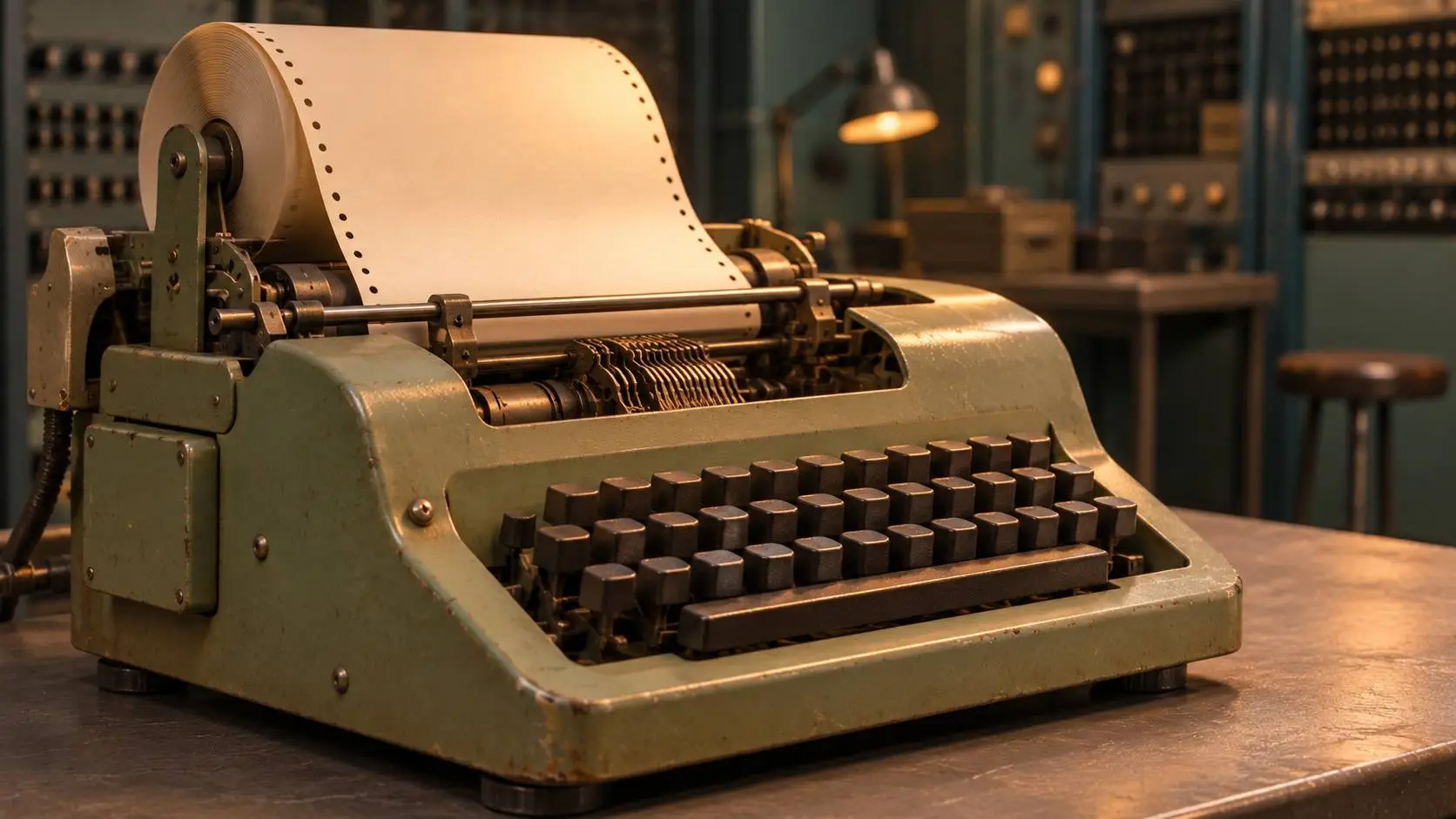
An electromechanical teletype feeds a blank roll of paper across a pale olive machine. AI-generated editorial illustration by AI World Today.
In the 1960s, Joseph Weizenbaum’s ELIZA gave people a place to type and get a reply. It picked words from what they wrote and used rules to form a question. Some users felt they were being heard. That gap between a rule and a real feeling is the heart of the ELIZA story.
Weizenbaum worked at MIT. He described the program in a paper published in January 1966. The paper shows that he could change the type of chat by giving the program a new script. The date tells us when readers could see his account of the work.
ELIZA and DOCTOR did separate jobs
ELIZA was the program. A script told it which words to look for and how to use them. DOCTOR was the script that made it famous. Its replies drew on a style of talk therapy that invites a person to say more about their own thoughts.
The role gave the script room to do a small set of things well. It could ask about a word or turn a phrase back into a question. A person who asked for a fact about the world would need a reply the script could never look up. In the kind of chat its author chose, a short question could keep the talk going.
You can see why the names get mixed up. DOCTOR was the part people met in the most famous chats. The program could run other scripts too. They set out different ways to rank words, break down a line and start a reply.
How a rule led to a reply
Think of a made-up chat. You type that you feel stuck at work. A rule sees the word “feel.” It keeps the words after it and asks why you feel stuck at work. The reply fits what you just said. You supply the rest of the story.
That example shows the basic idea. A real script can weigh two words that both look useful. It can choose the rule that fits best, then pull a piece from the line and use it in a new order. A script can also give itself a way to keep the chat going when it finds no good word to use.
The paper gives a name to each part of that work. A decomposition rule breaks up the input. A reassembly rule makes a new line out of the pieces. Read both parts when you want to know what a particular reply shows about the program.
A script also needs a plan for the scraps it leaves behind. Two people can use the same key word to say very different things. A rule that keeps the words on either side of it may do better than a set reply. Try writing both kinds of reply by hand. You can see how much of the new line still comes from the person who typed first.
Why people gave the chat meaning
MIT’s account of Weizenbaum’s life describes people who took the chats seriously and shared personal concerns. The response troubled him. In 1976 he set out a wider case for keeping human judgment in view in his book Computer Power and Human Reason.
One story about a user tells you what happened in that case. It gives no count of how many people felt the same way. People can know that a work of fiction is made up and still be moved by it. With a chat, the words also seem to answer what the person wrote a moment ago.
That fit is part of what made the tool so easy to overread. The script could recall a topic from the chat in some cases. The person could then feel that the program kept track of a great deal more. The history gives us good reason to ask what the tool knew and what the user brought to the exchange.
What an old listing can show
Later copies of ELIZA can differ from the one MIT users met. The ELIZA Archaeology Project reports that the original source code turned up in Weizenbaum’s papers in 2021. That gave the team a chance to look at the work itself.
The team found more than a list of stock replies. Its notes on the recovered program describe an editor for scripts. They also show how one version stored part of a chat and brought it back. A choice that might feel random to a user followed a set rule in that version.
It took more work to run the listing. The team’s 2025 report shows how they used a copy of the old work environment. They also found ways in which the code and the 1966 paper differed. When someone shows you an ELIZA chat, ask which copy they ran.
What to ask of a chat today
A reply that sounds right gives you a reason to keep reading. It pays to ask what else you expect it to do. A system may seem to know a fact it has no way to check. It may keep a good tone while missing the point. A few useful replies tell you how one part of a chat went.
People had to judge a new tool by its replies when ChatGPT came out too. Our story about the early reaction to ChatGPT shows how hard it was to tell which tasks would make it catch on. The two programs came from different eras and work in different ways.
What ELIZA gave its users
ELIZA made a chat feel like a way to use a computer. A person could type what was on their mind, read a reply and choose what to say next. That was a simple thing to try. It gave people a direct way to form views about how much a computer could grasp.
The next time a good reply feels like proof that a tool knows you, look at the step that led to it. Ask what it had to know to write that line. A chat can feel real even when the program has made only a small choice about what to say.
Read about the other AI and robotics work of the 1960s and 1970s, or pick another story from the AI history collection.



Popular news

XPeng Bets Everything on Physical AI and Robotics at Upcoming Tech Summit

AI Boom Will Push Data Center Carbon Emissions Up 70 Percent by 2030

AI Stocks Turn Red as Tech Shares Take a Hit

Podcast: Nvidia RTX Spark, What Local AI Keeps on Your Computer

US AI Chip Restrictions Threaten Indonesia Tech Investments