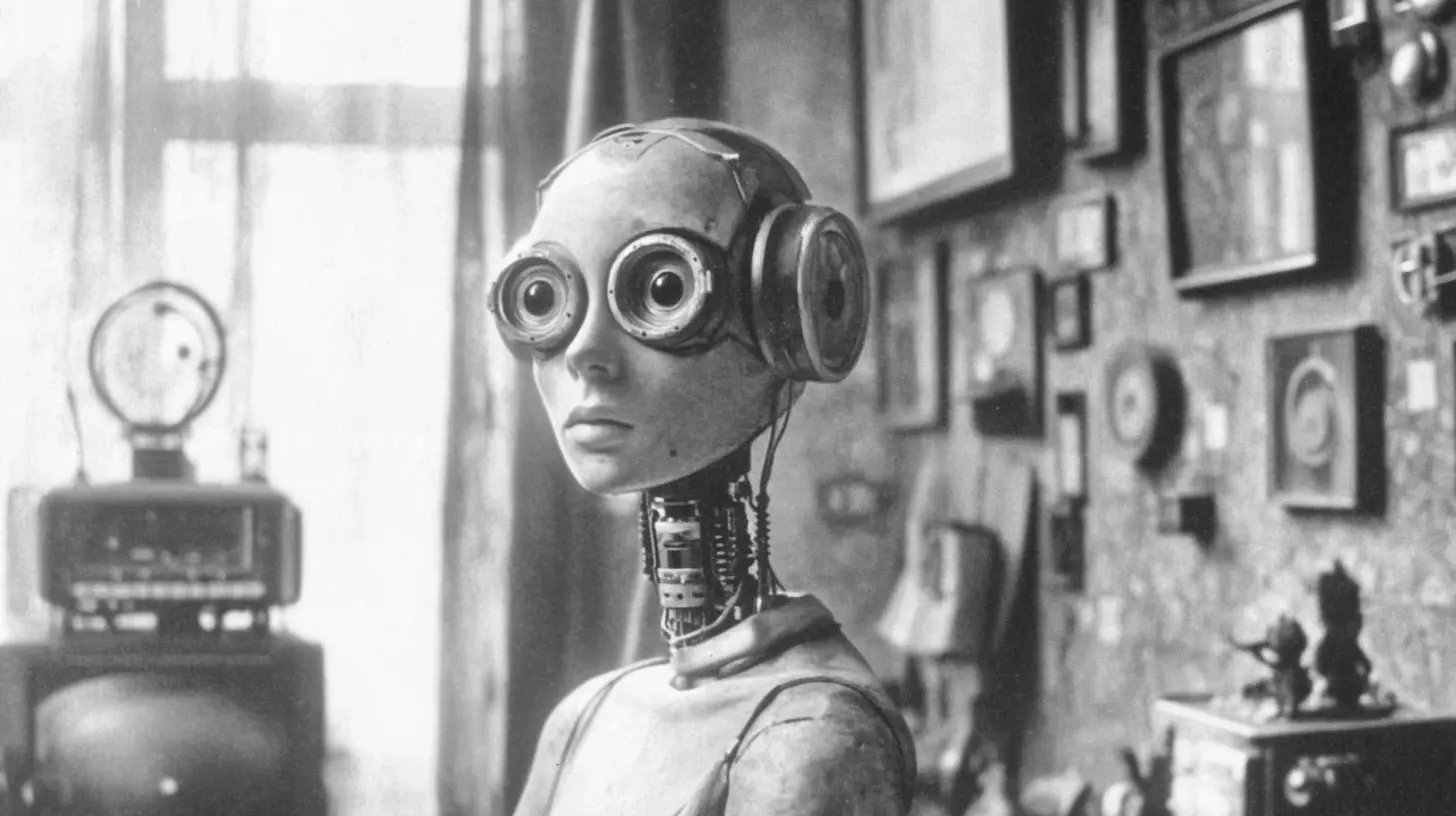
In the 1960s and ’70s, the foundations of modern robotics and artificial intelligence (AI) were set. Breakthroughs like the industrial robot Unimate, the language program ELIZA, and the mobile robot Shakey played a decisive role.
Unimate (1961): The First Industrial Robot
Origins and Development
In 1961, General Motors deployed Unimate—the world’s first industrial robot—at its plant in Ewing Township, New Jersey. Developed by George Devol and Joseph Engelberger, the robot automated dangerous tasks like moving hot metal parts, boosting safety and efficiency across the auto industry.
Technical Specifications
The original Unimate weighed 4,000 pounds and consisted of a large, computer-like cabinet connected to an arm that executed systematic tasks stored on drum memory.
Impact on the Job Market
Unimate’s arrival ignited debate over automation and its impact on jobs. While robots like Unimate took over hazardous, repetitive work, concerns grew about job displacement and the need to reskill workers.
ELIZA (1965): A Pioneer in Natural Language Processing
Development and Operation
In 1965, Joseph Weizenbaum created ELIZA, one of the first natural language processing programs. By spotting keywords and delivering scripted responses, ELIZA simulated conversation well enough that users often felt they were talking to a person.
Limitations and Reactions
Despite its shallow understanding, ELIZA revealed the potential of human-computer interaction and sparked debate about AI’s limits and promise. Users sometimes projected human traits onto ELIZA—coining the ELIZA effect, where people attribute more meaning to machine responses than is warranted.
Shakey the Robot (1966–1972): The First Mobile “Intelligent” Robot
Development and Capabilities
Between 1966 and 1972, the Stanford Research Institute developed Shakey, the first mobile robot able to autonomously perceive and manipulate objects. Combining cameras, sensors, and software, Shakey analyzed its surroundings and made decisions—a major milestone in robotics and AI.
The Complexity of Human Intelligence
The project underscored how complex human intelligence is—and how hard it is to model in machines. Shakey’s limitations made clear the challenge of replicating human perception and decision-making, spurring deeper research and advances in AI.
Conclusion
The 1960s and ’70s delivered landmark progress in robotics and AI. Innovations like Unimate, ELIZA, and Shakey laid the groundwork for today’s advanced technologies. They kicked off an era of increasingly intelligent, autonomous machines—driving technical leaps and fueling public debate over the role of automation.

Popular news

AI breathes new life into an old game: ask for your own Fallout 2 mods

Anthropic’s $80.7 Billion Loss Explained in Today’s AI News Podcast

Microsoft wants to keep AI agents in the workplace on a tighter leash

AI Cleans Up Your TV with CleanYourTV

Goldman Sachs Predicts AI IPOs Could Add 100 Billion Dollars to Indian Market Capitalization

Global Memory Shortage Threatens Corporate AI Adoption
Latest comments
Loading